ERP for small businesses: Do you need it in 2026?

TL;DR

  • ERP for small businesses is no longer a “nice to have” in 2026. Growing customer expectations, multiple tools, and manual processes are slowing teams down and causing errors and missed opportunities.
  • Modern ERP systems are cloud-based, modular, and built for speed, giving small companies real-time visibility across sales, projects, and finances without needing a big IT setup.
  • The biggest wins from ERP for small businesses are simple: less admin work, better planning, automated workflows, and clearer insight into profitability and project progress.
  • OpusFlow helps installation companies bring everything into one system, with built-in automation, AI insights via OpusAI, and tools designed specifically for solar and renewable installers.
ERP for small businesses | OpusFlow

Table of Contents

Want to receive the latest OpusFlow news and updates?

In this article:

Small businesses face unprecedented operational complexity in 2026, juggling multiple software tools, manual processes, and growing customer demands while competing against larger enterprises with sophisticated systems. The question isn’t whether ERP for small businesses is necessary anymore, it’s whether they can afford to operate without it.

Modern ERP solutions have evolved far beyond the expensive, complex systems that once required massive IT departments and six-figure budgets. Today’s cloud-based platforms offer modular, scalable functionality that transforms how small businesses manage everything from customer relationships to project execution, often at a fraction of traditional costs.

Why small businesses need better operations in 2026

Small businesses operating in 2026 face operational challenges that would have been unimaginable just a few years ago. Customer expectations for rapid response times, transparent communication, and seamless service delivery have reached enterprise levels, regardless of company size.

The competitive landscape demands operational efficiency that manual processes simply cannot deliver. Small businesses using spreadsheets for project management, separate tools for customer communication, and paper-based workflows find themselves losing deals to competitors who can quote faster, deliver projects more reliably, and provide superior customer experiences through integrated systems.

Data fragmentation represents another critical challenge. Without proper ERP for small businesses, data becomes fragmented across multiple tools: customer information lives in one system, project details in another, and financial data in a third, businesses lose visibility into their operations. This fragmentation leads to missed opportunities, duplicated work, and errors that damage customer relationships and profitability.

What makes modern ERP for small businesses different

Modern ERP software bears little resemblance to the monolithic systems that dominated the market a decade ago. Today’s solutions prioritize user experience, rapid implementation, and modular functionality that grows with business needs.

Cloud-first architecture eliminates the need for expensive on-premises infrastructure and dedicated IT staff. Small businesses can access enterprise-grade functionality through web browsers, with automatic updates and security patches handled by the software provider. This approach reduces total cost of ownership while ensuring access to the latest features and security standards.

Integration capabilities have transformed dramatically. Modern ERP for small businesses connect seamlessly with existing business tools through APIs and pre-built connectors, allowing businesses to maintain their preferred applications while centralizing data management. This flexibility eliminates the need to replace every system simultaneously, reducing implementation risk and user resistance.

AI-powered intelligence

Artificial intelligence integration represents the most significant advancement in ERP technology. AI-powered ERP for small businesses now provide instant answers to business questions, automated task creation, and predictive insights that were previously available only to enterprises with dedicated business intelligence teams.
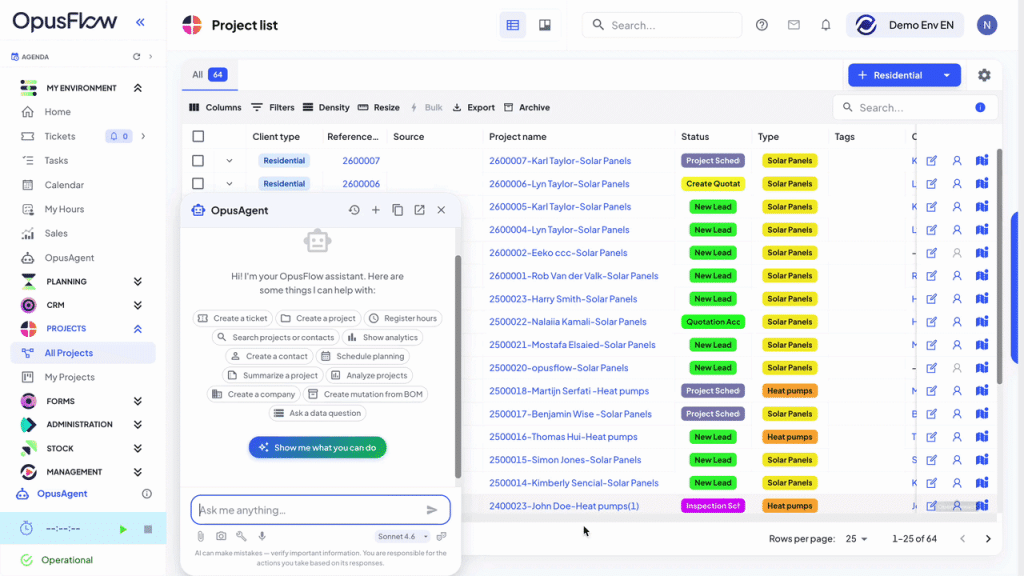
AI OpusAgent
These AI capabilities transform raw business data into actionable insights without requiring technical expertise or complex report generation. Small business owners can ask natural language questions about their operations and receive immediate, accurate responses based on real-time data.

How ERP software transforms small business operations

ERP implementation creates immediate operational improvements across multiple business areas. Customer relationship management becomes streamlined when all customer interactions, project history, and communication records exist in a single system accessible to every team member.
Project management efficiency increases dramatically through centralized coordination. Teams gain visibility into project status, resource allocation, and potential bottlenecks without constant status meetings or email chains. Automated task assignment ensures work progresses smoothly even during busy periods when manual oversight becomes challenging.

ERP for small businesses improves financial visibility through integrated invoicing, expense tracking, and reporting capabilities. Business owners gain real-time insights into cash flow, project profitability, and operational costs without waiting for month-end reports or manual data compilation.

Workflow automation benefits

Automation capabilities eliminate repetitive administrative tasks that consume valuable time. Sales processes become more consistent when leads automatically enter the system, tasks generate based on deal progression, and follow-up reminders ensure no opportunities slip through the cracks.
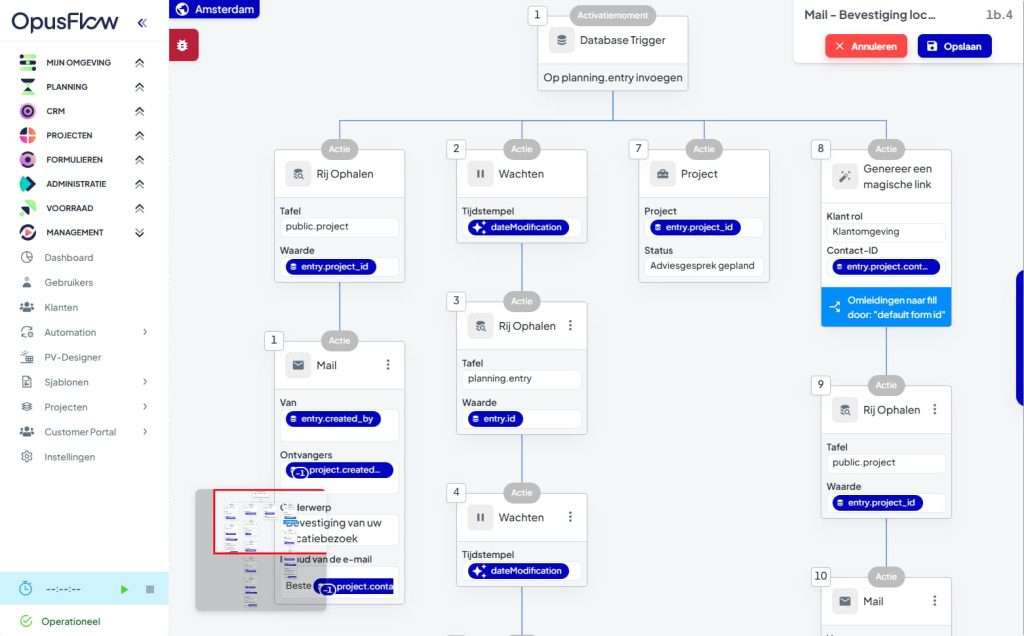
Automations | OpusFlow
Planning and scheduling optimize resource utilization through intelligent assignment recommendations and automated calendar integration. Teams spend less time coordinating schedules and more time executing billable work, directly impacting profitability.

Common ERP implementation challenges for small teams

Small businesses face unique implementation challenges that require careful planning and realistic expectations. Limited staff availability means implementation must occur alongside ongoing operations without disrupting customer service or revenue generation.
Change management becomes critical when small teams have established workflows and personal relationships with existing processes. Success requires clear communication about benefits, comprehensive training, and gradual transition periods that allow teams to adapt without overwhelming their capacity.
Data migration represents a significant technical hurdle for businesses with years of information stored across multiple systems. Poor data quality, inconsistent formatting, and incomplete records can complicate the transition process and delay system adoption.

Budget and resource constraints

Small businesses must balance implementation costs with operational requirements while maintaining cash flow for daily operations. Hidden costs such as training time, data cleanup, and temporary productivity decreases require careful budgeting and timeline planning.
Technical expertise limitations mean small businesses often rely heavily on vendor support and implementation services. Choosing providers with proven small business experience and comprehensive onboarding programs becomes essential for successful adoption.

One Platform to Run Your Entire Installation Business

Manage leads, projects, stock, and invoicing — everything in one smart system built for sustainable installers.


Primary benefits of ERP systems - Opusflow

Choosing the right ERP for small businesses

ERP selection requires careful evaluation of current needs, growth projections, and technical requirements. Small businesses benefit most from solutions designed specifically for their market segment rather than scaled-down enterprise systems that retain unnecessary complexity.
Modular architecture allows businesses to implement core functionality first and add capabilities as needs evolve. This approach reduces initial investment while ensuring the system can accommodate future growth without requiring complete replacement.

Industry-specific functionality provides immediate value for businesses in specialized sectors. Generic ERP for small businesses require extensive customization to handle industry-specific workflows, while purpose-built solutions include relevant features and best practices from day one.

Evaluation criteria

Implementation timeline should align with business capacity and seasonal considerations. Solutions requiring months of setup may not suit businesses needing immediate operational improvements or those with limited staff availability for training.
Vendor support quality becomes crucial for small businesses without dedicated IT resources. Comprehensive onboarding programs, responsive customer service, and ongoing training resources ensure successful long-term adoption and system optimization.

How OpusFlow helps small installation companies scale operations

OpusFlow provides a comprehensive ERP specifically designed for sustainable installation companies, addressing the unique operational challenges faced by businesses in the solar, heat pump, and renewable energy sectors. Our platform eliminates the need for multiple software tools by integrating every aspect of your business operations into one streamlined system.

Key operational improvements include:
  • Automated sales pipeline management with intelligent task creation and deal tracking
  • Integrated project management with real-time progress monitoring and resource allocation
  • Smart planning capabilities that optimize technician schedules and reduce travel costs
  • AI-powered business intelligence through OpusAI, providing instant answers to operational questions
  • Seamless integration with existing tools while centralizing all business data

Our modular approach allows businesses to implement core functionality immediately while adding specialized features as operations grow. With dedicated onboarding support and industry-specific workflows built for installation companies, OpusFlow delivers faster implementation and a quicker return on investment than generic ERP solutions. Contact us or book a free demo today to discover how OpusFlow can transform your installation business operations.

Related Articles

Want to continue your deep-dive?

These articles may also be of interest to you!

Schedule your free demo

Get a live customized demo or discovery call focused on what your organization needs, get answers to your specific questions, and find out why OpusFlow is the right choice for your organization

What can I expect?

“OpusFlow has really helped us during a difficult time by offering an affordable solution when we needed it most.”
Verdasol
Mike Buderath - Manager
VERDASOL

Sign Up

Select all services your company offers