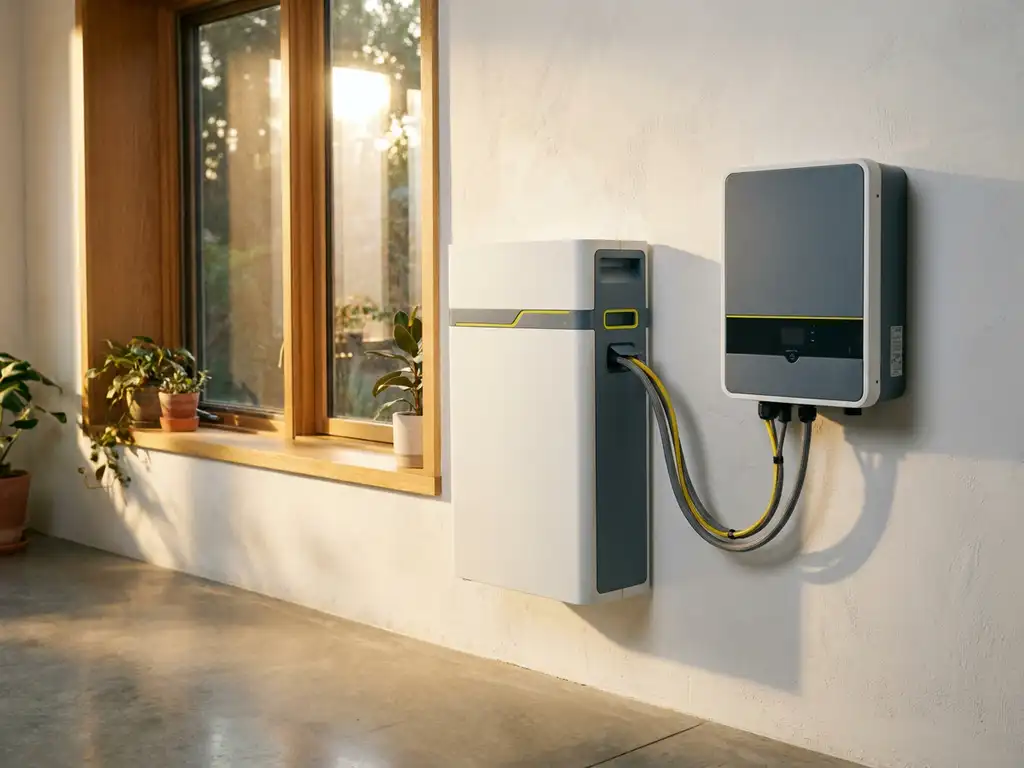
As solar-plus-storage installations become standard across commercial and residential projects alike, one question keeps coming up in technical planning meetings and procurement discussions: which battery systems actually work with which inverters? The answer is more nuanced than most product datasheets suggest. Compatibility depends on communication protocols, firmware versions, and sometimes the specific firmware release on a given inverter model. For installation companies managing multiple brands across a growing project portfolio, understanding these relationships is not just a technical nicety — it directly affects project timelines, warranty validity, and long-term system performance.
This guide breaks down inverter-battery compatibility in practical terms, covering the major inverter brands, the difference between proprietary and open-protocol systems, and the pitfalls that cause the most problems on real installations. Whether teams are sizing a commercial rooftop system or configuring a multi-unit residential development, getting compatibility right from the start is what separates a smooth handover from a costly callback.
How inverter-battery compatibility actually works
Inverter-battery compatibility comes down to communication, not just voltage or capacity. A battery and inverter may share the same DC voltage range and still fail to work together if they cannot exchange data properly. Modern battery management systems (BMS) need to communicate state of charge, temperature limits, charge and discharge rates, and fault codes to the inverter in real time.
The two primary communication pathways are CAN bus and RS485. CAN bus is faster and better suited to high-frequency data exchange, making it the preferred protocol for tightly integrated systems. RS485 is slower but widely supported and more forgiving across different hardware generations. Some inverters support both; others are locked to one. Beyond the physical interface, there is also the matter of the communication protocol itself — the specific language the devices use to interpret data. Even two devices sharing an RS485 port may not communicate if they use different protocol definitions, such as different BMS protocol variants from the same manufacturer.
Firmware plays an equally important role. Inverter manufacturers regularly release updates that add support for new battery models or adjust how existing ones are handled. A battery that was not compatible six months ago may work perfectly after a firmware update — and vice versa, as updates occasionally introduce regressions. This makes compatibility a moving target that installation teams need to track actively, not just verify once at the point of product selection.
Battery compatibility by major inverter brand
The major inverter brands each take a distinct approach to battery compatibility, and knowing those approaches saves significant time during system design.
SMA
SMA’s Sunny Boy Storage and Sunny Tripower Storage series are widely used in European markets and support a broad range of batteries via CAN bus and RS485. SMA maintains a published compatibility list, and the company has historically been relatively open to third-party batteries that meet its communication requirements. BYD, LG Chem (now RESU), and Pylontech are among the well-established compatible options.
Fronius
Fronius inverters, particularly the Symo GEN24 and Primo GEN24 lines, use a dedicated BYD battery integration as a flagship pairing but also support a range of third-party batteries through their BMS interface. Fronius publishes a battery compatibility guide that is updated regularly. Teams working with Fronius hardware should always cross-reference the specific inverter firmware version against the battery model before procurement.
Huawei
Huawei’s SUN2000 inverter series is primarily designed to work with Huawei’s own LUNA2000 battery system, creating a tightly integrated but largely closed ecosystem. Third-party battery integration is technically possible through the RS485 interface, but Huawei’s system is optimised for its own hardware, and warranty terms can be affected when pairing with non-Huawei storage.
SolarEdge
SolarEdge has historically been closely tied to LG Chem and later its own SolarEdge Home Battery. The platform supports DC-coupled storage, which changes the integration architecture compared to AC-coupled systems. Third-party battery support exists but is more limited than with SMA or Fronius, and the DC-coupled topology requires careful system design to avoid efficiency losses.
Growatt and Solis
Both Growatt and Solis have gained significant market share in cost-sensitive projects. They generally support Pylontech and BYD batteries well, and their RS485 interfaces are broadly compatible with batteries that use common BMS protocols. For commercial-scale projects, verifying compatibility at the firmware level remains essential, as these brands update their software frequently.
Proprietary vs. open-protocol battery systems
One of the most consequential decisions in system design is choosing between a proprietary battery ecosystem and an open-protocol battery that can work across multiple inverter platforms.
Proprietary systems — such as Tesla Powerwall, Huawei LUNA2000, or the SolarEdge Home Battery — are engineered to work seamlessly within their own ecosystems. The integration is typically tighter, the monitoring more granular, and the warranty terms more straightforward. The trade-off is reduced flexibility. If a client wants to change inverter brands in year five, or if the battery manufacturer discontinues a product line, the options for upgrading or replacing components are constrained.
Open-protocol batteries — Pylontech, BYD B-Box, and CATL-based systems being prominent examples — communicate using published or widely adopted BMS protocols. This makes them compatible with a much wider range of inverters and gives installation companies more flexibility in sourcing and system design. The solar battery calculator can be a useful tool when comparing capacity and runtime across different open-protocol options during the design phase.
For commercial and corporate clients with long asset lifecycles, open-protocol systems often represent a lower total cost of ownership because they reduce vendor lock-in. For residential clients who prioritise simplicity and a single point of support, proprietary systems can be the more practical choice. The right answer depends on the specific project context, and framing that decision clearly for clients is part of delivering a high-quality installation service.
Common compatibility pitfalls in solar-battery installations
Even experienced installation teams run into compatibility problems. Most of them are preventable with the right checks in place before equipment arrives on site.
- Mismatched firmware versions: A battery and inverter may be listed as compatible in general terms, but the specific firmware versions on the installed hardware may not yet support each other. Always check the inverter’s firmware release notes, not just the general compatibility list.
- Protocol variants: Some battery manufacturers use slightly modified versions of standard protocols (such as Pylontech’s protocol variants across different product generations). An inverter configured for one variant may not correctly interpret data from another.
- DC voltage window mismatches: Even when communication works, the battery’s operating voltage range must sit within the inverter’s DC input window. This is especially relevant when stacking battery modules or configuring systems for partial state-of-charge operation.
- Warranty voiding through unofficial pairings: Some manufacturers explicitly state that pairing their inverter with a non-approved battery voids the warranty. This is a commercial risk that needs to be communicated clearly to clients before system design is finalised.
- AC vs. DC coupling assumptions: Teams switching between AC-coupled and DC-coupled system architectures sometimes apply compatibility assumptions from one topology to the other. The two architectures have different requirements, and a battery compatible in an AC-coupled setup may not be appropriate for a DC-coupled configuration.
Building a structured compatibility verification step into the project workflow — before purchase orders are raised — eliminates the majority of these issues. It is a small time investment that prevents significant rework costs.
How to stay on top of compatibility changes
Compatibility in solar-plus-storage is not static. Inverter manufacturers update firmware, battery manufacturers release new hardware revisions, and communication protocol support evolves continuously. Staying current requires a systematic approach rather than relying on memory or outdated reference documents.
Subscribing directly to technical update channels from the inverter and battery brands most commonly used in a company’s project portfolio is the most reliable method. Most major manufacturers — SMA, Fronius, Huawei, SolarEdge — publish firmware release notes and updated compatibility matrices. Setting a calendar reminder to review these quarterly ensures the team is working from current information rather than assumptions carried over from previous projects.
Building an internal compatibility reference document, maintained by a designated technical lead, also pays dividends at scale. When teams are running multiple concurrent projects across different brands, a centralised reference reduces the risk of individual engineers working from different versions of compatibility information. This is particularly relevant for companies expanding into new geographic markets, where different inverter brands may dominate compared to the home market.
Industry forums and installer networks are another valuable source. Peer knowledge often surfaces real-world compatibility issues faster than official documentation, particularly for newer hardware combinations that have not yet accumulated a large installation base. Engaging actively in those communities keeps technical teams informed about emerging issues before they become costly problems on live projects.
How OpusFlow supports battery and inverter project management
Managing compatibility checks, procurement, project timelines, and client documentation across a growing installation portfolio is operationally complex. OpusFlow is built specifically for sustainable installation companies handling exactly this kind of complexity at scale.
- Integrated calculation tools: Our battery calculator supports accurate system sizing, helping teams verify capacity and runtime requirements before design decisions are locked in.
- End-to-end project management: From initial quotation through planning, procurement, and aftercare, all project data lives in one platform — reducing the risk of version mismatches or information gaps between departments.
- Workflow automation: Compatibility verification steps, purchase order triggers, and installation checklists can be automated within the platform, ensuring consistent processes across every project and every crew.
- AI-Agentic capabilities via Toni: OpusFlow’s AI agent Toni helps teams surface relevant project information, flag process gaps, and support decision-making — reducing the manual overhead that slows down growing installation businesses.
- Scalable architecture for larger teams: Whether managing ten projects or several hundred, OpusFlow’s modular structure scales with the business without requiring additional headcount for administrative coordination.
Installation companies serious about building a scalable, technically rigorous operation can get in touch with our team to see how OpusFlow fits their specific workflow and project mix.
Related Articles
- What is SEPA Direct Debit and how does it work?
- What is the relationship between solar panel kWp and battery storage kWh?
- How do you handle a battery warranty claim as an installation company?
- What are the benefits of ERP for small businesses?
- Can ERP systems improve efficiency for heat pump installation businesses?