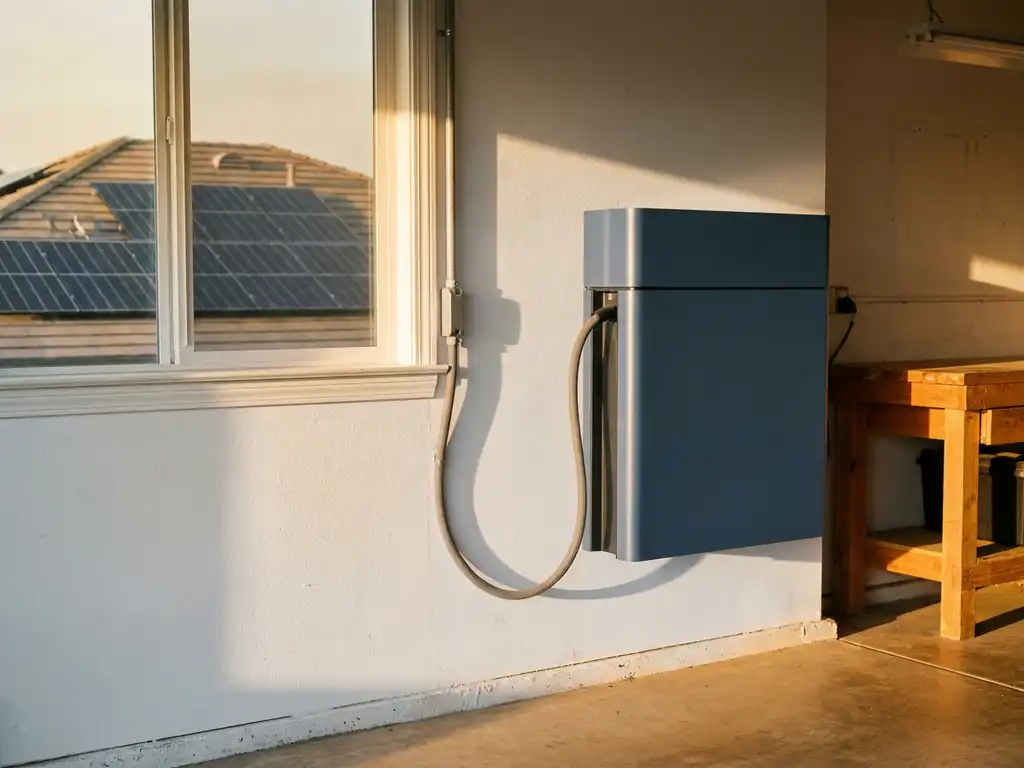
Solar panel systems and battery storage are increasingly being designed together, yet the relationship between the two core metrics, kWp (kilowatt-peak) and kWh (kilowatt-hour), is still widely misunderstood. For installation companies working on solar-plus-storage projects, getting this relationship right is not just a technical detail. It directly affects system performance, customer satisfaction, and the accuracy of every quote and proposal that leaves the business. Whether running a solar battery calculator for a mid-size commercial client or designing a large-scale rooftop system, understanding how these two units interact is the foundation of sound system design.
This article breaks down the kWp-to-kWh relationship in practical terms, covers the factors that shift the ideal ratio, flags the most common sizing mistakes in the field, and explains how modern ERP software is changing the way installation teams approach solar-plus-storage design.
How kWp and kWh measure different things
kWp and kWh are related but fundamentally distinct measurements. kWp (kilowatt-peak) describes the maximum power output a solar array can generate under standard test conditions. It is a measure of capacity, specifically how much electricity the panels can produce at peak sunlight. kWh (kilowatt-hour), on the other hand, measures energy, the total amount of electricity stored in or consumed from a battery over time.
A helpful way to think about it: kWp tells you how fast the solar array can generate electricity, while kWh tells you how much energy the battery can hold. A 5 kWp solar system might generate around 4,500 to 5,500 kWh of electricity per year depending on location, shading, and orientation. A 10 kWh battery stores a fixed amount of that energy for use when the sun is not shining. These two figures operate on different axes, and conflating them leads to poorly sized systems.
How much battery storage a solar system actually needs
There is no universal answer to this question, but there are clear principles that guide good sizing decisions. The goal of battery storage is to shift excess solar generation into periods of low or zero production, typically evenings, cloudy days, or overnight. A battery that is too small relative to the array will regularly overflow and waste generation. A battery that is oversized will rarely reach full charge, reducing its cost-effectiveness for the end client.
As a general starting point, many system designers work with a ratio of roughly 1 to 1.5 kWh of battery capacity per kWp of solar installed. A 6 kWp residential or small commercial system might therefore pair well with a battery in the 6 to 9 kWh range. However, this is a baseline, not a rule. Actual consumption patterns, grid export limitations, and the client’s energy goals all shift this figure significantly. Using a reliable battery capacity calculator that accounts for these variables produces far more accurate results than applying a fixed ratio.
Key factors that shift the ideal kWp-to-kWh ratio
Several variables influence how much battery storage a given solar array actually needs, and experienced installers know that each project has its own profile.
Energy consumption patterns
A site that consumes most of its electricity during daylight hours, such as a manufacturing facility or office building, has less need for large battery storage than a residential or retail site where most consumption happens in the evening. Understanding when energy is used is just as important as knowing how much is used.
Grid export rules and tariffs
In markets like the Netherlands, Germany, and Belgium, grid export compensation has shifted significantly in recent years. Where net metering has been reduced or eliminated, the financial case for battery storage strengthens, and the optimal battery size relative to the solar array increases. Installers working across multiple European markets need to account for these regulatory differences in every solar and battery calculator they use.
System orientation and local irradiance
A south-facing array in southern Spain generates a very different daily energy profile compared to an east-west split roof in the Netherlands. Higher peak generation in a shorter window often means more energy needs to be stored to avoid waste, pushing the ideal kWh figure upward relative to the kWp rating.
Client goals
Self-sufficiency targets, backup power requirements, and EV charging integration all affect battery sizing. A client who wants to charge an electric vehicle overnight from solar generation will need meaningfully more storage than one focused purely on daytime self-consumption.
Common sizing mistakes installers and homeowners make
Sizing errors are one of the most persistent sources of post-installation complaints and warranty claims in the solar-plus-storage sector. The most frequent mistake is treating kWp and kWh as interchangeable or assuming a fixed conversion ratio applies to every project. Every site has a unique load profile, and applying a one-size-fits-all formula consistently produces systems that underperform against expectations.
Another common error is ignoring battery depth of discharge (DoD). Most lithium batteries are rated at 90 to 95% usable capacity, but some older or lower-cost products operate at 80% or less. A 10 kWh battery with 80% DoD delivers only 8 kWh of usable storage. Failing to account for this when using a battery runtime calculator leads to undersized installations. Similarly, failing to account for inverter losses, temperature derating, and degradation over the system’s lifetime can cause a system that looks correct on paper to fall short in practice within just a few years.
Over-reliance on manufacturer datasheets without validating assumptions against real-world site data is also a recurring issue, particularly for installation teams scaling up and handling higher project volumes. As project complexity grows, the risk of manual calculation errors increases, which is where structured tooling becomes essential.
How OpusFlow simplifies solar-plus-storage system design
For installation businesses managing multiple crews, complex project pipelines, and clients across different regulatory environments, accurate solar-plus-storage sizing needs to be embedded into the workflow, not treated as a separate manual step. OpusFlow is built specifically for sustainable installation companies and addresses this challenge directly through a set of integrated tools and automations.
- Built-in solar battery calculator: OpusFlow includes a dedicated battery capacity and solar power calculator that accounts for site-specific variables, consumption profiles, and regional irradiance data, reducing the risk of sizing errors at the quotation stage.
- Calculation and quotation module: System designs flow directly into quotations, eliminating the manual re-entry of figures that causes errors when teams work across separate tools.
- Project management and planning integration: Once a quote is accepted, project data moves seamlessly into planning and crew scheduling, keeping the entire process connected from initial design through to installation and aftercare.
- Toni, our AI agent: OpusFlow’s AI agent Toni supports teams by automating routine tasks, flagging inconsistencies in project data, and helping larger installation businesses manage higher volumes without proportionally increasing headcount.
- Multi-market support: With clients across the Netherlands, Germany, Spain, and Belgium, OpusFlow is designed to handle the regulatory and tariff differences that affect storage sizing recommendations in each market.
Getting the kWp-to-kWh relationship right is not just a technical exercise. It is a commercial and reputational one. Installation companies that consistently deliver well-sized systems build stronger client relationships and reduce costly post-installation interventions. If you want to see how OpusFlow can support your solar-plus-storage workflow from design through to delivery, get in touch with our team to arrange a demonstration.
Related Articles
- What is SEPA Direct Debit and how does it work?
- How do you calculate battery needs for a household with high daytime consumption?
- How do you upsell a battery to an existing solar customer?
- How does mobile ERP access improve daily life for installation field crews?
- What are the key benefits of using ERP software for installation businesses?