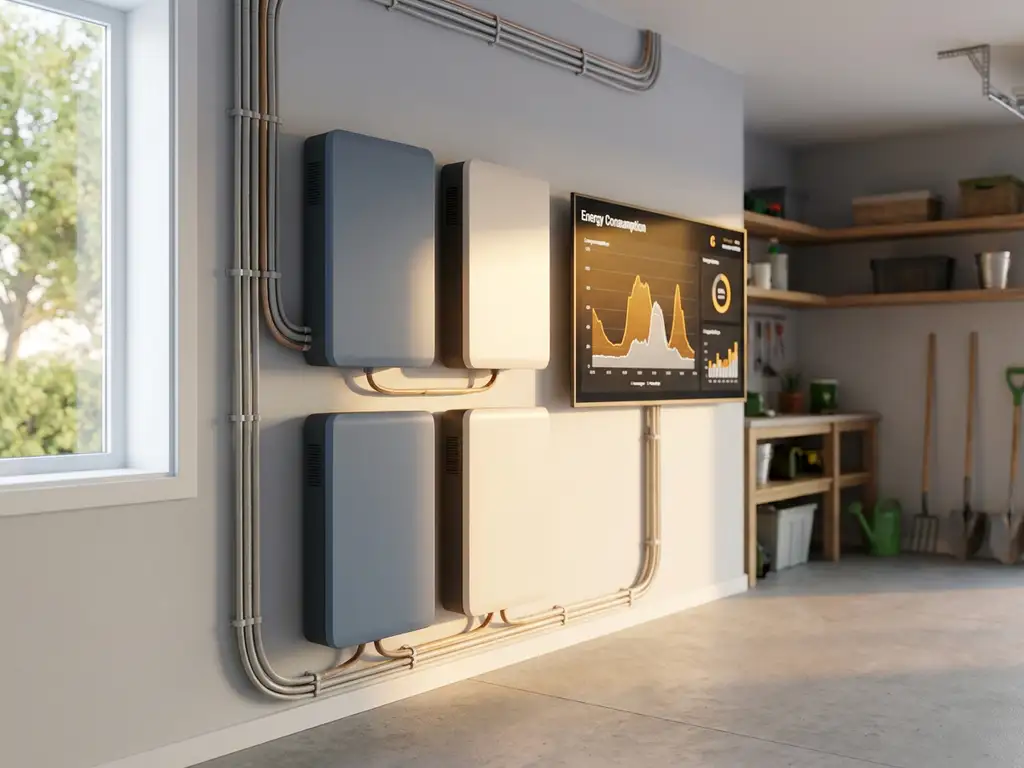
For households running energy-intensive appliances during the day, whether that means heat pumps, EV chargers, or industrial-grade home offices, battery storage is no longer a luxury add-on. It is a core part of a well-designed energy system. Yet one of the most common challenges installation companies face is helping clients understand exactly how much storage capacity they need. Get it wrong in either direction and the result is either a system that runs flat by evening or an oversized investment that never pays back. Understanding the calculation behind battery sizing is what separates a well-engineered installation from a costly guess.
This guide walks through the key principles behind battery sizing for high daytime consumption profiles, covering the factors that drive capacity requirements, how to approach the calculation methodically, and where even experienced installers tend to go wrong. Whether you are advising a commercial client or designing a residential system with an above-average load, the same fundamentals apply.
Key factors that affect battery sizing
Battery sizing starts with understanding the energy profile of the property, not just the total consumption. For high daytime users, the critical variable is when energy is consumed relative to when solar generation peaks.
The following factors all play a direct role in determining how much storage is needed:
- Daily energy consumption (kWh): The total electricity used per day, broken down by time of use where possible
- Self-consumption ratio: How much of the solar generation is used directly versus exported to the grid
- Peak load timing: Whether high-draw appliances like heat pumps or EV chargers run during or outside solar generation hours
- Grid dependency preference: Whether the client wants full independence, backup resilience, or simply reduced grid import
- Seasonal variation: Solar yield changes significantly between summer and winter, which affects how much storage is needed to cover evening and overnight demand
For households with high daytime consumption, the good news is that direct solar usage reduces the burden on the battery. The challenge comes when that daytime consumption outpaces generation, leaving the battery to fill the gap rather than charge for later use.
How to calculate the right battery capacity
A reliable battery capacity calculation follows a structured approach rather than a rule-of-thumb estimate. The goal is to match storage capacity to the actual energy shortfall that occurs outside peak solar generation hours.
Step one: establish the daily load profile
Map out when energy is consumed throughout the day. For high daytime users, a significant portion of the load may already be covered by direct solar generation. The battery only needs to cover what solar cannot supply in real time, plus what is needed after sundown.
Step two: calculate the usable solar surplus
Estimate the expected solar generation for the installed system size, then subtract the daytime load. Any surplus generation is available to charge the battery. If daytime consumption consistently exceeds generation, the battery will be partially depleted during the day and will have less capacity available for evening use.
Step three: determine the evening and overnight load
This is the core figure the battery needs to cover. Add up consumption from the point solar generation drops off until the system recharges the following morning. For most households, this window runs from late afternoon through to around 9 or 10 in the morning.
Step four: apply depth of discharge
Most lithium batteries should not be discharged to zero. A usable depth of discharge (DoD) of around 80 to 90 percent is typical for modern lithium iron phosphate systems. Divide the required evening load by the DoD factor to arrive at the gross battery capacity needed. For example, if the evening load is 8 kWh and the DoD is 0.9, the minimum battery capacity required is approximately 8.9 kWh. A solar battery calculator can help streamline this calculation for different system configurations.
Common sizing mistakes that lead to under- or over-investment
Even with a clear methodology, battery sizing errors are frequent in practice. The consequences range from disappointed clients to systems that underperform against expectations.
Under-sizing is the most visible problem. A battery that runs flat before midnight leaves the client drawing from the grid at peak tariff rates, which undermines the financial case for the installation entirely. This often happens when the calculation is based on average annual consumption rather than actual evening load.
Over-sizing carries its own risks. A battery that rarely charges to full capacity degrades faster in some chemistries and delivers a poor return on investment. It can also skew the payback calculation to the point where the system no longer makes financial sense for the client.
Other common mistakes include:
- Ignoring seasonal variation and sizing only for summer performance
- Failing to account for battery degradation over time, which reduces usable capacity by roughly 20 to 30 percent over a typical 10-year cycle
- Treating the battery as a standalone component rather than part of an integrated solar and consumption system
- Not accounting for future load growth, such as an additional EV or heat pump being added to the property
How battery type and chemistry influence your choice
Not all batteries perform the same way under the same conditions, and chemistry plays a significant role in how sizing decisions translate into real-world performance.
Lithium iron phosphate (LFP) is currently the dominant chemistry for residential and light commercial storage. It offers a high cycle life, good thermal stability, and a usable DoD of up to 90 percent. This makes it well-suited for daily cycling in high-consumption households. NMC (nickel manganese cobalt) batteries offer higher energy density, which matters where space is constrained, but they are more sensitive to temperature and typically have a lower cycle life.
Lead-acid batteries, while less common in new installations, still appear in retrofit projects. Their usable DoD is significantly lower, often around 50 percent, which means the gross capacity required to deliver the same usable storage is substantially higher. This must be factored into the sizing calculation when working with legacy systems.
The choice of inverter and battery management system also affects effective capacity. A poorly matched inverter can limit charge and discharge rates, reducing the battery’s practical output even if the rated capacity looks sufficient on paper.
When to revisit your battery calculation
A battery calculation is not a one-time exercise. Energy systems evolve, and a sizing decision that was correct at installation may become inadequate or oversized within a few years.
Revisiting the calculation makes sense when any of the following occur:
- A significant new load is added to the property, such as an EV charger or a second heat pump
- The client’s occupancy pattern changes, shifting consumption to different times of day
- Battery degradation has measurably reduced usable capacity below the original design threshold
- Grid tariff structures change in a way that affects the economics of storage versus export
- Solar panel capacity is expanded, increasing the available surplus for charging
For installation companies managing multiple projects and long-term client relationships, building a review process into aftercare workflows ensures that clients continue to get value from their systems and creates natural opportunities for system upgrades.
How OpusFlow supports battery system design and project management
Accurate battery sizing is only one part of delivering a high-quality installation. The operational side, from quoting and procurement to planning and aftercare, needs to run just as precisely. That is where OpusFlow comes in.
OpusFlow is the most complete ERP platform built specifically for sustainable installation companies. For businesses working with solar, batteries, heat pumps, and EV charging, it provides the tools to manage every stage of a project without switching between disconnected systems. Key capabilities include:
- Integrated battery and solar calculation tools that support accurate system design directly within the platform
- Calculation and quotation modules that turn sizing outputs into professional proposals without manual rework
- Planning and project management that connects sales, installation crews, and aftercare in a single workflow
- Workflow automation powered by Toni, our AI agent, which handles repetitive tasks so teams can focus on technical and client-facing work
- Purchasing and stock management that keeps battery inventory aligned with project pipelines
For installation companies looking to scale without adding administrative overhead, OpusFlow replaces the patchwork of spreadsheets and standalone tools with one connected platform. Get in touch with our team to see how OpusFlow can support your battery installation business.
Related Articles
- How do you explain battery ROI to a homeowner who does not follow energy?
- What is the first thing a growing installation business should stop doing manually?
- What happens to your existing data when you switch to a new ERP system?
- What is the difference between AI and automation in field service software?
- What are the future trends in ERP software for sustainable installation companies?