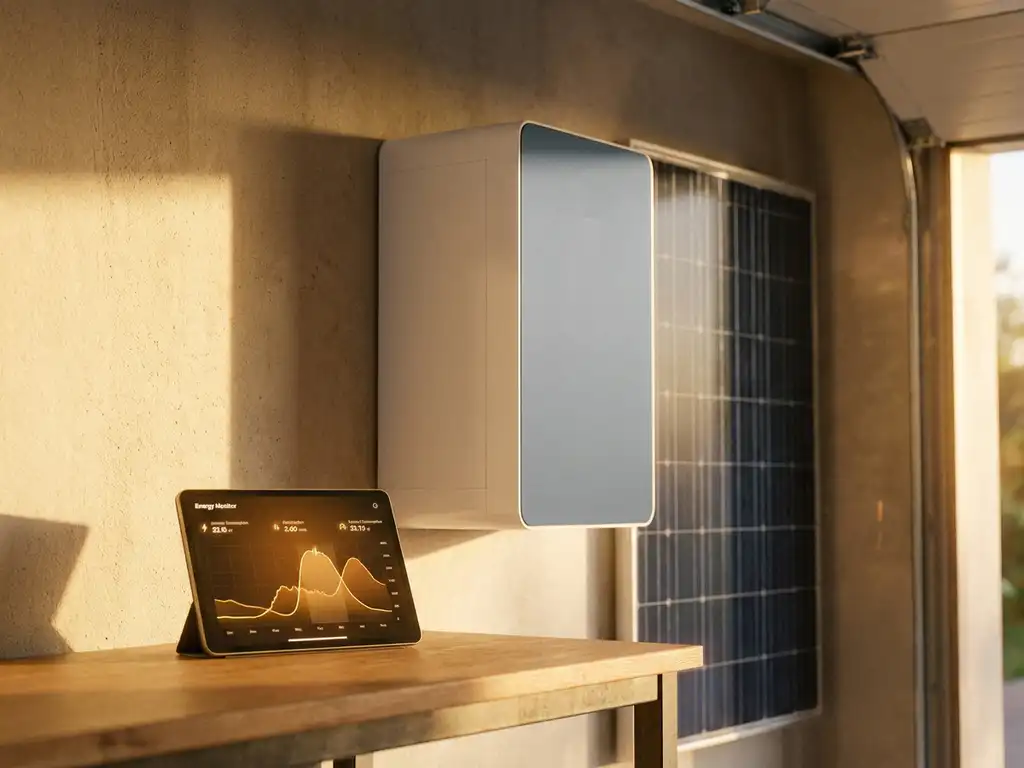
When a customer asks for a battery quote, they are rarely asking a simple question. Behind that request is a more complex one: how much will a battery actually save me, and is it worth the investment? Answering that well requires more than listing a product and a price. It requires a self-consumption scenario comparison, a structured analysis that shows how different usage patterns, system configurations, and consumption behaviors affect the financial and technical case for battery storage. For installation companies quoting batteries alongside solar systems, getting this right is the difference between a compelling proposal and a lost deal.
A well-executed scenario comparison draws on tools like a solar battery calculator to model real-world outcomes based on actual consumption data, solar yield estimates, and battery sizing options. It transforms a quote from a static document into a decision-support tool, one that builds trust, justifies pricing, and moves projects forward faster.
How different self-consumption scenarios change battery sizing
Battery sizing is not a one-size-fits-all calculation. The right battery capacity depends heavily on when and how energy is consumed, and small differences in consumption behavior can lead to significantly different sizing recommendations.
Consider two households or commercial properties with identical solar installations. One consumes most of its energy during the day, meaning solar production and demand are well aligned. The other shifts most consumption to the evening, creating a larger gap between production and use. In the second scenario, a larger battery is needed to capture surplus daytime generation and cover the evening load. A scenario comparison models both situations explicitly, showing how battery duration and capacity requirements shift based on these patterns.
Key variables that change across scenarios include:
- Daily energy consumption volume and timing
- Solar array size and expected yield by season
- Grid export and import tariff structures
- Whether the battery is sized for daily cycling or backup purposes
- Demand peaks that affect how quickly a battery depletes
Running a battery capacity calculator across multiple scenarios allows installers to present a range of options rather than a single recommendation, giving customers a clearer picture of the trade-offs involved.
What a self-consumption scenario comparison includes
A thorough self-consumption scenario comparison is more than a spreadsheet with numbers. It is a structured presentation of how different configurations perform under different conditions, built around the customer’s actual situation.
At minimum, a solid scenario comparison should include:
- Baseline consumption profile: Annual and monthly energy use, ideally broken down by time of day if smart meter data is available
- Solar yield estimate: Based on system size, orientation, shading, and location, using a reliable solar power calculator
- Self-consumption rate per scenario: The percentage of solar energy consumed directly rather than exported to the grid
- Battery runtime and charge cycle modeling: How long the battery lasts under typical and peak load conditions, effectively a battery runtime calculator applied to the specific site
- Financial projection per scenario: Estimated savings, payback period, and return on investment based on current tariffs
- Sensitivity analysis: How outcomes change if energy prices rise or consumption patterns shift
The goal is not to overwhelm the customer with data but to present two or three clearly differentiated scenarios, each with a distinct sizing recommendation, cost point, and financial outcome. This gives the customer a genuine choice rather than a take-it-or-leave-it offer.
How scenario comparisons affect customer decision-making
Presenting multiple scenarios fundamentally changes the dynamic of a sales conversation. Instead of asking a customer to accept or reject a single proposal, the installer invites the customer into a structured decision, which increases engagement and shortens the path to a signed agreement.
When customers can see a clear comparison between, say, a 5 kWh and a 10 kWh battery option, each with its own projected savings and payback timeline, they are better equipped to make a confident decision. The comparison removes ambiguity and reduces the likelihood of post-sale doubt or disputes about whether the right product was chosen.
There is also a trust dimension. A quote that includes detailed solar and battery calculator output signals that the installer has done the analytical work, not just picked a product from a catalog. For larger commercial clients in particular, this level of rigor is often expected as a baseline. Corporate procurement teams and facility managers are accustomed to evaluating proposals on financial merit, and a scenario comparison speaks directly to that evaluation process.
Scenario comparisons also create natural upsell opportunities. When a customer sees that a slightly larger battery meaningfully improves their self-consumption rate and reduces payback time, the upgrade becomes a data-driven choice rather than a sales push.
Common mistakes in battery quotes without scenario comparisons
Skipping a scenario comparison is one of the most common reasons battery quotes underperform or fail to convert. Without it, several problems tend to surface.
Over-sizing or under-sizing the battery
Without modeling actual consumption against solar yield, installers often default to rules of thumb that do not reflect the customer’s real situation. An over-sized battery means unnecessary capital expenditure; an under-sized one leaves self-consumption potential on the table. Either outcome damages credibility when the customer eventually compares actual performance against expectations.
Weak financial justification
A quote that lists a battery price without showing projected savings gives the customer no basis for evaluating the investment. This is especially problematic for commercial clients who need to justify expenditure internally. Without a battery charge calculator or solar to battery calculator output embedded in the proposal, the quote is essentially asking the customer to take the installer’s word for it.
Losing deals to more analytical competitors
In a competitive market, the installer who presents the most credible analysis tends to win, even if their price is not the lowest. A bare-bones quote without scenario modeling is easily displaced by a competitor who takes the time to show their work. This is a particularly acute risk when quoting for larger installations where the financial stakes are higher and the decision process is more rigorous.
How ERP software streamlines scenario comparison in battery quotes
Building scenario comparisons manually is time-consuming, especially when managing a high volume of quotes across multiple projects and crews. ERP software designed for sustainable installation companies can automate much of this process, making it practical to include detailed scenario analysis in every battery quote without adding significant time to the quoting workflow.
Integrated tools within an ERP platform can pull consumption data, apply solar yield models, and run battery longevity calculator logic across multiple configurations simultaneously. The output can be formatted directly into a professional quote document, ready to present to the customer. This removes the need for separate spreadsheets, disconnected tools, or manual data entry that introduces errors.
Beyond the quote itself, ERP integration means that scenario data flows forward into project management, purchasing, and planning. When a customer selects a specific scenario and signs the proposal, the correct battery specification is already in the system, connected to procurement and scheduling without manual re-entry.
How OpusFlow helps with battery quote scenario comparisons
OpusFlow is built specifically for sustainable installation companies that need to move fast, quote accurately, and deliver projects without operational friction. For battery quotes that include self-consumption scenario comparisons, OpusFlow provides a fully integrated environment that covers the entire process from analysis to signed proposal.
- Built-in solar battery calculator: Model multiple sizing scenarios based on consumption profiles, solar yield, and tariff data, without leaving the platform
- Automated quote generation: Scenario outputs feed directly into professional, branded quote documents that are ready to send
- CRM and pipeline integration: Scenario data is linked to the customer record and deal stage, so nothing is lost when a quote moves forward
- Toni, our AI agent: OpusFlow’s AI-agentic layer, Toni, can assist in automating repetitive steps in the quoting workflow, flagging anomalies and accelerating turnaround time
- End-to-end project flow: Once a scenario is accepted, the specification connects directly to purchasing, stock management, and planning, eliminating re-entry and reducing errors
For installation companies looking to quote more competitively and convert more battery projects, the ability to deliver a rigorous scenario comparison quickly is a genuine differentiator. Get in touch with us to see how OpusFlow can bring this capability into your quoting process, or explore our solar battery calculator to understand what is already possible on the platform.
Related Articles
- What is the difference between AC-coupled and DC-coupled battery storage?
- What does a fully automated workflow look like from enquiry to invoice for installers?
- What subcontractor management features are available in ERP systems?
- How does ERP software support preventive maintenance scheduling?
- What are the key performance indicators that ERP software can track for installers?