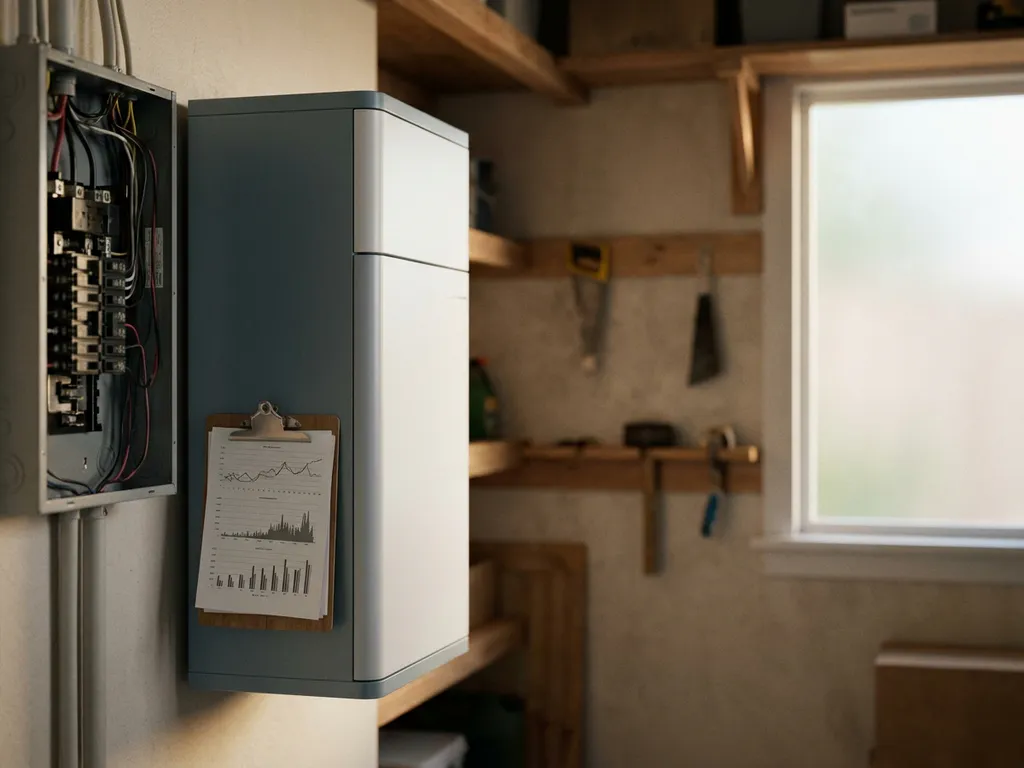
Sizing a home battery correctly is one of the most technically demanding steps in any residential energy storage installation. Get it right, and the customer enjoys reliable backup power, optimized self-consumption, and a system that pays for itself over time. Get it wrong, and the result is an undersized battery that runs flat by midnight or an oversized unit that never reaches its full potential. Before any solar battery calculator can produce a meaningful result, the right consumption data needs to be on the table. This guide walks through exactly what that data looks like and why each piece matters.
Daily energy usage: your starting point
The foundation of any battery sizing exercise is a clear picture of how much energy a household consumes in a typical day. This figure, usually expressed in kilowatt-hours, sets the upper boundary for what the battery needs to deliver. A system sized only on peak demand without accounting for daily totals will almost always fall short.
The most reliable source for this data is a full year of smart meter readings, broken down by day where possible. Monthly utility bills can provide a rough average, but they mask the day-to-day variation that directly affects storage requirements. When working with a client who has solar panels already installed, the inverter’s production and export logs add another layer of precision, showing not just total consumption but also how much of that consumption was already being met by generation.
Peak load patterns and time-of-use data
Daily totals tell part of the story, but peak load patterns reveal whether a battery can actually handle the moments that matter most. A household that consumes 20 kWh per day but draws 8 kW during a two-hour evening cooking and heating window presents a very different challenge than one with a flat, consistent load profile.
Time-of-use data, ideally at 15-minute or 30-minute intervals, makes it possible to identify these peaks and determine whether the battery’s continuous discharge rate is sufficient. This is particularly important when backup power is a priority. A battery with adequate capacity but an insufficient discharge rate will trip under high instantaneous loads, leaving the customer without power precisely when they need it most.
For installers working with dynamic electricity tariffs, this data also informs charge and discharge scheduling strategies, allowing the battery to charge during low-rate periods and discharge during expensive peak windows to maximize the customer’s financial return.
Self-consumption ratio and solar production data
When a solar array is part of the installation, the relationship between generation and consumption becomes central to the battery sizing decision. The self-consumption ratio, which describes what proportion of solar output is used directly on-site rather than exported, determines how much surplus energy is actually available to charge a battery.
A household that already self-consumes 80% of its solar production has a much smaller surplus to store than one exporting 60% back to the grid. Oversizing the battery in the first scenario wastes capital; undersizing it in the second leaves money on the table. Accurate solar production data, ideally from at least 12 months of inverter logs, combined with simultaneous consumption readings, allows installers to calculate the realistic daily surplus and match battery capacity to it precisely. A dedicated battery calculator for solar systems can automate this calculation when the input data is clean and complete.
Seasonal variation and its effect on sizing
Energy consumption and solar production both shift significantly across the seasons, and a battery sized purely on summer averages will underperform in winter when it matters most. In northern and central European markets, winter days are shorter, heating loads are higher, and solar yield can drop to a fraction of peak summer output.
This seasonal mismatch means the worst-case scenario for battery performance typically occurs between November and February. Sizing against this period ensures the system delivers on its promises year-round rather than only during the months when solar generation is abundant. At the same time, oversizing purely for winter conditions can result in a battery that rarely cycles fully during summer, which affects both economics and long-term cell health.
The practical approach is to model both scenarios, present the trade-offs clearly, and let the customer’s priorities guide the final decision. Some clients will accept slightly reduced winter autonomy in exchange for a lower upfront investment; others will prioritize resilience regardless of cost.
Grid independence goals and backup requirements
Before finalizing any sizing recommendation, it is essential to establish what the customer actually expects the battery to do. Grid independence goals and backup requirements vary enormously, and they drive very different sizing outcomes.
A customer who wants to reduce their grid dependence during normal operation needs a battery sized around their typical evening consumption gap, the period after sunset when solar production stops but household demand continues. A customer who wants full backup capability during a grid outage needs a system sized to cover their critical loads for a defined duration, which may be significantly larger and requires a battery with islanding capability built into the inverter.
Key questions to establish before sizing include:
- Which loads need to remain operational during an outage, and for how long?
- Is the goal partial backup for essential circuits or whole-home coverage?
- What is the expected frequency and duration of grid interruptions in the area?
- Does the customer want the system to be expandable if requirements grow?
Backup sizing often requires a battery runtime calculator approach, working backwards from the load requirements and desired autonomy period to arrive at the minimum viable capacity. This is a fundamentally different calculation than optimizing for self-consumption, and conflating the two leads to systems that fail to meet expectations on either front.
How OpusFlow supports battery sizing and project management
Gathering, organizing, and acting on all of this consumption data is straightforward in principle but demanding in practice, especially when managing multiple projects across different customer profiles. That’s where we come in. OpusFlow is the most complete ERP platform for sustainable installation companies, and it is built to handle exactly this kind of complexity at scale.
- Built-in solar battery calculator: Our dedicated calculation module processes consumption data, solar production figures, and customer goals to produce accurate battery sizing recommendations without switching between tools.
- Integrated project management: Every sizing calculation connects directly to the project workflow, so the data gathered during pre-sales flows seamlessly into planning, purchasing, and installation scheduling.
- Quotation and invoicing in one platform: Once sizing is confirmed, generate a professional quote and convert it to an invoice without re-entering data, reducing errors and saving time.
- Toni, our AI agent: OpusFlow’s AI feature Toni helps automate follow-up tasks, flag missing data, and keep projects moving through the pipeline without manual chasing.
- Scalable for growing teams: Whether managing five installations a month or fifty, the platform scales with the business without requiring additional administrative headcount.
If your team is ready to move beyond spreadsheets and disconnected tools, get in touch with us to see how OpusFlow can streamline your battery installation workflow from first consultation to final sign-off.
Related Articles
- Should you factor in battery replacement costs when calculating long-term ROI?
- How do you document a battery installation for compliance and commissioning?
- How does battery degradation affect long-term self-consumption calculations?
- Why do we keep losing track of what's been installed where?
- How does digital job site documentation work inside an ERP system?