For installation companies working in the home battery space, timeline management is one of the most common pain points on the job. Clients want to know exactly when their system will be live, project managers need to coordinate surveys, equipment, and crews, and any slip in the schedule can quickly turn a profitable job into a costly one. Understanding the typical flow from initial survey to final commissioning helps teams plan more effectively and deliver a consistent experience at scale.
While every installation is different, most residential battery projects follow a predictable sequence of stages. Knowing how long each one typically takes, and what can throw it off course, is essential for any installation business that wants to manage multiple crews efficiently and keep projects on budget.
The key stages of a home battery installation
A home battery installation does not begin the moment a technician arrives on site. The process starts well before that, with a structured sequence of steps that each carry their own requirements, dependencies, and potential complications.
The main stages of a typical residential battery installation project are:
- Site survey: A technical assessment of the property to evaluate the existing electrical setup, available space, and compatibility with the chosen battery system.
- System design and quotation: Based on the survey findings, the appropriate battery capacity and configuration are determined. Using a solar battery calculator at this stage helps ensure the system is accurately sized to meet the client’s energy needs.
- Permitting and grid notification: Depending on the country and local regulations, grid operators and/or local authorities may need to be notified or grant approval before work begins.
- Equipment procurement: Ordering and receiving the battery unit, inverter components, cabling, and any ancillary materials.
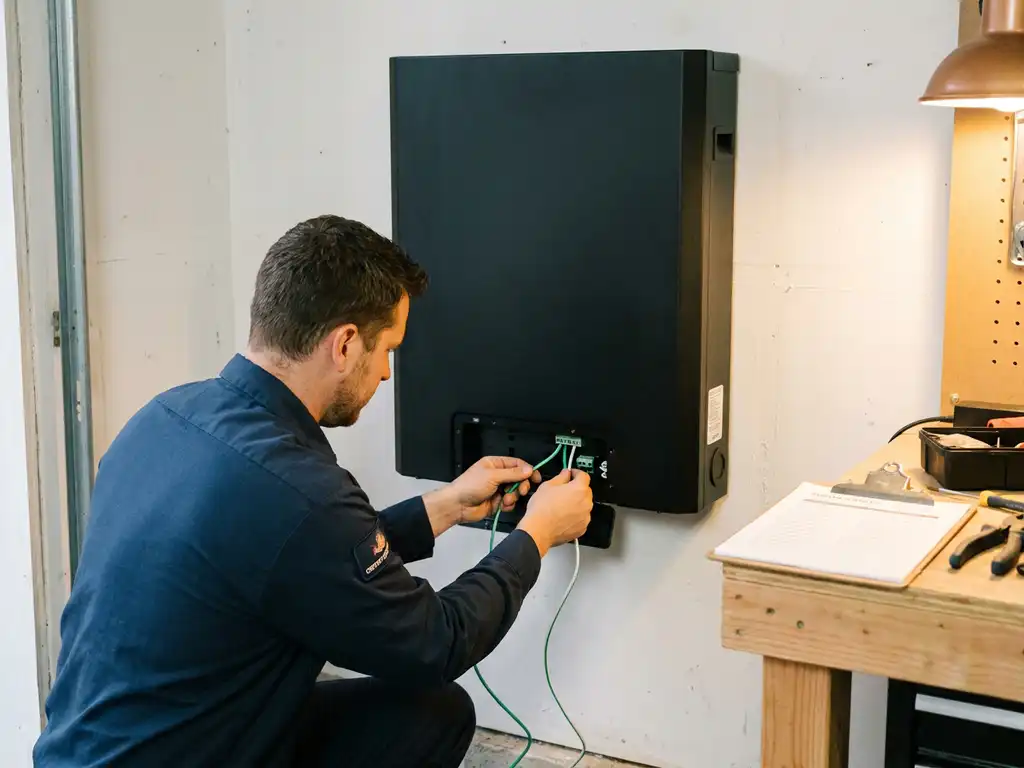
- Physical installation: The on-site work, including mounting, wiring, and integrating the battery with the existing electrical system or solar array.
- Testing and commissioning: Verifying that the system operates correctly, configuring software settings, and handing over documentation to the client.
Each stage feeds directly into the next, which means a delay in one area will ripple through the entire project. Understanding these dependencies is the first step toward tighter scheduling and better resource allocation across multiple jobs.
How long each stage typically takes
Timelines vary based on system complexity, local regulations, and supplier lead times, but the following ranges reflect what most installation companies encounter in practice across markets like the Netherlands, Germany, Belgium, and Spain.
- Site survey: Usually completed within one to two hours on site. Scheduling the visit typically adds two to five business days depending on crew availability.
- System design and quotation: For a straightforward residential job, this can be completed in a day or two. More complex configurations, particularly where the battery is integrated with an existing solar setup, may take longer to model accurately.
- Permitting and grid notification: This is often the longest and least predictable stage. In some regions, grid notification is a simple online submission that clears in a few days. In others, formal approval can take two to six weeks or more.
- Equipment procurement: Standard battery models from established manufacturers typically have lead times of one to three weeks. Supply chain disruptions or less common configurations can extend this significantly.
- Physical installation: A standard single-battery installation generally takes between four and eight hours on site for an experienced crew. More complex setups with additional integration work can run into a second day.
- Testing and commissioning: Usually completed on the same day as installation, taking one to two hours for system checks, configuration, and client handover.
Adding these stages together, a straightforward home battery project can realistically be completed within two to four weeks from survey to commissioning. However, when permitting delays or equipment shortages enter the picture, that window can stretch to eight weeks or beyond.
Factors that can delay or speed up the timeline
Several variables sit outside any installer’s direct control, but understanding them allows project managers to anticipate bottlenecks and build realistic buffers into their scheduling.
Common causes of delay
- Grid operator backlogs: In markets with high adoption of residential energy storage, grid operators are often processing large volumes of notifications or applications simultaneously. This is a known pressure point in the Netherlands and Germany in particular.
- Incomplete survey data: If the initial survey misses a detail, such as an incompatible consumer unit or insufficient wall space, the design phase may need to be revisited after equipment has already been ordered.
- Stock availability: Battery inventory can fluctuate with demand cycles and manufacturer production schedules. Relying on a single supplier without backup options increases exposure to lead time risk.
- Crew scheduling conflicts: When multiple projects are running in parallel, a delay on one job can cascade into others if crews are not flexibly allocated.
What tends to accelerate projects
- Thorough, standardized surveys that capture all necessary data in a single visit
- Pre-qualified supplier relationships with reliable stock levels
- Early submission of grid notifications, ideally triggered as soon as a job is confirmed rather than waiting until equipment arrives
- Clear internal handoffs between the sales, planning, and installation teams so nothing falls through the gaps
What installers can do to keep projects on schedule
Keeping battery installation projects on track comes down to process discipline and the right tools to support it. The companies that consistently hit their timelines are not necessarily the ones with the most experienced crews. They are the ones with the tightest operational workflows connecting every stage of the job.
A few practices that make a measurable difference:
- Standardize the survey process: Use structured digital forms that ensure every technician captures the same data points, every time. This eliminates the back-and-forth that happens when a planner has to follow up for missing information before a design can be finalized.
- Trigger permitting steps early: Do not treat grid notification as a post-design task. Where regulations allow, begin the notification process as soon as the survey is complete and the system type is confirmed.
- Build procurement buffers into the schedule: Rather than ordering equipment only after a permit is approved, maintain a working stock of commonly installed battery models to avoid waiting on deliveries.
- Connect sales and planning in real time: One of the most common sources of scheduling friction is the gap between when a deal is won and when the planning team actually receives the job details. Automating that handoff removes a significant source of delay and reduces the risk of double-booking crews.
- Track job progress centrally: When project managers can see the status of every active installation in one place, they can spot a stalled job before it becomes a missed deadline. This is particularly important for businesses managing multiple crews across different regions.
The installation companies that scale successfully are those that treat each project not as a one-off event, but as a repeatable process. Building that repeatability into the workflow is what allows teams to take on more volume without proportionally increasing overhead or error rates.
How OpusFlow supports home battery installation teams
Managing the full lifecycle of a battery installation project, from survey to commissioning, requires more than a shared calendar and a spreadsheet. OpusFlow is built specifically for sustainable installation businesses that need to coordinate sales, planning, procurement, and field operations in a single platform.
Here is what OpusFlow brings to battery installation workflows:
- Integrated solar and battery calculator: Accurately size systems during the quotation stage so designs are right the first time, reducing costly revisions later in the process.
- Automated task creation: When a deal moves through the pipeline, tasks are automatically generated for the relevant teams, ensuring that grid notifications, procurement steps, and crew scheduling are triggered without manual follow-up.
- Connected planning and project management: Sales and planning operate from the same data, eliminating the handoff delays that push projects past their deadlines.
- Standardized digital forms: Survey data is captured consistently and flows directly into the project record, removing information gaps that slow down design and procurement.
- Real-time project tracking: Project managers get a clear overview of every active job, making it easier to manage multiple crews and catch delays before they escalate.
- AI-powered support with Toni: Our AI agent Toni helps teams move faster by surfacing relevant information, supporting decision-making, and reducing the administrative load on project managers.
If your installation business is ready to bring more structure and speed to its battery projects, get in touch with us to see how OpusFlow can support your team from the first survey to final commissioning.