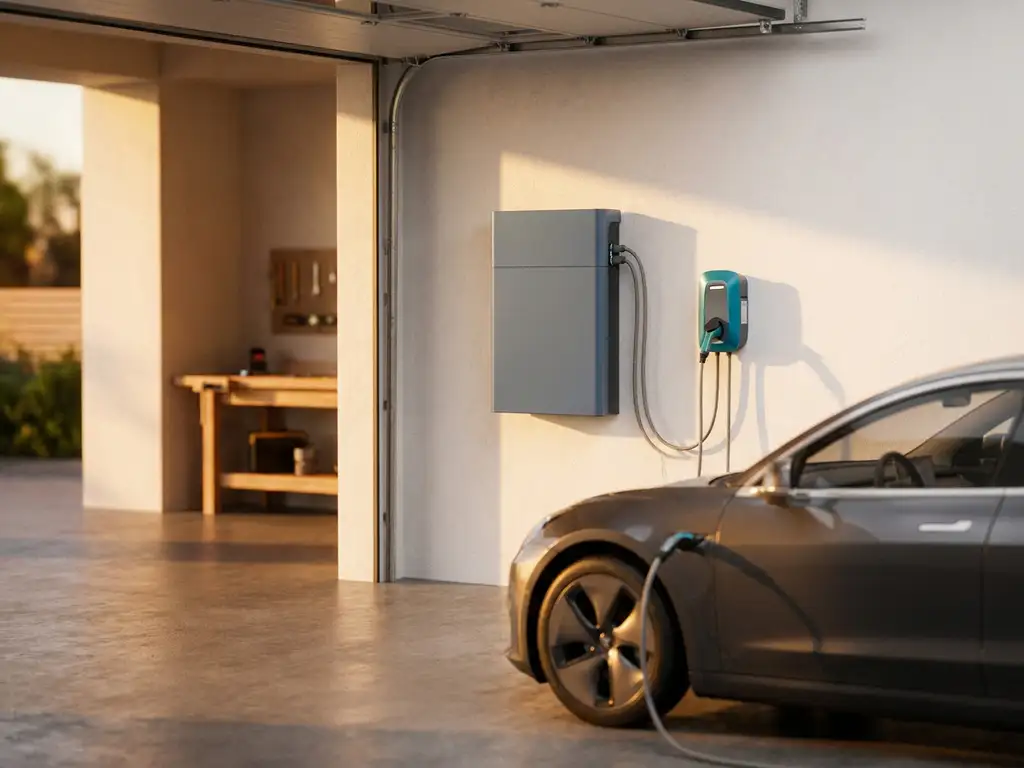
As more homes combine rooftop solar with battery storage and electric vehicles, the question of how these systems actually work together is becoming increasingly relevant for installation professionals. Understanding the technical and operational relationship between a home battery and an EV charger is essential for any installer advising clients on integrated energy systems. This article breaks down the mechanics, smart charging logic, and practical considerations that define a well-designed combined installation.
The intersection of battery storage and EV charging represents one of the fastest-growing segments in the sustainable installation market. Getting the integration right means more value for the end user and fewer callbacks for the installer.
The connection between home batteries and EV chargers
A home battery and an EV charger are both energy storage and consumption devices, but they serve different roles in a residential energy system. The home battery acts as a buffer, storing surplus energy from solar panels and releasing it when generation drops or demand peaks. The EV charger, on the other hand, draws energy to charge the vehicle’s onboard battery, which can represent a significant and relatively predictable daily load.
When connected through a smart energy management system, these two components can communicate and coordinate. Rather than the EV charger pulling directly from the grid at full power regardless of conditions, it can be instructed to draw from the home battery when solar generation is low or grid tariffs are high. This coordination is what transforms a collection of independent devices into a genuinely integrated home energy system.
How smart charging uses stored solar energy
Smart charging is the process by which an EV charger adjusts its charging rate and timing based on real-time energy availability. When a home battery is part of the system, the smart charging controller can factor in the battery’s state of charge alongside live solar production and household consumption data.
In practice, this means the EV can be programmed to charge primarily during peak solar generation hours, with the home battery acting as a reserve when solar output dips. A well-configured system might follow this priority logic:
- First, direct solar energy charges the EV in real time
- If solar output is insufficient, stored battery energy supplements the charge
- Grid power is only used when both solar and battery reserves fall below a defined threshold
- Overnight or off-peak grid charging can be scheduled as a fallback at lower tariff rates
This layered approach maximises self-consumption of renewable energy, which is increasingly a key selling point for installation companies advising larger commercial and residential clients.
Bidirectional charging and vehicle-to-home technology
Bidirectional charging takes the relationship between an EV and a home energy system a step further. Rather than the vehicle simply receiving energy, vehicle-to-home (V2H) technology allows the EV battery to discharge back into the home during periods of high demand or grid outages.
This is particularly relevant for installations where the home battery has limited capacity. A modern EV battery can hold anywhere from 40 kWh to over 100 kWh of energy, which dwarfs most residential battery storage systems. With V2H capability, the EV effectively becomes an extension of the home battery, providing a substantial backup reserve.
It is worth noting that not all EV chargers or vehicles support bidirectional charging. Installers need to verify compatibility at both the charger and vehicle level before specifying a V2H-capable system. The hardware requirements, including compatible onboard chargers and appropriate inverter technology, add complexity and cost that must be factored into project calculations. Using a solar battery calculator during the design phase can help quantify the energy flows involved and set realistic expectations.
Managing energy flow across solar, battery, and EV
Coordinating solar panels, a home battery, and an EV charger requires a central energy management system (EMS) or home energy management system (HEMS). This controller monitors all inputs and outputs in real time and makes automated decisions about where energy should flow at any given moment.
The key variables the EMS must balance include:
- Solar generation: Variable by time of day, season, and weather
- Battery state of charge: Available stored energy and current charge or discharge rate
- EV charging demand: Required charge level, departure time, and maximum charge rate
- Household load: Background consumption from appliances, heating, and lighting
- Grid tariff signals: Dynamic pricing or time-of-use tariffs that influence when grid import is economical
For installers working on larger or multi-unit projects, the complexity of managing these flows scales quickly. Proper system design, including accurate load profiling and battery capacity sizing, is critical to avoiding situations where the home battery is depleted before the EV has finished charging or vice versa.
Key benefits of combining a home battery with an EV charger
When designed and installed correctly, the combination of a home battery and an EV charger delivers meaningful advantages that go beyond simply owning both devices separately.
The most significant benefits include:
- Higher solar self-consumption: Excess solar energy that would otherwise be exported to the grid at low feed-in tariffs is instead used to charge the vehicle or stored for later use
- Reduced grid dependency: The home battery smooths out the mismatch between solar generation peaks and EV charging demand, reducing the need for grid imports
- Energy cost optimisation: Smart scheduling allows charging to occur during the cheapest available energy window, whether that is solar surplus or off-peak grid power
- Resilience and backup capability: With V2H-enabled systems, the combined storage capacity of the home battery and EV provides meaningful backup power during grid interruptions
- Future-proofing: As dynamic energy tariffs and grid services become more common across European markets, integrated systems are better positioned to participate and generate additional value
These benefits are increasingly driving demand among larger residential developments, commercial properties, and multi-family housing projects where energy cost management is a strategic priority.
What installers need to know about combined installations
Installing a home battery and EV charger as an integrated system rather than two independent products requires careful planning at every stage, from initial design through to commissioning and aftercare.
System compatibility and communication protocols
Not all batteries, inverters, and EV chargers communicate using the same protocols. Common standards include OCPP for EV chargers and Modbus or SunSpec for inverters and batteries, but compatibility between brands is not guaranteed. Specifying components at an early stage with integration in mind avoids costly workarounds during installation.
Sizing and load calculations
Accurate sizing is one of the most critical steps. A battery that is too small relative to the EV charging load will deplete quickly and fail to deliver the expected benefits. Load profiling the site, including typical daily driving patterns and household consumption, is essential. Tools like a battery capacity calculator can support this process by modelling expected charge and discharge cycles against available solar generation.
Grid connection and regulatory requirements
Combined systems, particularly those with V2H capability, may trigger additional grid connection requirements or approvals depending on the country of installation. In markets like the Netherlands, Germany, Spain, and Belgium, grid operators may have specific rules around bidirectional energy flows. Staying current with local regulations is a non-negotiable part of professional installation practice.
Customer handover and ongoing support
End users benefit most from these systems when they understand how to set charging schedules, monitor battery status, and interpret energy dashboards. A thorough handover process reduces support calls and builds long-term client relationships.
How OpusFlow supports combined home battery and EV charger installations
Managing integrated energy system installations, from initial quotation through to project delivery and aftercare, involves coordinating a significant amount of data, documentation, and team activity. OpusFlow is built specifically for sustainable installation companies handling exactly this kind of complexity.
For companies managing combined battery and EV charger projects, OpusFlow provides:
- Calculation and quotation tools that support accurate system sizing and professional proposals, including battery capacity and solar energy calculations
- Project management and planning modules that keep installation crews coordinated across multi-component jobs
- Purchasing and stock management to ensure compatible components are available when needed, avoiding costly delays
- Workflow automations that trigger follow-up tasks, maintenance reminders, and aftercare processes automatically as projects progress
- A customer portal that keeps clients informed throughout the installation process, reducing inbound queries
- Toni, our AI agent, which supports operational decision-making and helps teams work more efficiently across every stage of the project lifecycle
As the first AI-agentic ERP in the sustainable installation industry, OpusFlow is designed to help growing installation businesses handle more projects without adding proportional overhead. Whether managing a handful of combined installations or scaling to hundreds of projects across multiple regions, the platform brings every part of the business into one connected workflow. Get in touch with our team to see how OpusFlow can support your combined battery and EV charger installation business.
Related Articles
- What is self-sufficiency rate and how do you calculate it for a solar project?
- What is the difference between a home battery and a power wall?
- What is a good ROI for a home battery installation in 2026?
- How can AI identify unprofitable jobs before work has started?
- What does a fully automated workflow look like from enquiry to invoice for installers?