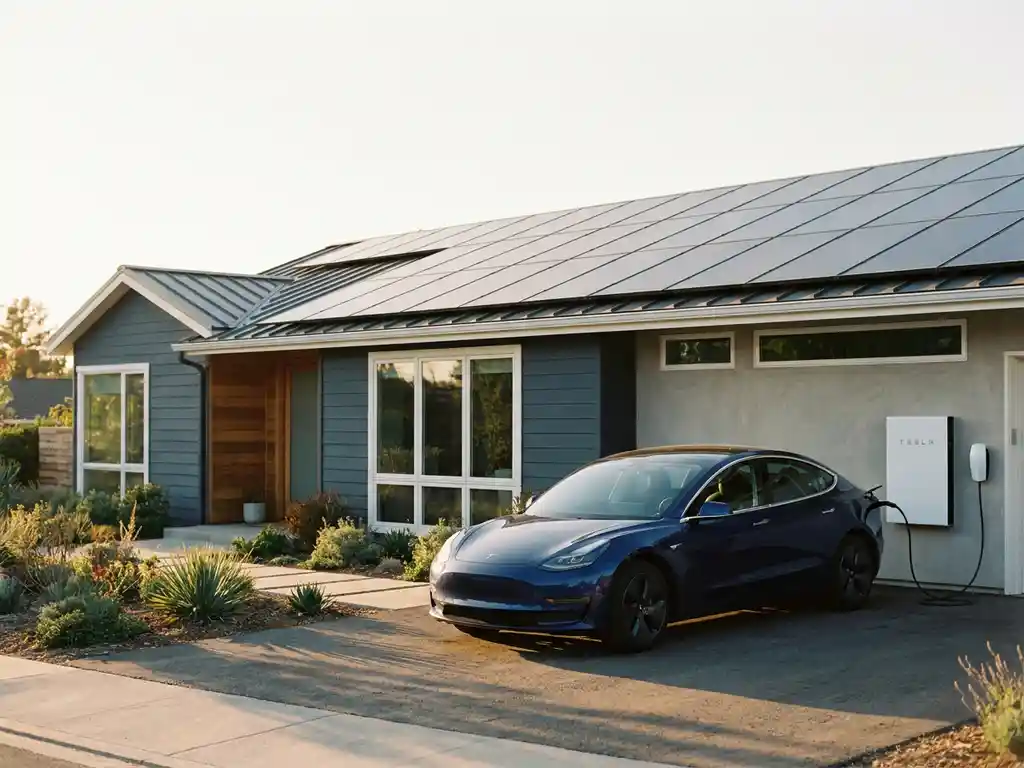
Designing a solar and battery system for a household that also charges an electric vehicle is one of the more complex sizing challenges installers face in 2026. The energy profile of an EV-owning household looks fundamentally different from a standard residential customer, and getting the numbers wrong means an undersized system that disappoints, or an oversized one that kills the project margin. Understanding how these three elements, solar generation, battery storage, and EV charging demand, interact with each other is the foundation of a well-designed system.
This guide walks through the key design decisions in sequence, from load analysis through to system integration, with a focus on the practical considerations that matter most for professional installers working on residential projects at scale.
Key energy loads to account for before sizing
Before touching array or battery sizing, a thorough load analysis is essential. An EV-owning household typically consumes significantly more electricity than a comparable home without a vehicle, and the pattern of that consumption matters as much as the total volume. A mid-size EV driven an average distance each day can add anywhere from 8 to 15 kWh of daily charging demand, depending on the vehicle, the charger type, and the driver’s habits.
Beyond the EV, the base household load needs to be broken down carefully. Heat pumps, if present, add a substantial and weather-dependent draw. Appliances with high peak demand, such as induction hobs or tumble dryers, affect battery sizing even if their total energy contribution is modest. The goal at this stage is to build a realistic hourly load profile across a typical day, not just a daily kWh total. That profile is what drives accurate battery and inverter sizing decisions.
How to calculate the right solar array size
Array sizing for an EV household needs to cover both the base household load and a meaningful portion of the vehicle’s charging demand. A common approach is to target self-sufficiency across a full annual cycle, which means accounting for seasonal variation in both generation and consumption. In northern European markets, winter generation can drop to a fraction of summer output, so a system sized only for summer performance will leave the household grid-dependent for much of the year.
A practical starting point is to calculate the total annual energy demand, including EV charging, and then use local irradiation data to work backwards to the required peak power in kWp. Tools like a solar and battery calculator can accelerate this process significantly, particularly when handling multiple projects with different roof orientations and shading profiles. Orientation and tilt angle adjustments should be applied before finalising the panel count, since a south-facing 30-degree pitch and an east-west split roof will require very different configurations to hit the same annual yield.
Installers working with larger residential portfolios or commercial clients should also factor in grid export limitations, since some network operators impose caps that affect the economic case for larger arrays.
Choosing battery capacity for EV households
Battery sizing for an EV household involves balancing three competing objectives: storing enough solar energy to cover evening household demand, providing backup capacity if required, and ideally buffering some of the EV charging load to shift it away from peak grid tariff periods. These objectives can pull in different directions, and the right answer depends heavily on the household’s charging behaviour.
A household that charges the EV overnight on a cheap tariff has different battery requirements than one that wants to charge primarily from solar during the day. For daytime solar-to-EV charging, battery capacity needs to be large enough to absorb midday generation surplus and then release it into the charger during the early evening. A battery capacity calculator that models this charge and discharge cycle across different seasons is far more reliable than a simple rule-of-thumb approach.
As a general principle, EV households benefit from larger battery capacities than comparable homes without a vehicle, often in the 10 to 20 kWh range depending on the array size and load profile. Round-trip efficiency, depth of discharge limits, and degradation over time should all factor into the usable capacity calculation, not just the nominal rating on the product datasheet.
Smart charging and system integration
The difference between a well-designed EV solar system and a great one often comes down to how intelligently the components communicate with each other. A static system where the inverter, battery, and EV charger operate independently will always underperform compared to one where smart charging logic coordinates energy flows in real time.
Dynamic load management is particularly important for households with limited grid connection capacity. When the EV charger, heat pump, and household appliances all run simultaneously, the combined draw can exceed the available grid supply, triggering fuse trips or demand charges. Smart charging systems solve this by throttling the EV charger in real time based on available headroom, keeping total consumption within safe limits without manual intervention.
Integration between the solar inverter, battery management system, and EV charger should be confirmed at the design stage rather than assumed. Not all combinations of hardware communicate cleanly, and incompatibility issues discovered during commissioning are expensive to resolve. Checking protocol compatibility, whether that is Modbus, SunSpec, OCPP, or a proprietary API, before specifying the hardware stack is a straightforward step that prevents significant rework.
Common design mistakes installers should avoid
Several recurring errors show up in EV solar system designs, and most of them stem from applying residential sizing logic without accounting for the added complexity of vehicle charging. The most common is underestimating the EV load. Using an average annual mileage figure without considering peak charging periods, such as returning from a long trip with a near-empty battery, can lead to a battery runtime that falls short of expectations in real-world use.
A second frequent mistake is ignoring the interaction between the battery and the EV charger during periods of low solar generation. If the battery discharge rate is limited by the inverter’s output capacity, the EV charger may draw from the grid even when stored energy is technically available. Matching the inverter output to the combined peak demand of the household and the charger is a detail that is easy to overlook in the quoting phase.
Finally, installers sometimes underestimate the importance of metering. Accurate consumption data at the household, battery, and EV charger level is what enables both smart charging optimisation and meaningful performance reporting to the customer. Specifying the right metering infrastructure from the outset, rather than retrofitting it later, is a small upfront cost that pays dividends in system performance and customer satisfaction.
How OpusFlow supports solar and battery system design
Designing accurate systems across a growing project pipeline requires tools that keep pace with the complexity. OpusFlow is built specifically for sustainable installation companies handling exactly this kind of work, and it brings together the key functions that make system design, quoting, and project delivery more efficient and less error-prone.
- Integrated solar and battery calculator: Our built-in solar battery calculator allows installers to model array output, battery capacity, and EV charging loads in a single workflow, reducing manual calculation time and improving quote accuracy.
- Calculation and quotation module: System designs flow directly into professional quotes, eliminating the re-entry errors that occur when design tools and quoting tools are separate.
- Project management and planning: From signed quote to commissioning, every project step is tracked in one platform, with automated task creation as deals move through the pipeline.
- Workflow automation powered by Toni: Our AI agent Toni handles repetitive process steps across the sales-to-aftercare cycle, freeing up technical staff to focus on the work that requires their expertise.
- Purchasing and stock management: Component availability is visible at the point of design, so installers can quote with confidence rather than discovering stock issues after a project is sold.
For installation companies looking to handle more EV solar projects without proportionally growing their back-office overhead, OpusFlow provides the operational foundation to make that possible. Get in touch with us to see how the platform fits your business.
Related Articles
- What consumption data do you need before sizing a home battery?
- What is the difference between basic automation and AI in a solar business?
- How does ERP integration with email and calendar actually work for installers?
- How do you build a live performance dashboard for an installation business?
- Which forms and checklists should installation companies digitise first?