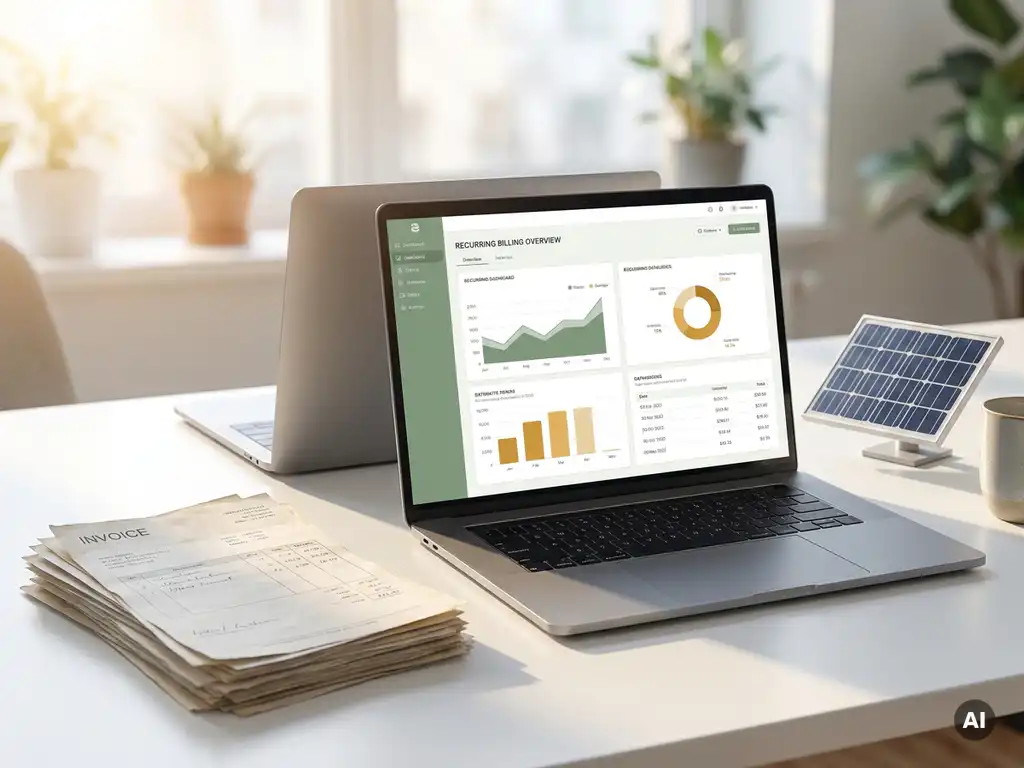
For installation companies managing a growing portfolio of service and maintenance contracts, the billing process can quietly become one of the biggest operational drains in the business. What starts as a manageable spreadsheet or a folder of contract PDFs turns into a tangle of manual checks, missed invoices, and finance team bottlenecks. Switching from one-off invoicing to automated recurring billing is not just a finance upgrade; it is a fundamental shift in how a business generates and protects its revenue. This guide walks through what that transition looks like in practice, how to structure services for it, and what pitfalls to avoid along the way.
Signs your invoicing process is holding you back
Most companies do not realize their invoicing process is a liability until the symptoms become impossible to ignore. The clearest signal is when billing depends on one or two people who hold all the context in their heads. If a team member is absent, invoices get delayed. If they leave, critical billing knowledge walks out the door with them.
Other warning signs include finance teams spending significant time each billing cycle manually verifying what was agreed in a contract, what has already been sent, and what remains outstanding. This kind of reconciliation work is not just time-consuming; it introduces genuine risk. Duplicate invoices damage customer relationships, and missed billing cycles directly reduce cash flow. For companies running dozens or hundreds of active service agreements, the cumulative impact of these inefficiencies can be substantial. If accurate cash flow forecasting feels difficult because no one has a clean, real-time overview of billed versus pending amounts, the invoicing process is already holding the business back.
What recurring billing actually looks like in practice
Automated recurring billing replaces the manual cycle of checking, calculating, and sending with a system-driven process that runs on a defined schedule. In practice, this means a contract is created once, configured with a billing frequency, and then the system takes over.
A well-implemented billing engine runs automatically, identifies which contracts have reached their next billing date, and generates the corresponding invoices without any manual trigger. Payments can be collected through SEPA Direct Debit, where the customer authorizes a bank mandate at the point of signing, and subsequent payments are collected automatically on the scheduled dates. For customers who prefer standard bank transfer, the invoice is still generated automatically; only the payment method differs.
What makes this model powerful for installation companies specifically is the combination of predictability and scale. A company managing fifty service contracts operates with the same administrative overhead as one managing five hundred, because the system handles the volume. Revenue becomes predictable, cash flow becomes forecastable, and the finance team shifts from reactive chasing to proactive oversight.
How to map your services to a recurring billing model
Before automating billing, the underlying service offering needs to be structured in a way that a system can process consistently. This is where many companies underestimate the preparation required.
Define your service packages clearly
The starting point is identifying which services lend themselves to recurring contracts. For sustainable installation companies, the obvious candidates are annual maintenance agreements, remote monitoring subscriptions, warranty extension plans, and periodic inspection services. Each of these has a defined scope, a predictable delivery cost, and a natural billing frequency, making them ideal for recurring billing models.
Once the services are identified, they need to be standardized into reusable packages. Rather than negotiating bespoke terms for every customer, defining a set of named service tiers, such as a basic monitoring plan or a comprehensive maintenance package, allows the entire team to sell and contract consistently. This standardization is what makes automation possible: when a package has fixed pricing, a defined billing frequency, and a set duration, a billing system can apply it reliably without human interpretation at each cycle.
Align billing frequency with service delivery
Billing frequency should reflect the rhythm of the service, not just what is administratively convenient. Annual contracts work well for services like yearly inspections or warranty coverage. Quarterly billing suits monitoring services where customers want more regular touchpoints. Monthly billing creates the highest payment frequency but also the strongest sense of ongoing engagement for the customer. Choosing the right frequency for each service type reduces friction at renewal and keeps the customer relationship aligned with the value they are receiving.
Connecting recurring billing to your broader ERP workflow
Recurring billing does not operate in isolation. Its real value emerges when it is connected to the rest of the business, from the initial project sale through to aftercare and contract renewal. An automated contract management system that sits inside a broader ERP platform creates a continuous workflow rather than a handoff between disconnected tools.
Consider the sales process. When an installation project closes, the natural next step is to offer a service agreement. If the billing system is integrated with the CRM and project management tools, that contract can be created and sent for signature within the same platform, without switching systems or re-entering customer data. Once signed, the contract feeds directly into the billing engine, and the customer record reflects the active agreement. Operations, finance, and sales all work from the same source of truth.
This integration also supports better customer communication. Automated pre-notifications before a payment is collected, digital contract signing via a secure link that works on any device, and a customer portal where agreements can be reviewed all reduce inbound queries and build trust. The administrative burden on both sides of the relationship decreases, and the customer experience improves as a direct result.
Common mistakes when switching billing systems
Transitioning from manual or one-off invoicing to automated recurring billing is straightforward in principle but often stumbles in execution. Understanding the most common mistakes helps avoid the disruption they cause.
Migrating contracts without standardizing them first is the most frequent error. If existing contracts have inconsistent terms, pricing structures, or billing dates, importing them into an automated system without cleaning them up first simply automates the inconsistency. The preparation work of standardizing service packages and contract terms is not optional; it is the foundation the automation runs on.
Skipping the testing phase is another costly mistake. Any billing system worth implementing includes a way to simulate billing runs before they go live. Running a dry-run simulation allows the team to verify that the correct contracts are being picked up, the amounts are accurate, and no duplicate invoices would be generated. Skipping this step in the interest of speed frequently results in billing errors that damage customer relationships and require time-consuming corrections.
Underestimating the customer communication required is the third common pitfall. Customers who are moving from receiving a manual invoice to having payments collected automatically via Direct Debit need clear, proactive communication about what is changing and why. Framing the change as a convenience improvement rather than an administrative shift makes adoption smoother. Providing a simple, device-friendly signing experience helps too; requiring customers to create accounts or navigate complex portals introduces unnecessary friction at a critical moment in the relationship.
How OpusFlow supports the switch to automated recurring billing
We built the Contract Management module in OpusFlow specifically to address the operational complexity that installation companies face when scaling their service and maintenance agreements. Rather than bolting billing automation onto a generic platform, we designed it as a native part of the ERP workflow, so every step from contract creation to payment collection runs in one place.
Here is what the module delivers in practice:
- Automated billing engine: Runs every night, identifies contracts that have reached their billing date, and generates invoices automatically without any manual trigger.
- SEPA Direct Debit via Mollie: Customers authorize a bank mandate when they sign their contract. Future payments are collected automatically on the scheduled dates, eliminating the need to chase unpaid invoices.
- Digital contract signing: Customers receive a secure magic link by email, open it on any device, and sign without needing an account or download. Every signature is timestamped and recorded.
- Reusable contract types: Define your service packages once, with default pricing, billing frequency, and duration. Every new contract populates correctly regardless of who creates it.
- Double-billing protection: Once a contract period is processed, it is locked in the system and cannot be invoiced again, even if a billing trigger is accidentally activated more than once.
- Dry Run mode: Simulate the entire billing run before going live to verify accuracy and catch any configuration issues before they affect customers.
For installation companies ready to move beyond manual invoicing and build a predictable, automated revenue stream from their service contracts, OpusFlow provides the complete infrastructure to make that transition without operational disruption. Book a demo to see the Contract Management module in action and find out how it fits into your current workflow.
Related Articles
- Should you factor in battery replacement costs when calculating long-term ROI?
- What does AI actually do inside a business — in plain English?
- How can installers track profitability across different project types?
- How can installation companies automate order confirmations and job scheduling?
- Can ERP systems help installation companies comply with environmental regulations?