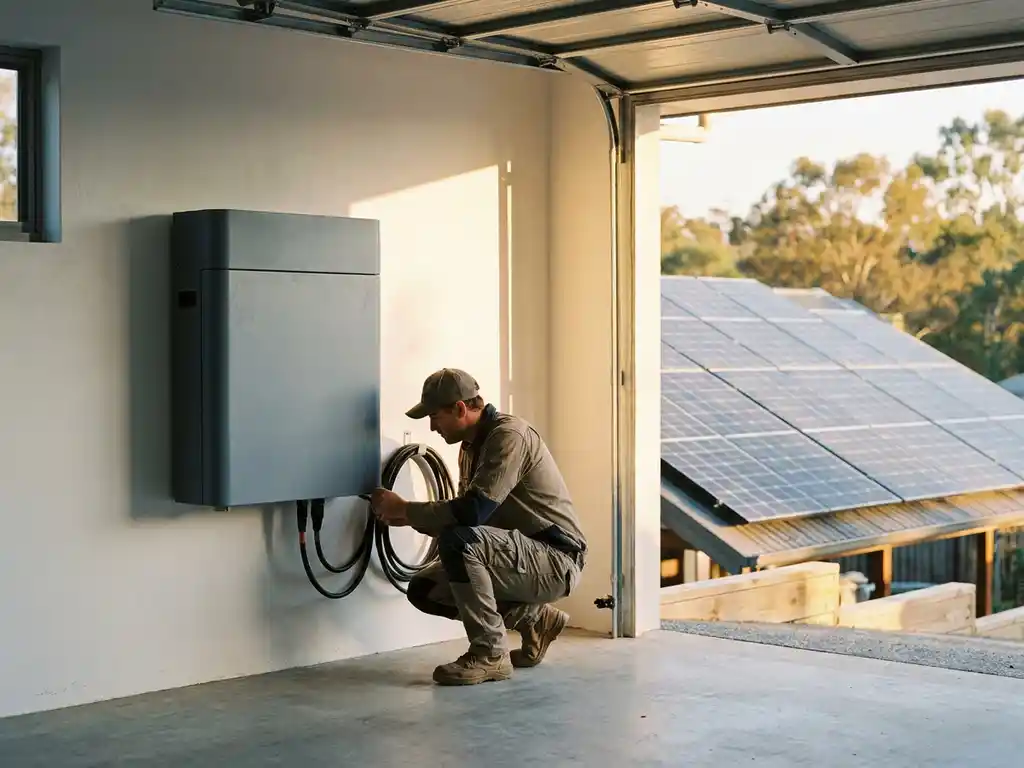
Pairing a solar system with battery storage is one of the smartest moves an installation company can make for its clients, but getting the sizing right is where the real expertise lies. A battery that is too small leaves usable solar energy on the table. One that is too large inflates the project cost and erodes return on investment before the system ever pays for itself. For a 10-panel solar installation specifically, there is a well-defined calculation process that removes the guesswork and ensures every kilowatt-hour is working as hard as possible. Understanding that process is essential for any professional working in the sustainable installation space.
Whether you are advising a commercial client on a rooftop array or scoping a larger multi-site project, the principles behind battery sizing remain consistent. This guide walks through the key variables, the step-by-step calculation method, and the common errors that quietly reduce system ROI over time. A reliable solar battery calculator can support this process, but understanding the underlying logic is what separates a competent installer from a trusted advisor.
What a 10-panel solar system actually produces
Before calculating battery capacity, it helps to establish a realistic output baseline for a standard 10-panel array. Most modern residential and light commercial solar panels are rated between 380W and 430W. A 10-panel system therefore sits in the range of 3.8 kWp to 4.3 kWp of installed peak capacity. Under real-world conditions, accounting for orientation, shading, inverter efficiency, and seasonal variation, a system of this size typically generates between 3,500 and 4,500 kWh of electricity per year in Western European climates.
On a good summer day, that same system might produce 20 to 25 kWh. On a cloudy winter day, output can drop to just 2 to 4 kWh. This variability is precisely why battery sizing cannot be based on peak production alone. The battery needs to be matched to the realistic daily generation curve, not the theoretical maximum. Understanding this production profile is the essential first step before any capacity calculation begins.
Key factors that determine your battery capacity
Battery capacity is not determined by the solar system in isolation. Several site-specific and technical variables interact to define the right storage size for any given installation.
Daily energy consumption profile
The most important input is the client’s actual energy consumption pattern. A commercial facility running heavy loads during daylight hours will self-consume a large share of solar output directly, leaving relatively little surplus to store. A site with significant evening or overnight consumption, on the other hand, needs enough battery capacity to cover those off-peak hours reliably. Reviewing at least 12 months of metered consumption data gives the clearest picture of when energy is used and how much storage is genuinely needed.
Depth of discharge and usable capacity
Battery capacity is not the same as usable capacity. Most lithium-ion batteries are designed to operate between 10% and 90% of their rated capacity, meaning a 10 kWh battery delivers roughly 8 kWh of usable storage. This depth of discharge (DoD) rating varies by manufacturer and chemistry, and it must be factored into every sizing calculation. Ignoring DoD is one of the most common errors that leads to undersized systems in practice.
Round-trip efficiency and degradation
Every charge and discharge cycle involves energy losses. Round-trip efficiency for modern lithium iron phosphate (LFP) batteries typically sits between 90% and 95%. Battery capacity also degrades over time, with most manufacturers guaranteeing 70% to 80% of original capacity after 10 years. A properly sized system accounts for this degradation so that the battery still meets the client’s needs in year eight or nine, not just at installation.
How to calculate the optimal battery size step by step
With the key variables in hand, the battery sizing calculation follows a logical sequence. Working through these steps systematically produces a defensible recommendation that holds up under client scrutiny.
- Determine daily surplus solar energy. Subtract the client’s daytime self-consumption from the system’s average daily generation. For a 10-panel system producing 12 kWh on an average day with 5 kWh consumed directly, the surplus available for storage is 7 kWh.
- Identify the evening and overnight load. Calculate how much energy the site needs after solar generation stops. If the evening and overnight load is 6 kWh, that defines the minimum functional storage requirement.
- Adjust for usable capacity. Divide the target storage volume by the battery’s DoD rating. If the target is 6 kWh and the DoD is 80%, the minimum rated capacity needed is 7.5 kWh.
- Apply a round-trip efficiency correction. At 92% round-trip efficiency, the system needs to store slightly more than the target to deliver the required output. Dividing 7.5 kWh by 0.92 gives approximately 8.2 kWh of rated capacity.
- Account for degradation over the system’s design life. If the battery is expected to retain 80% capacity after 10 years and the system is designed for a 10-year horizon, divide 8.2 kWh by 0.80 to arrive at a final recommendation of approximately 10.2 kWh of rated capacity.
This stepwise approach using a structured battery capacity calculator ensures the recommendation is grounded in real operating conditions rather than rule-of-thumb estimates. It also gives installation teams a clear, documentable rationale to present to clients or project stakeholders.
Common sizing mistakes that reduce ROI
Even experienced installers fall into sizing patterns that look reasonable on paper but quietly undermine system performance and client satisfaction over time.
The most frequent mistake is sizing the battery to match peak solar output rather than actual surplus. A 10-panel system producing 20 kWh on its best summer day does not need 20 kWh of storage. If the client self-consumes 10 kWh during the day and only needs 5 kWh overnight, a 6 to 7 kWh battery is the right fit. Oversizing inflates capital cost and extends the payback period without delivering proportional benefit.
A second common error is treating the nameplate capacity as usable capacity. This leads to undersized recommendations that leave clients frustrated when the system cannot cover their evening loads. Always calculate from usable capacity, not headline figures. Similarly, ignoring round-trip losses and long-term degradation means the system will underperform against the projections used to justify the investment, which damages both client trust and the installer’s reputation.
When to scale up beyond the calculated minimum
The minimum calculated capacity covers the baseline use case, but there are several scenarios where scaling up makes strong commercial and technical sense.
Grid instability or planned outages are an increasingly relevant consideration for commercial clients. A battery sized purely for self-consumption optimization offers limited backup capability. Adding 20% to 30% of additional capacity provides meaningful resilience without dramatically affecting project economics. For clients in regions with time-of-use tariffs, a larger battery can also capture more arbitrage value by storing cheap off-peak grid electricity in addition to solar surplus.
Future load growth is another valid reason to size upward. A commercial site expecting to add EV charging infrastructure or expand its operations within the next few years will benefit from a battery system that accommodates that growth without requiring a costly retrofit. Sizing for a three to five year demand horizon rather than current consumption is a practical approach that larger installation projects routinely adopt. The incremental cost of additional capacity at installation is almost always lower than the cost of a future upgrade.
How OpusFlow supports solar battery projects end to end
Calculating the right battery size is only one part of delivering a successful solar storage project. Managing the full workflow, from initial scoping and quotation through procurement, scheduling, installation, and aftercare, requires a level of operational coordination that quickly outgrows spreadsheets and disconnected tools. That is where we come in.
OpusFlow is the most complete ERP platform built specifically for sustainable installation companies. For teams working on solar and battery projects, the platform brings together everything needed to run those projects efficiently at scale:
- Integrated battery and PV calculation tools that feed directly into quotations, removing manual data transfer and reducing specification errors
- Calculation and quotation modules that connect sizing outputs to accurate, professional proposals without re-entering data
- Planning and project management that coordinates installation crews, material delivery, and site readiness in a single view
- Purchasing and stock management to ensure batteries, inverters, and mounting components are available when crews need them
- Workflow automations powered by Toni, our AI agent, which handles task creation, status updates, and follow-up actions automatically as projects progress through the pipeline
- Customer portal and aftercare tools that keep clients informed and support long-term service relationships
For installation businesses looking to handle more projects without proportionally increasing headcount, OpusFlow provides the operational backbone that makes scaling possible. Get in touch with our team to see how the platform fits your project workflow.
Related Articles
- How is the European home battery market changing and what does it mean for installers?
- How do you manage quotes, invoices, and projects in one system?
- What an AI assistant inside your solar business software actually does all day
- What is the difference between basic automation and AI in a solar business?
- What can AI actually do for a solar installation business?