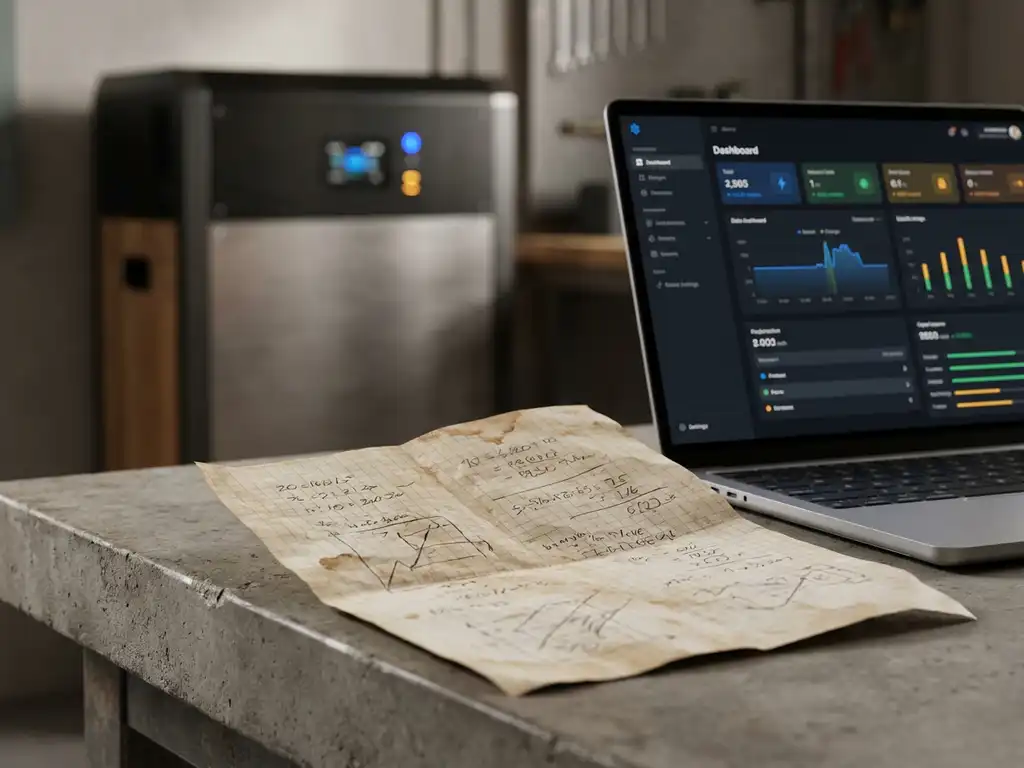
Battery calculations sit at the heart of every solar and storage installation proposal. Get them right, and clients receive accurate system sizing, realistic runtime expectations, and competitive pricing. Get them wrong, and the consequences ripple outward: underperforming systems, unhappy clients, and jobs that quietly drain margin. For installation businesses operating at scale in 2026, the question is no longer whether to calculate battery specifications carefully, but which tool is actually built for the job.
Many installation teams still rely on spreadsheets for their battery capacity calculator workflows, largely out of habit or because the initial setup cost feels low. Purpose-built software, by contrast, is designed specifically to handle the complexity of solar battery sizing, runtime estimation, and system design. The difference between these two approaches becomes more significant as project volume grows and the cost of errors compounds.
How spreadsheets fall short for battery calculations
Spreadsheets are general-purpose tools, and that generality is precisely their limitation when applied to battery calculations. A battery runtime calculator built in a spreadsheet relies entirely on the person who built it. If a formula is wrong, a cell reference breaks, or a colleague updates one tab without realising it feeds three others, the entire calculation can silently produce incorrect results.
Beyond formula fragility, spreadsheets struggle with the dynamic inputs that make battery sizing genuinely complex. Factors such as depth of discharge, temperature coefficients, inverter efficiency, and consumption profiles require layered logic that becomes increasingly difficult to maintain in a flat grid format. When a new battery model enters the market or a manufacturer updates its specifications, updating a spreadsheet manually across every template in use is both time-consuming and error-prone. For a growing installation business handling dozens of proposals per week, that maintenance burden becomes a real operational risk.
What purpose-built battery calculation software actually does differently
Purpose-built software approaches the solar battery calculator problem from the ground up, embedding the logic that experienced installers use into a structured, validated engine. Rather than relying on a user to remember which variables to adjust, the software surfaces the right inputs automatically and applies consistent calculation logic every time.
A dedicated solar and battery calculator tool typically includes up-to-date product libraries, so when a client asks about a specific battery brand or capacity, the relevant specifications are already present in the system. This removes the manual lookup step and reduces the risk of using outdated data. The software also handles scenarios that spreadsheets handle poorly, such as comparing multiple system configurations side by side or modelling how battery longevity changes under different usage patterns. These capabilities directly support faster, more confident quoting.
Accuracy and speed: where the gap becomes critical
The accuracy gap between spreadsheet-based and purpose-built battery charge calculators tends to be most visible under time pressure. When a sales team is working through a high volume of proposals, the temptation to copy a previous spreadsheet and adjust a few figures is real, and it is also where errors enter the process. A dedicated tool enforces consistent inputs and flags anomalies, making it structurally harder to produce a calculation based on stale assumptions.
Speed matters equally for competitive installation businesses. A battery usage calculator embedded in purpose-built software can generate a complete system sizing recommendation in minutes rather than the extended back-and-forth that manual spreadsheet work often requires. That speed advantage compounds across a sales pipeline: faster proposals mean shorter sales cycles, which matters when clients are comparing multiple installers simultaneously.
How connected software links calculations to the full installation process
One of the most significant limitations of standalone spreadsheets is that they exist in isolation. A completed solar to battery calculator output in a spreadsheet has to be manually transferred into a quotation, then separately into a purchase order, then again into a project plan. Each transfer is an opportunity for data to drift, and for the original calculation to become disconnected from what actually gets ordered and installed.
Purpose-built software addresses this by treating the battery calculation as the starting point of a connected workflow rather than a standalone document. When a system design is completed using a solar battery calculator that is integrated with the broader platform, the outputs can flow directly into quotation generation, procurement, and planning. This kind of integration is what separates tools built for installation businesses from general-purpose alternatives.
The practical benefit is significant. Installation teams no longer need to re-enter data at each stage of the project lifecycle. The calculation that informed the sale becomes the same data that drives the purchase order and the installation schedule, reducing discrepancies and the rework that follows them. For businesses managing multiple crews and projects simultaneously, this connected approach is a foundational requirement rather than a nice-to-have.
Choosing the right tool as your installation business scales
The right tool depends heavily on where a business is in its growth trajectory. For an installer completing a handful of projects per month, a well-maintained spreadsheet may be functional, even if it carries risk. But as project volume increases, the limitations of spreadsheet-based battery capacity calculators become structural rather than occasional. The manual effort required to keep templates updated, the fragility of shared files across a team, and the disconnection from downstream processes all scale negatively with business growth.
Businesses that are serious about how to manage installation projects more efficiently and reduce the margin erosion that comes from calculation errors and rework tend to reach a tipping point where purpose-built software becomes the more cost-effective choice. The investment in a proper tool pays back through reduced errors, faster proposals, and the ability to handle greater project volume without proportionally increasing administrative headcount. That last point is particularly relevant for businesses exploring how to scale an installation business without hiring more staff.
When evaluating options, it is worth looking beyond the calculation feature itself. A tool that handles battery sizing but sits separately from CRM, quotation, and planning workflows will still require manual data transfer at the handoff points. The most efficient outcome comes from software where the calculation is genuinely embedded in the end-to-end process.
How OpusFlow supports battery calculations and beyond
OpusFlow is built specifically for sustainable installation companies, and our battery calculator is a core part of that. Rather than offering a standalone tool, we embed battery and solar system sizing directly within a fully connected ERP platform. Here is what that means in practice:
- Integrated system design: Battery calculations are connected to quotation generation, so the figures that inform a proposal are the same ones that drive pricing and procurement.
- Up-to-date product data: Our platform maintains current battery and component specifications, removing the manual update burden from your team.
- End-to-end workflow connection: From the initial solar power calculator battery output through to project planning, purchasing, and invoicing, every step shares the same data.
- AI-powered support through Toni: Our AI agent Toni assists with automating repetitive steps across the workflow, helping larger installation teams handle higher project volumes without proportional increases in admin overhead.
- Scalable for growing businesses: Whether managing a small team or coordinating multiple crews across regions, OpusFlow is designed to grow with the business rather than become a bottleneck.
If your installation business is ready to move beyond spreadsheets and connect your battery calculations to the full project lifecycle, we would be glad to show you how OpusFlow works in practice. Get in touch with our team to arrange a demonstration.
Related Articles
- How do you calculate the optimal battery size for a 10-panel solar system?
- What factors affect how long a home battery lasts on a full charge?
- What an AI assistant inside your solar business software actually does all day
- What to look for in software if you run an installation company with 10 to 50 people
- How can ERP software help installation companies track employee hours?