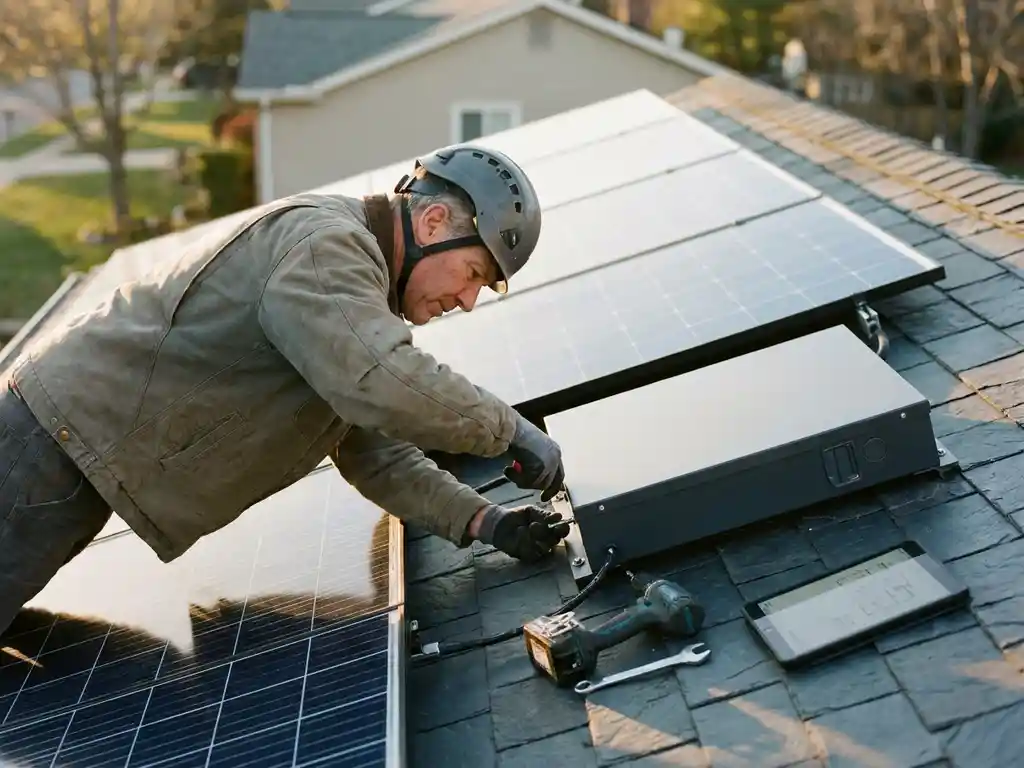
Managing solar and battery storage projects simultaneously has become one of the defining operational challenges for installation companies in 2026. As demand for home batteries and commercial energy storage systems continues to grow alongside solar adoption, many installers find themselves running two distinct product lines that share crews, warehouses, and customer pipelines. Without the right processes in place, this overlap creates scheduling conflicts, stock shortages, and jobs that quietly go over budget before anyone notices.
The companies that handle this well are not necessarily the largest ones. They are the ones that have built structured workflows connecting sales, planning, procurement, and field operations into a single coherent system. Understanding how they do it is the first step toward replicating that operational discipline at scale.
The operational challenge of running solar and battery jobs together
Solar installations and battery storage projects look similar on the surface but behave very differently in practice. A solar job typically follows a predictable sequence: site survey, design, permitting, installation, grid connection. A battery project, whether standalone or paired with solar, introduces its own set of variables, including load calculations, inverter compatibility checks, and sometimes separate electrical sign-offs.
When these two project types run in parallel, the operational load multiplies quickly. Field crews need different skill sets, procurement timelines differ, and customer communication touchpoints multiply. Many installation companies report that this is where errors begin to creep in. A crew arrives on site without the right battery unit because it was logged under the wrong job. An invoice goes out missing half the materials. A customer calls because nobody followed up after the solar installation to schedule the battery commissioning. These are not random failures. They are the predictable result of managing two product lines with disconnected tools and manual handoffs.
How planning and scheduling keep dual projects on track
Effective scheduling across solar and battery jobs requires visibility into crew availability, skill sets, and job dependencies at the same time. A crew qualified to install a battery storage system is not always the same crew handling the rooftop panels, and coordinating both on a single site visit demands precise planning.
The most effective approach treats each job phase as a discrete task with its own resource requirements. Rather than scheduling a “solar plus battery” job as one block, experienced operations managers break it into linked milestones: survey, design sign-off, materials delivery confirmation, installation day, commissioning, and customer handover. Each milestone has its own crew assignment and deadline. When one milestone slips, the system flags downstream tasks before they become problems.
For companies managing multiple crews across multiple sites simultaneously, a centralized planning platform becomes essential. Spreadsheets and shared calendars break down quickly when five crews are running eight jobs across three product categories. The ability to see crew utilization, job status, and material readiness in one view is what separates companies that scale cleanly from those that grow into chaos.
Stock and purchasing across two product lines
Inventory management is where many installation businesses quietly lose money on jobs. Solar panels, inverters, mounting hardware, battery units, and cabling all have different lead times, storage requirements, and supplier relationships. Running both product lines without a unified purchasing process means double the risk of stockouts, overordering, and materials sitting idle in a warehouse.
A structured approach to purchasing starts with job-level material lists generated at the quoting stage. When a quote is accepted, the required materials should flow automatically into a procurement workflow, triggering purchase orders based on current stock levels and supplier lead times. This prevents the common scenario where a battery unit is ordered two days before installation because nobody checked stock until the crew was already dispatched.
Linking purchasing directly to project milestones also improves cash flow. Materials ordered too early tie up working capital. Materials ordered too late delay jobs and damage customer relationships. The goal is just-in-time procurement driven by confirmed job schedules, not by manual reminders or last-minute calls to suppliers.
How ERP software connects battery and solar workflows
The core problem with managing solar and battery projects through separate tools is that information breaks down at every handoff. A quote created in one system does not automatically inform the planner. A purchase order raised in a spreadsheet does not update the project manager. A completed installation does not trigger the invoice without someone manually connecting the dots.
An integrated ERP platform eliminates these gaps by treating every stage of a job as part of one connected workflow. When a deal moves from quoted to approved, tasks are created automatically. When materials are confirmed as received, the installation milestone becomes schedulable. When the field crew marks a job complete, the invoicing process begins without a manual trigger. This kind of end-to-end automation is particularly valuable for companies running a solar and battery calculator at the quoting stage, because the output of that calculation can feed directly into the job record rather than being re-entered by hand.
The practical benefit is not just efficiency. It is accuracy. Every team member, from the sales rep to the field technician to the finance department, is working from the same data. Errors that stem from re-keying information or working from outdated records are eliminated at the source.
Scaling up without losing oversight
Growth creates complexity faster than most installation businesses expect. Adding a second product line like battery storage, or expanding into a new region, does not just double the workload. It multiplies the number of interdependencies that need to be managed. More crews, more suppliers, more project types, and more customers all demand more coordination, and that coordination has to happen without proportionally more administrative staff.
The companies that scale successfully tend to share a common characteristic: they have standardized their core processes before they grow. A repeatable quoting workflow, a consistent job setup process, and a clear escalation path when something goes wrong are all prerequisites for growth that does not erode margins. Without these foundations, every new hire and every new job type adds friction rather than capacity.
Oversight at scale also means having reliable data. Knowing which job types are most profitable, which crews are most efficient, and which suppliers are causing delays requires that information to be captured consistently across every job. That is only possible when the tools used to run the business are integrated rather than siloed.
How OpusFlow helps manage solar and battery projects
OpusFlow is built specifically for installation companies running complex, multi-product workflows. As the most complete ERP platform for sustainable installation businesses, we connect every stage of the job lifecycle in one system, from first contact to final invoice, so nothing falls through the gaps when solar and battery projects run in parallel.
- Integrated solar and battery calculator: Generate accurate quotes for combined solar and storage projects, with outputs that feed directly into job records and procurement workflows.
- Automated task creation: When a deal progresses through the pipeline, tasks are created automatically, ensuring planning, purchasing, and field teams are always aligned without manual coordination.
- Unified planning and scheduling: Manage crew assignments, skill requirements, and job dependencies across multiple project types in a single planning view.
- Stock and purchasing management: Link material requirements to confirmed jobs, automate purchase orders based on stock levels, and eliminate last-minute procurement surprises.
- Real-time project oversight: Track job status, crew utilization, and financial performance across your entire operation, giving leadership the visibility needed to scale with confidence.
- AI-agentic capabilities via Toni: OpusFlow is the first ERP in the sustainable installation industry with an AI agent, Toni, that actively supports operational decision-making and workflow management.
If your installation business is managing solar and battery projects and finding that the operational complexity is outpacing your current tools, we would be glad to show you how OpusFlow brings it all together. Get in touch with our team to see the platform in action.
Related Articles
- What is the first thing a growing installation business should stop doing manually?
- How do installation companies handle partial invoicing on longer projects?
- How can small installation companies benefit from data-driven decision making?
- How can installers use role-based access to protect sensitive business data?
- How does ERP software help with warranty tracking for installation work?