Whether you install solar panels, heat pumps, air conditioners or EV chargers, one thing is for sure: Customers care about return on investment (ROI). They want numbers. They want proof to be sure they’re making the right decision. And you want to show them the value of what you’re offering, without spending half your day building spreadsheets.
And the easy way is with automation in OpusFlow’s PV Designer and advanced ROI calculator.
That’s exactly what this blog is all about. We’re going to unpack:
Why ROI matters for installers (a lot)
Who needs it (hint: not just your customer)
What a good ROI calculator actually looks like
What’s the hard way to do it
What is ROI and 4 reasons why an ROI calculator matters?
In a perfect world, your customer would just say:
“Looks great. I trust you. Let’s do it.”
But the real world looks more like this:
“How much will I save? What’s my payback period? What if energy prices drop?”
In other words: they want to know if the investment is really worth it, and that’s exactly what ROI tells them.
What is ROI, anyway?
ROI stands for Return on Investment which is just a fancy way of asking, “Is this thing worth the money?” It tells your customer how long it’ll take before their investment in solar, heat pumps, EV chargers (or whatever you install) starts paying them back. In simple terms: the higher the ROI, the faster they save money. And when you can explain that clearly, it’s a lot easier for them to say “yes.
But ROI is not just for the customer’s peace of mind. Here are 4 main reasons why it matters for you:
1. An ROI calculator speeds up deal closing
Telling a customer “You’ll save money in the long run” sounds nice, but it’s also vague. People hear that kind of thing all the time, and it doesn’t always move the needle. But when you say, “This system will pay for itself in 6 years and save you over €15,000 in the next 20,” suddenly the conversation changes. Now you’re not just promising value, you’re proving it. ROI gives your offer real weight, real numbers, and real trust. And in most cases, that’s exactly what a hesitant customer needs to confidently move forward.

2. An ROI calculator builds customer trust

Let’s be honest, customers are skeptical. They’ve seen too many vague claims and slick sales pitches. But when you walk them through a clear ROI calculation, it shows you’ve done your homework. You’re not just throwing out numbers, you’re backing them up with real data. That transparency makes a big difference. It shifts the conversation from “Are they trying to sell me something?” to “Wow, they actually care about what’s best for me.” And that’s when trust starts to build, not because you said you’re an expert, but because you acted like one.
3. ROI calculations help qualify leads
When someone starts asking about ROI, they’re not just browsing, they’re thinking. They’re weighing options, comparing quotes, maybe even talking it over with their partner. That’s a good sign. These are the kinds of leads worth your time. Sharing a clear ROI helps you filter out the tire-kickers from the serious buyers. It gives you a simple way to focus on people who are genuinely ready to invest, not just curious about the tech. And that means fewer dead-end conversations, and more deals that actually go somewhere.

4. ROI helps you present investments professionally

Anyone can sell panels or heat pumps. But when you walk in with a clear ROI breakdown, you’re doing more than selling hardware, you’re helping customers make a smart investment. That’s a different level of service. It shows you understand the bigger picture: not just how to install the product, but how it pays off over time. And that’s exactly what sets you apart from the competition. You’re not just an installer, you’re a trusted advisor. Someone they’ll come back to, recommend, and remember.
ROI isn’t fluff. It’s a decision-making tool. And in an industry where competition is growing and customers are cautious, being able to explain ROI clearly (and confidently) can set you apart.
Who uses ROI calculations
(and why it goes beyond the numbers)
You don’t need to be a finance expert to talk ROI calculations, and honestly, you shouldn’t have to be. But understanding return on investment (and being able to explain it simply) can unlock serious value across your entire business.
Let’s break it down:
- Sales reps use ROI to turn interest into action: When a lead is on the fence, a solid ROI gives them a reason to say yes, not “maybe later.” It helps justify the purchase with logic, not just enthusiasm.
- Installers use ROI during site visits to answer the classic question: “Is this really worth it?” With a clear, personalised calculation, you can replace uncertainty with confidence, and look like a total pro while you’re at it.
- Business owners rely on ROI to decide where to focus: Which product lines are bringing the most value to customers? Which projects close fastest? Understanding ROI helps prioritise what’s profitable and drop what’s not.
- Marketing teams (or let’s be honest, maybe it’s just you in a hoodie running Facebook ads) use ROI to boost conversion: Ads and landing pages with clear savings or payback times get way more clicks than vague claims about being “eco-friendly.”
- And let’s not forget the customer. Homeowners often use ROI to convince their partner, their bank, or even themselves. A €12,000 investment sounds scary until they see that it pays for itself in 5 years, and keeps saving money long after.
What a good ROI calculator for installers should include
A decent ROI calculator gives you a number.
A great ROI calculator helps you win trust, close deals, and position yourself as the obvious choice. It doesn’t just answer the question, “Will this pay off?”, it shows how, when, and why.
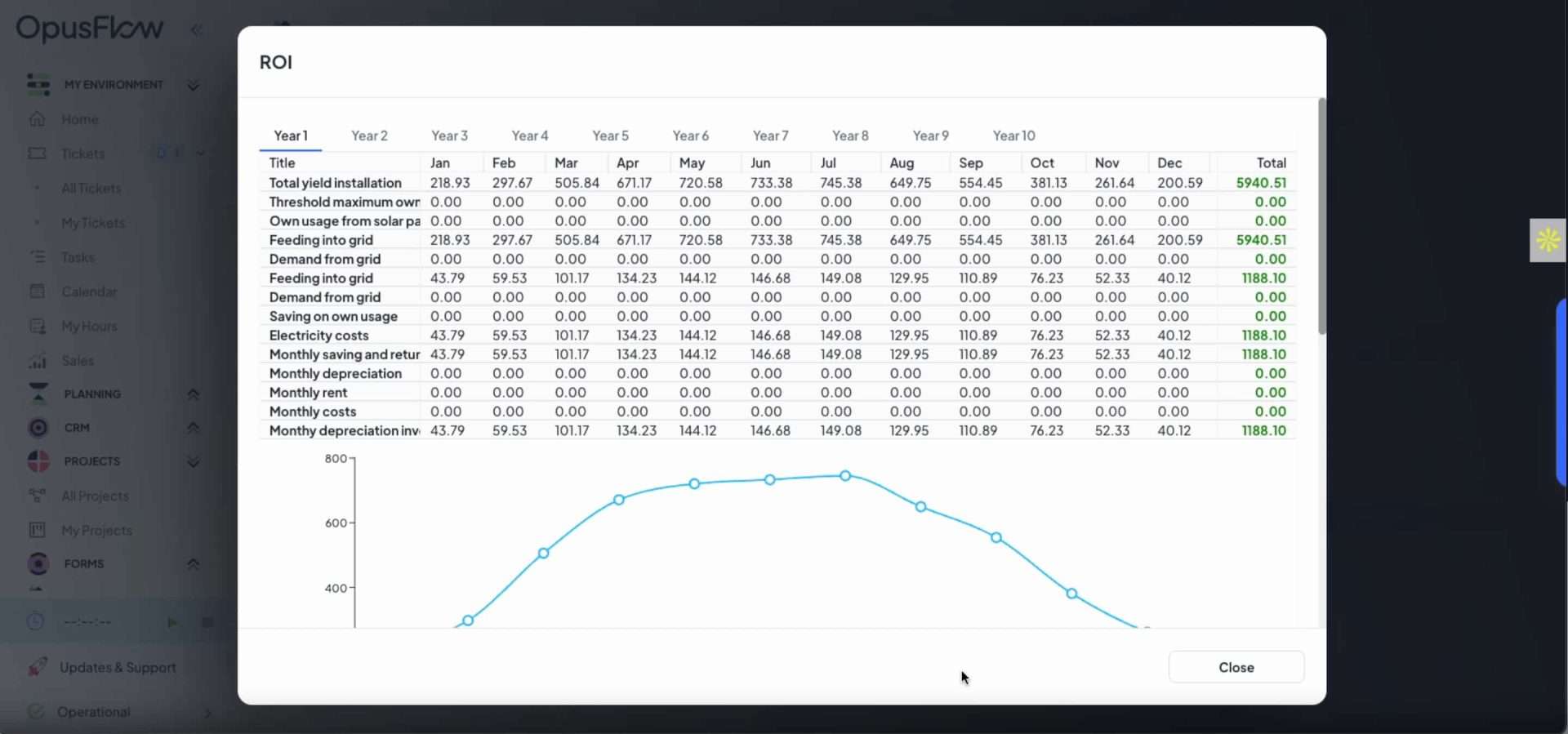
1. Easy-to-use ROI tool that gives fast estimates
2. Realistic ROI estimates based on local and dynamic data
There’s nothing worse than overpromising and underdelivering, and that’s exactly what happens when your ROI calculator is based on outdated or overly optimistic data.
The best calculators factor in:
- Rising energy prices (because let’s be honest, they’re not going down)
- Efficiency drop-off over time (solar panels and heat pumps degrade slowly, but they do degrade)
- Available subsidies or incentives (which vary by region and change often)
- Local conditions like sun hours, heating degree days, or grid prices
3. Professional ROI reports that build trust and win customers
4. A sales-boosting ROI tool that sets installers apart from competitors
If every other installer in your area is emailing plain-text quotes, and you’re sending detailed ROI reports with charts, long-term savings, and tailored data? That’s a serious edge.
It tells your customer: “We’ve thought this through.”
It shows that you’re not just here to sell, you’re here to help them make a smart decision.
In a market full of choices, the way you communicate value is everything. A strong ROI calculator helps you show value in a way that feels clear, professional, and personal, and that’s what wins deal.
What an ROI calculator typically shows (and why these numbers matter to customers)
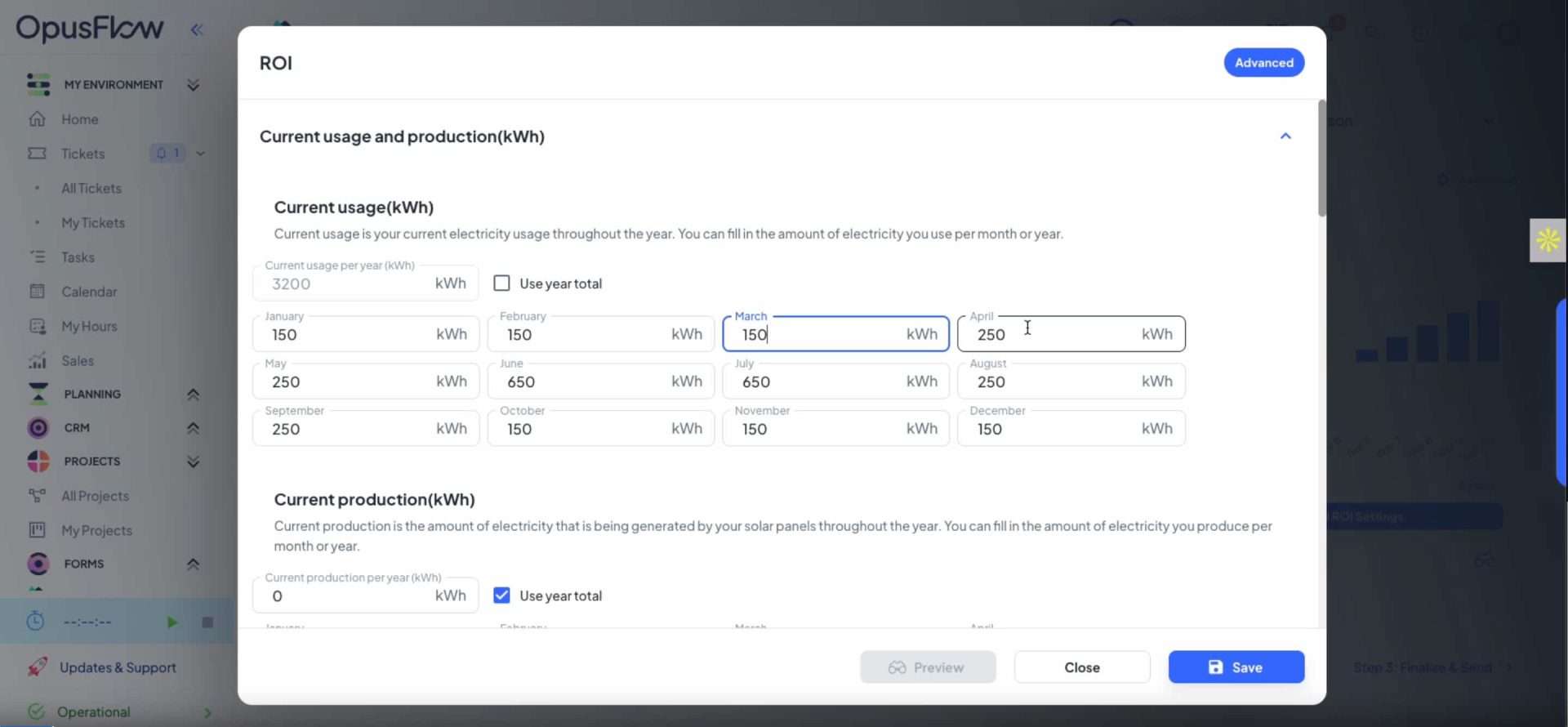
When a customer asks about ROI calculations, they’re not looking for a finance lesson, they’re looking for peace of mind.
What they really want to know is:
- “When will I get my money back?”
- “How much will I actually save in the long run?”
- “Is this better than just leaving things the way they are?”
Here’s what a good ROI calculator typically includes:
Upfront investment:
This is the full cost of the installation, including materials, labour, taxes, and any other fees. It sets the baseline for all future savings. If your customer is going to commit to a €10,000 heat pump or €12,000 solar system, they want to know what they’re starting with.
Estimated energy savings per year:
This is where things get exciting. A proper ROI tool calculates how much money the customer will save on their energy bill every year, based on their consumption, local energy rates, and the performance of the system. It turns “eco-friendly” into “budget-friendly.”
Break-even point (payback time):
This is one of the most powerful numbers in any quote. The break-even point shows how many years it will take for the investment to pay for itself. If your customer sees that their system will be paid off in 5–7 years, it makes the upfront cost much easier to swallow.
Cumulative savings over time:
Some people think short-term. Others care about the big picture. Showing long-term savings, over 10, 15, or even 25 years, helps both types of buyers understand just how much they’ll benefit. This figure can often go into the tens of thousands, depending on energy prices and system size.
Subsidies or tax incentives:
ROI should include any available financial incentives automatically. These can make a massive difference in reducing upfront cost and speeding up the payback period, especially for customers who aren’t even aware they exist.
CO₂ savings and environmental impact:
Not every customer is driven by the numbers alone. Many care just as much (or more) about the environmental impact. Showing how many kilos or tons of CO₂ they’ll avoid each year makes your offer emotionally compelling, not just financially smart.
Payback timeline chart:
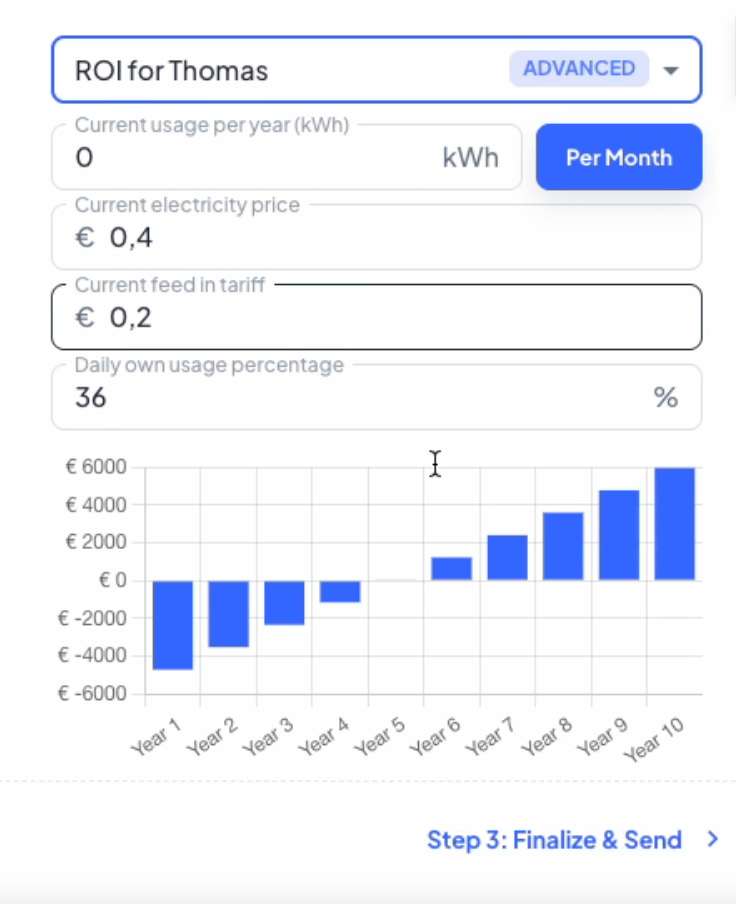
This is the secret weapon. A visual chart showing “cost vs. savings over time” can do more than paragraphs of explanation ever could. It gives customers a clear mental picture of when they hit the break-even point, and how the savings just keep climbing after that. When they see that curve bending in their favor, the decision becomes a lot easier.
How to use an ROI calculator manually as an installer
Alright, let’s say you’re doing it the old-school way. Just you, your laptop, and a fresh cup of coffee that’s already gone cold.
You’ve got a customer interested in a solar installation, let’s say it costs €9,000. You estimate it’ll save them about €1,200 a year on electricity. No battery, no subsidies, just a basic system for the sake of example.
Here’s your classic ROI formula:
ROI = (Annual Savings / Investment) × 100
So you plug in the numbers:
(1,200 / 9,000) × 100 = 13.3%
That’s actually a pretty solid return. Most people would be happy with a 13% return on anything these days, especially something that helps the planet. But hold on… are you done? Not even close.
Now you start thinking:
- What about inflation? Energy prices are rising, should I adjust that €1,200 per year up over time?
- Do solar panels degrade? Yep, around 0.5% to 1% per year. Better factor that in as well.
- What about regional data? Someone in Valencia gets way more sun than someone in Hamburg. Time to look up solar irradiance charts!
- What if their electricity usage increases? They just bought an EV… should that be part of the calculation?
Before you know it, you’re knee-deep in Google Sheets with 14 browser tabs open, one for the customer’s utility rate, another for the local weather, one for subsidy eligibility, and a bunch more you’ve already forgotten about.
You’re building formulas, adjusting assumptions, triple-checking your math, and constantly asking yourself:
“Wait, is this too optimistic? Or not optimistic enough?”
It’s not just time-consuming, it’s mentally exhausting. And if the customer changes one detail (“Actually, we’re thinking of adding a battery now…”) guess what? Back to the spreadsheet.
It’s moments like these where you realise: you didn’t become an installer to become a part-time financial modeller.
An automated ROI calculator for installers:
How OpusFlow makes it easy
Here’s the part where everything gets easier.
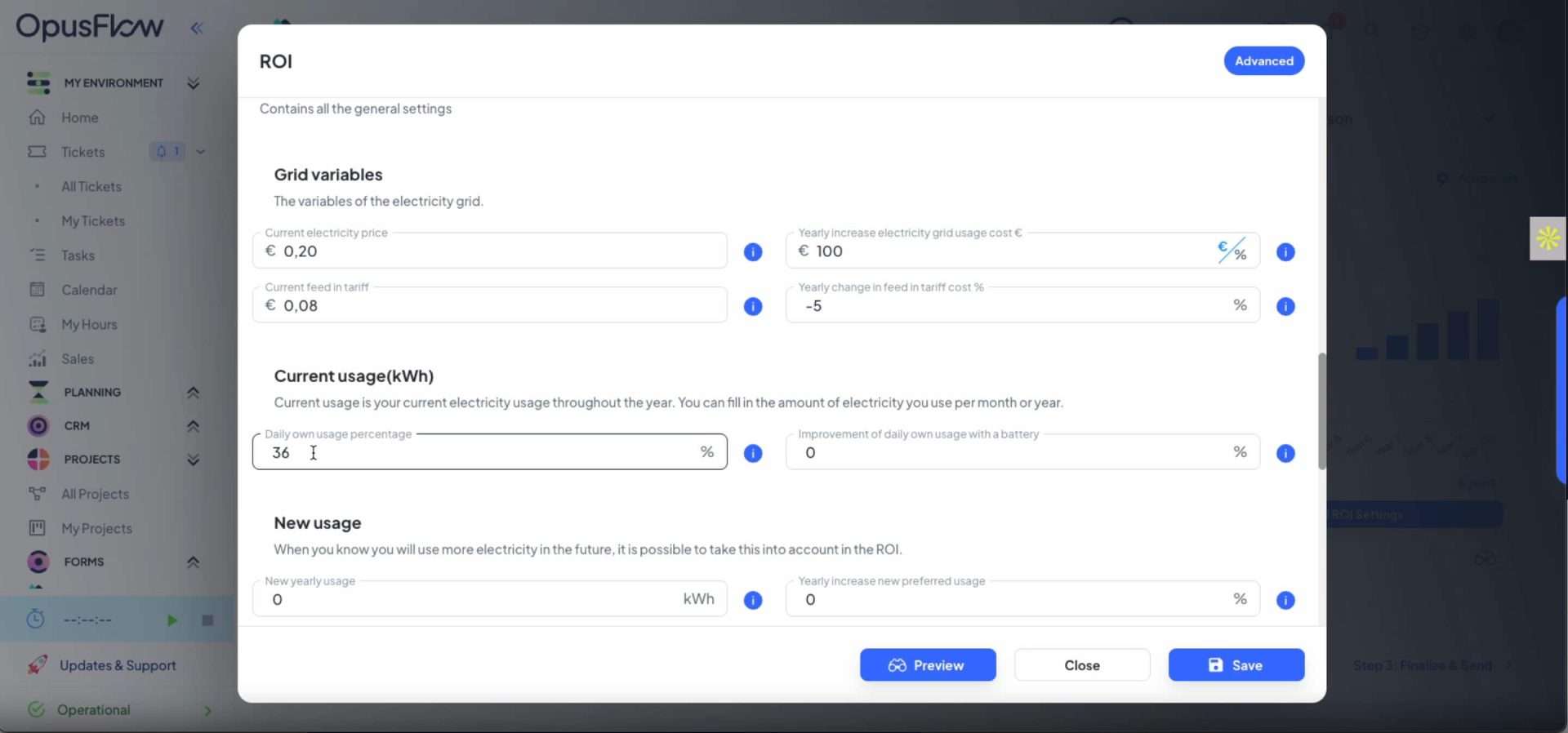
With OpusFlow, you don’t just get a smart ROI calculator, you get one that’s fully integrated into your workflow. It’s part of the platform. No need to pay extra. No switching between tools. Just seamless, automated calculations built right into your PV Designer.
And yes, it looks good too. The ROI reports are clean, clear, and made to impress, whether you’re emailing a quote or presenting it on-site.
One Platform to Run Your Entire Installation Business
Manage leads, projects, stock, and invoicing — everything in one smart system built for sustainable installers.

🎥 Watch the video below to see how fast and easy it is to deliver accurate, visual ROI reports your customers can trust.
Final thought: Stop guessing your ROI and start closing more deals
If you’re still doing ROI manually, you’re wasting time and possibly losing deals. OpusFlow makes it effortless to show your value, prove your numbers, and give every customer a reason to say yes.
Want to see how it works?
👉 Book a demo and discover how ROI (and the rest of your workflow) gets faster, smarter, and more professional with OpusFlow.
All your questions answered...
What is ROI?
ROI stands for Return on Investment. It tells your customer how long it’ll take before their investment in solar, heat pumps, EV chargers (or whatever you install) starts paying them back.
What is an ROI formula?
Why does an ROI calculator matter?
- An ROI calculator speeds up deal closing
- An ROI calculator builds customer trust
- ROI calculations help qualify leads
- ROI helps you present investments professionally
What does a good ROI calculator should include?
- Easy-to-use tool that gives fast estimates
- Realistic ROI estimates based on local and dynamic data
- Professional ROI reports that build trust and win customers
- A sales-boosting ROI tool that sets installers apart from competitors