That question came up again and again while reviewing survey results from active users of OpusFlow in their daily operations, sustainable installers across key European markets.
The picture that emerges is not a market in decline. It is a market that is maturing.
And for installers, that changes everything.
Market demand trends in the installer market
One of the biggest misconceptions about 2025 is that demand disappeared.
The reality is more nuanced.
This suggests that customers are still interested in investing in renewable energy solutions. However, they are taking more time to make decisions and are being more careful about where they spend their money.
For installers, this creates a different type of challenge. Opportunities still exist, but converting interest into signed contracts requires more effort than before.
And when customers become more selective, competition naturally becomes stronger.
Competition is increasing in the installer market
While demand remained present, many installers experienced stable or declining business performance compared to the previous year. The reason becomes clearer when looking at the biggest challenge reported by respondents.
Why price pressure is becoming a challenge
Price competition is not new in the renewable energy sector. What makes today’s market different is how widespread it has become.
As the installer market matures, customers have more choice than ever before. Comparing multiple quotations has become standard practice, and buyers are increasingly taking the time to evaluate both price and value before making a decision.
At the same time, the industry itself is evolving. Installers in our survey described the market as becoming more professional, more technology-driven, and increasingly competitive. This suggests that businesses are no longer competing only on technical expertise. Customer experience, response times, communication, and operational efficiency are becoming important differentiators.
Why profitability matters more than volume
How sales efficiency helps installers win more projects
As installers compete for the same projects, responsiveness can become a key differentiator. A faster quote, a quicker follow-up, or a smoother customer journey can be the difference between winning a project and losing it.
That is why one result from our industry insights stands out.
This is where digitalisation is becoming increasingly important. By connecting sales, project management, customer communication, calculations, quotations, installation planning, and service processes in one workflow, installers can reduce manual work and spend more time focusing on customers.
But improving efficiency is only one side of the equation.
The other question installers are asking is where future growth will come from.
Why battery storage is becoming a major growth opportunity
Among all the technologies included in the survey, one stood out clearly.
This aligns with broader industry trends. According to the International Energy Agency (IEA), battery deployment expanded strongly in 2025, with rapid growth across multiple markets as storage plays an increasingly important role in helping households, businesses, and energy systems make better use of renewable energy.
For years, most renewable energy projects focused on generating electricity. Today, customers are increasingly thinking about what happens after that energy is produced. They want greater control over how and when they use it.
What battery storage means for installers
One Platform to Run Your Entire Installation Business
Manage leads, projects, stock, and invoicing — everything in one smart system built for sustainable installers.

Managing growth in a more complex market
At the same time, battery projects often bring additional complexity. They require careful planning, accurate system design and calculations, and closer coordination between sales, engineering, installation, and service teams.
The question is no longer whether battery storage will become an important part of the installer market.
For many businesses, it already is.
What installers should prepare for in 2026
These results suggest that businesses are not expecting the market to become easier overnight. Instead, they are preparing for a period where efficiency, adaptability, and profitability will remain key priorities.
But what stood out most was what respondents identified as the industry’s hidden bottlenecks.
Two-thirds believe the lack of long-term policy stability is holding the sector back. Others highlighted administrative workload, grid connection limitations, and coordination challenges across the industry.
Yet despite these concerns, the overall picture is far from negative. Demand remains present, new technologies are creating opportunities, and installers continue to adapt to changing market conditions.
This is where an all-in-one platform such as OpusFlow can help. By connecting CRM, quotations, solar design, heat pump and battery calculators, AI, project management, service, and automation in one platform, installers can reduce manual work, improve visibility across projects, and create the operational efficiency needed to remain competitive in a changing market.
The installer market is becoming more professional, more technology-driven, and more competitive. Businesses that embrace that shift may be best positioned to succeed in the years ahead.
In today’s installer market, the challenge is no longer finding opportunities. It’s making the most of them.
Where do you stand? See the full survey results
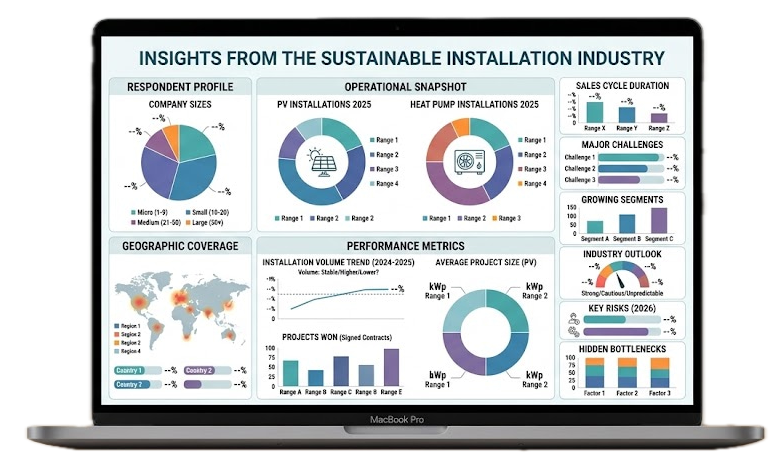
Are your recent business challenges unique to you, or is the entire market feeling the weight of price erosion and administrative burdens? To give you a transparent look at how your peers performed last year and what they are prioritizing next, we’ve mapped out our entire dataset. Swipe or click through the carousel below to explore the exact breakdown of installation volumes, top business risks, and emerging bottlenecks.
Survey results
(out of 18 number of people that completed the survey)
- Netherlands: 55.56%
- Germany: 27.78%
- Spain: 11.11%
- Belgium: 5.56%
- 1–9 employees: 55.56%
- 10–20 employees: 27.78%
- 21–50 employees: 16.67%
Approximately how many solar systems did you install in 2025?
- 26–75 systems: 38.89%
- 0–25 systems: 33.33%
- 76–149 systems: 22.22%
- 150+ systems: 5.56%
Approximately how many heat pumps did you install in 2025?
- 0–10 heat pumps: 83.33%
- 11–30 heat pumps: 5.56%
- 31–75 heat pumps: 5.56%
- 76–149 heat pumps: 5.56%
Compared to 2024, your total installation volume in 2025 was:
- Approximately the same: 33.33%
- Much lower: 27.78%
- Slightly lower: 22.22%
- Slightly higher: 11.11%
- Much higher: 5.56%
How many projects did you win (signed contracts) in 2025?
- 0–50 projects: 50.00%
- 51–150 projects: 33.33%
- 300+ projects: 11.11%
- 151–300 projects: 5.56%
- 10–20 kWp: 55.56%
- Below 10 kWp: 38.89%
- 50+ kWp: 5.56%
What is your average sales cycle? (From first contact to signed contract)
- 2–4 weeks: 52.94%
- Less than 2 weeks: 29.41%
- 1–2 months: 11.76%
- More than 2 months: 5.88%
What was your biggest challenge in 2025?
(Respondents could select multiple answers)
- Price pressure & competition: 83.33%
- Labor shortage: 27.78%
- Policy/subsidy changes: 16.67%
- Other: 5.56%; mentioned "too few inquiries"
Which segment is growing fastest for your company?
- Battery storage: 44.44%
- Residential & Commercial PV: 27.78%
- Heat pumps: 16.67%
- EV charging: 5.56%
- Service & maintenance: 5.56%
How did your turnover change in 2025 compared to 2024?
- Declined: 44.44%
- Stable (±5%): 33.33%
- Grew 5–25%: 11.11%
- Grew more than 25%: 11.11%
How would you describe current market demand?
- Stable but cautious: 50.00%
- Highly unpredictable: 27.78%
- Slowing down: 16.67%
- Very strong: 5.56%
How would you describe the overall direction of the sustainable installation industry?
- Moving toward professionalization and consolidation: 29.41%
- Becoming increasingly price-competitive: 23.53%
- Becoming more technology-driven: 23.53%
- Facing structural slowdown: 17.65%
- Becoming service-oriented: 5.88%
What are currently the biggest risks for your business in 2026?
(Respondents could select multiple answers)
- Further price erosion: 50.00%
- Policy/subsidy uncertainty: 50.00%
- Customer demand slowdown: 44.44%
- Labor shortage: 22.22%
How would you describe the overall direction of the sustainable installation industry?
(Respondents could select multiple answers)
- Lack of long-term policy stability: 66.67%
- Excessive administrative workload: 38.89%
- Grid connection limitations & inconsistent procedures: 22.22%
- Poor coordination between installers, utilities, and authorities: 11.11%
- Insufficient digitalization in project management: 5.56%