Home batteries are becoming a cornerstone of residential energy systems, and as more households invest in solar-plus-storage setups, the question of long-term maintenance is moving to the front of the conversation. For installation companies managing dozens or hundreds of battery systems across their client base, understanding what proper aftercare looks like is not just a service differentiator. It is a fundamental part of delivering on the promise of sustainable energy. Whether working with lithium iron phosphate systems or other battery chemistries, a proactive maintenance approach extends battery life, protects warranties, and keeps end customers satisfied well beyond the installation date.
This guide walks through the key maintenance requirements for home batteries, from routine owner checks to professional inspection schedules, and explains how installation businesses can manage aftercare at scale without letting service quality slip.
Routine checks every home battery owner should do
Most home battery systems are designed to operate with minimal owner intervention, but that does not mean they should be ignored entirely. A few simple habits can catch small issues before they develop into costly problems.
Owners should regularly check the battery management system (BMS) display or companion app to confirm the system is operating within normal parameters. This includes verifying that the state of charge is cycling appropriately, that charge and discharge rates look consistent with recent usage, and that no error codes or warning lights are active. Many modern systems provide real-time data through a mobile app, making this a quick daily or weekly habit rather than a technical task.
Physical checks matter too. Inspecting the battery unit for visible signs of damage, swelling, or unusual heat around the casing takes only a few minutes and can flag early warning signs. Keeping the area around the battery clear of clutter, dust, and moisture is equally important. These are not complex tasks, but they form the foundation of a responsible ownership routine that supports the longer service intervals provided by professional inspectors.
Professional inspections: what they cover and how often
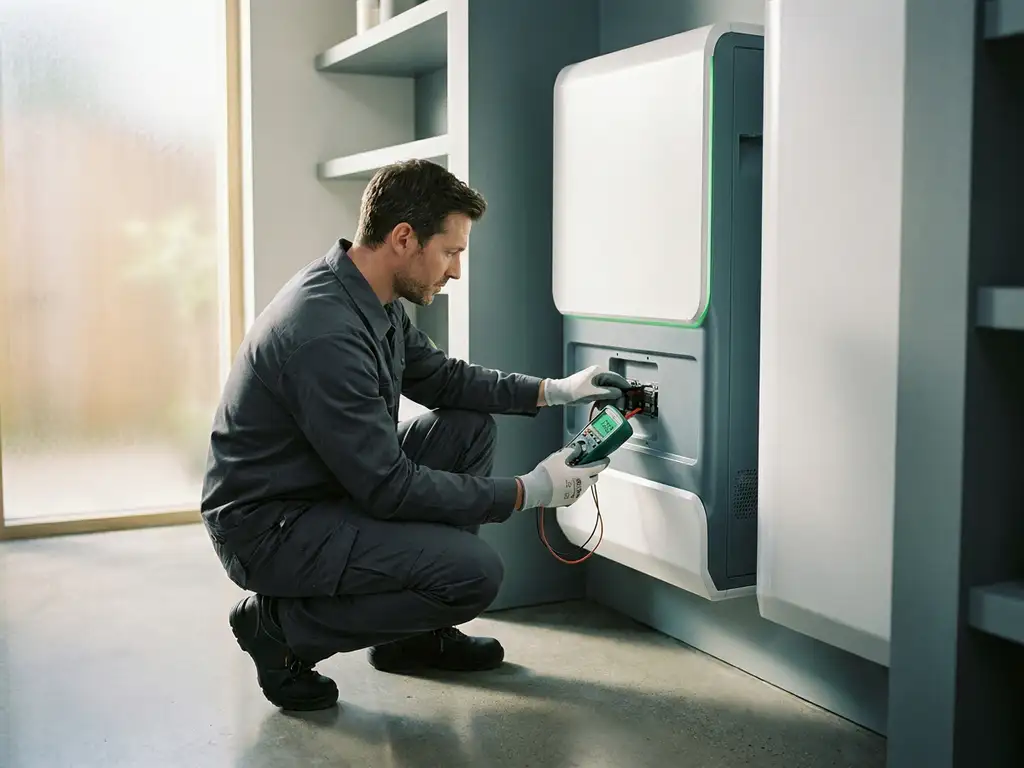
Professional inspections go well beyond what an owner can assess visually or through an app. A qualified technician will evaluate the full electrical installation, including cable integrity, connection tightness, fuse conditions, and earthing. Over time, vibration and thermal cycling can loosen connections, and even a slightly loose terminal can create resistance that degrades performance or poses a safety risk.
A thorough inspection also includes a capacity test to verify that the battery is still delivering close to its rated storage capacity. Battery degradation is a normal process, but a faster-than-expected drop in usable capacity may indicate a cell-level issue or a problem with the BMS. Technicians will also review inverter-battery communication and confirm that firmware is current.
For most home battery systems, a professional inspection every one to two years is a reasonable baseline. However, systems that are cycled heavily, exposed to extreme temperatures, or installed in demanding environments may benefit from annual checks. Installers who use a solar battery calculator during the design phase can also use capacity benchmarks established at installation as a reference point for future performance comparisons.
Temperature and environment factors that affect battery health
Temperature is one of the most significant variables in battery longevity. Lithium-based batteries perform best within a moderate temperature range, typically between 10°C and 35°C. Operating or storing a battery consistently outside this range accelerates degradation and can reduce the total number of charge cycles the system delivers over its lifetime.
In practice, this means the installation location matters enormously. Batteries installed in uninsulated garages, lofts, or outdoor enclosures in northern climates may experience cold-related performance drops in winter. In southern European markets, batteries installed in poorly ventilated spaces can suffer from heat stress during summer months. Both extremes shorten the effective lifespan of the system.
Humidity and condensation are secondary environmental concerns. While most modern battery enclosures carry a reasonable IP rating, persistent moisture exposure around cable entry points or in flood-prone areas can compromise the installation over time. Installers advising clients on placement should factor in seasonal temperature swings and ventilation conditions as part of the original site assessment, not as an afterthought during a maintenance visit.
Software updates and remote monitoring for home batteries
Modern home battery systems are increasingly software-driven, and keeping firmware current is a genuine maintenance requirement. Manufacturers regularly release updates that improve BMS algorithms, fix bugs, enhance grid interaction settings, and occasionally unlock new features. Skipping updates for extended periods can leave systems running on outdated logic that does not reflect current grid conditions or safety standards.
Remote monitoring platforms have transformed how both owners and installers interact with battery systems. Rather than waiting for a fault to become obvious, monitoring tools surface anomalies early, flagging unusual charge patterns, unexpected shutdowns, or communication errors between the battery and inverter. For installation businesses managing a large fleet of installed systems, remote monitoring is not a luxury. It is the infrastructure that makes proactive aftercare possible without sending a technician to every site.
Configuring monitoring alerts correctly at the time of installation pays dividends throughout the system’s life. Installers who establish clear alert thresholds and maintain access to client systems can respond to issues quickly, often resolving problems remotely or scheduling a targeted visit before the client is even aware of an issue.
Warning signs that your home battery needs attention
Even well-maintained systems can develop issues, and recognising the early warning signs is key to preventing minor faults from escalating. The most common indicators that a battery system needs professional attention include:
- Unexplained drops in usable capacity that are not accounted for by normal degradation curves
- Frequent error codes or fault alerts appearing in the monitoring app or on the BMS display
- Unusual heat emanating from the battery casing or surrounding wiring during normal operation
- Inconsistent charging behaviour, such as the system failing to reach full charge or discharging faster than expected under a known load
- Communication errors between the battery and the inverter or energy management system
- Physical changes to the casing, including swelling, discolouration, or any signs of leakage
Any of these signs warrants a prompt inspection rather than a wait-and-see approach. Battery faults left unaddressed can void warranties, reduce system safety, and in rare cases create more serious hazards. Installers who maintain ongoing aftercare relationships with their clients are far better positioned to catch and address these issues early.
How OpusFlow helps installers manage battery aftercare
Managing aftercare across a growing portfolio of installed battery systems is one of the more operationally complex challenges facing sustainable installation businesses. Tracking inspection schedules, monitoring alerts, warranty periods, and service histories across hundreds of client sites requires a level of coordination that spreadsheets and disconnected tools simply cannot support reliably.
OpusFlow is built specifically for installation companies operating in the sustainable energy sector, and our platform is designed to make aftercare management as structured and scalable as the installation process itself. Here is what we bring to battery aftercare operations:
- Asset Management module to track every installed battery system by client, location, installation date, and warranty status
- Planning and scheduling tools that allow service teams to organise inspection visits efficiently across multiple crews and regions
- Workflow Automations that trigger service reminders, follow-up tasks, or inspection scheduling based on asset age or monitoring alerts
- Customer Portal that keeps clients informed about their system status and upcoming service visits without manual communication overhead
- Project Management and Forms modules to standardise inspection checklists and capture field data consistently across every technician visit
- Toni, our AI agent, which helps teams surface insights, prioritise tasks, and manage aftercare workflows intelligently at scale
For companies looking to grow their installed base without proportionally growing their admin burden, structured aftercare management is a competitive advantage. Get in touch with our team to see how OpusFlow can support your business from first installation through to long-term aftercare.