The features that matter most to your business, compared side by side.


Most platforms track your projects. OpusFlow tracks your margins. Built from the ground up for solar and sustainable energy installers, it connects every job, every euro, and every team member in one system.
Below, we break down some of OpusFlow’s key capabilities that make it a powerful all-in-one alternative in the PV*SOL vs OpusFlow comparison.
OpusFlow’s native PV design functionality lets you create solar layouts without leaving your project workflow. Designs are connected to customer data, pricing, and project stages from the very beginning, removing the friction of disconnected design tools.
This means faster turnaround times, fewer handovers, and more reliable project data. Your team can move seamlessly from design to quote and into execution, keeping momentum high and avoiding costly rework or data mismatches.


OpusFlow is built to handle the full operational complexity of an installation business. Automation connects every phase, from lead intake and quoting to planning, procurement, invoicing, and post-installation support.
Tasks, reminders, documents, and status updates are triggered automatically as projects progress. Instead of manually pushing work forward, OpusFlow keeps everything moving in the background. This reduces delays, improves consistency, and frees your team from repetitive admin so they can focus on higher-value work.
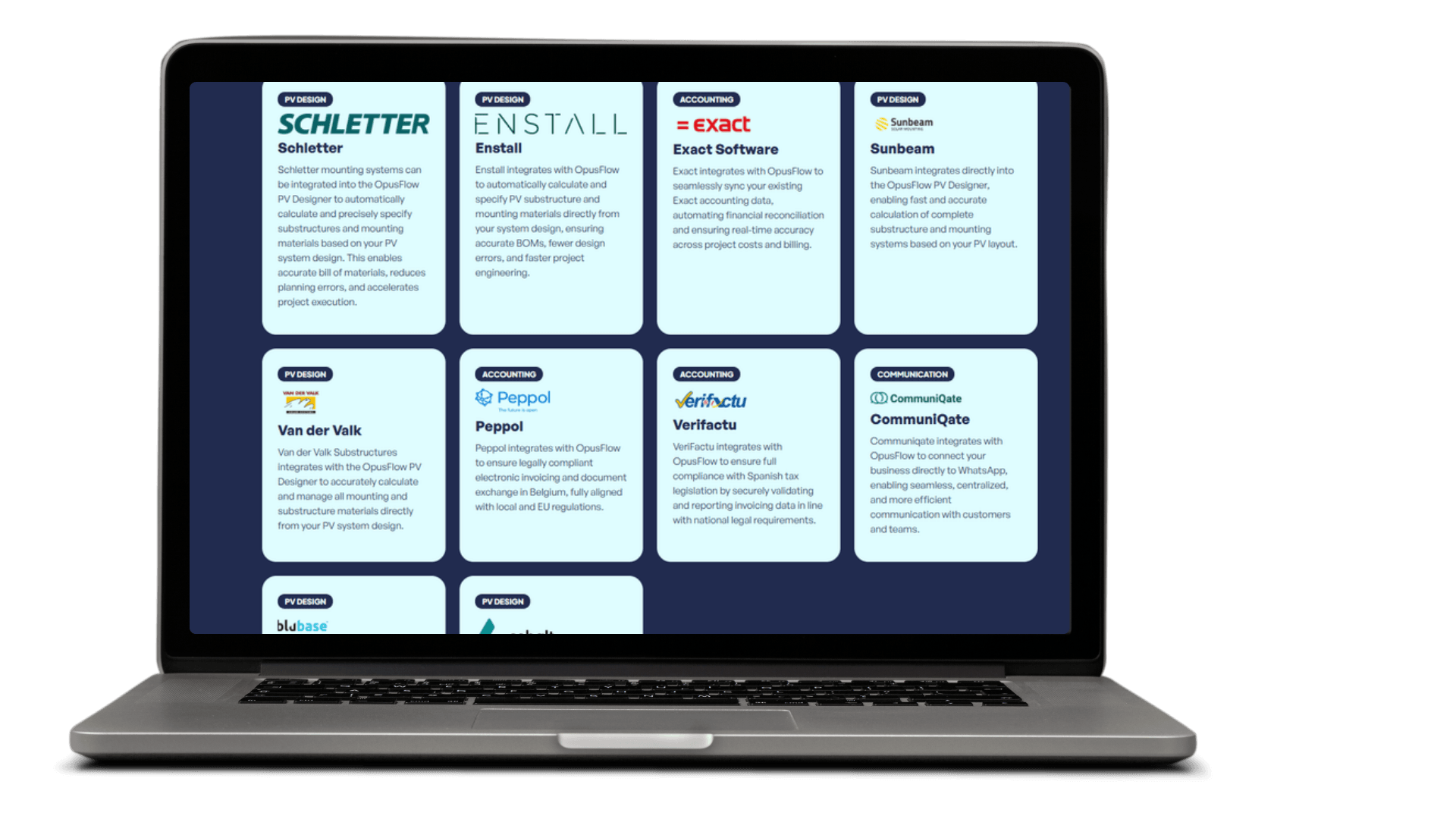
OpusFlow offers flexible API integrations that allow you to connect the platform with the tools and systems your business already relies on. Whether it’s accounting software, external data sources, reporting tools, or custom internal systems, OpusFlow can exchange data seamlessly across your tech stack.
This open approach means you’re not locked into rigid workflows. You can automate data flows, keep systems in sync, and build custom integrations as your business evolves. OpusFlow becomes the central hub of your operation while still fitting naturally into your existing ecosystem.
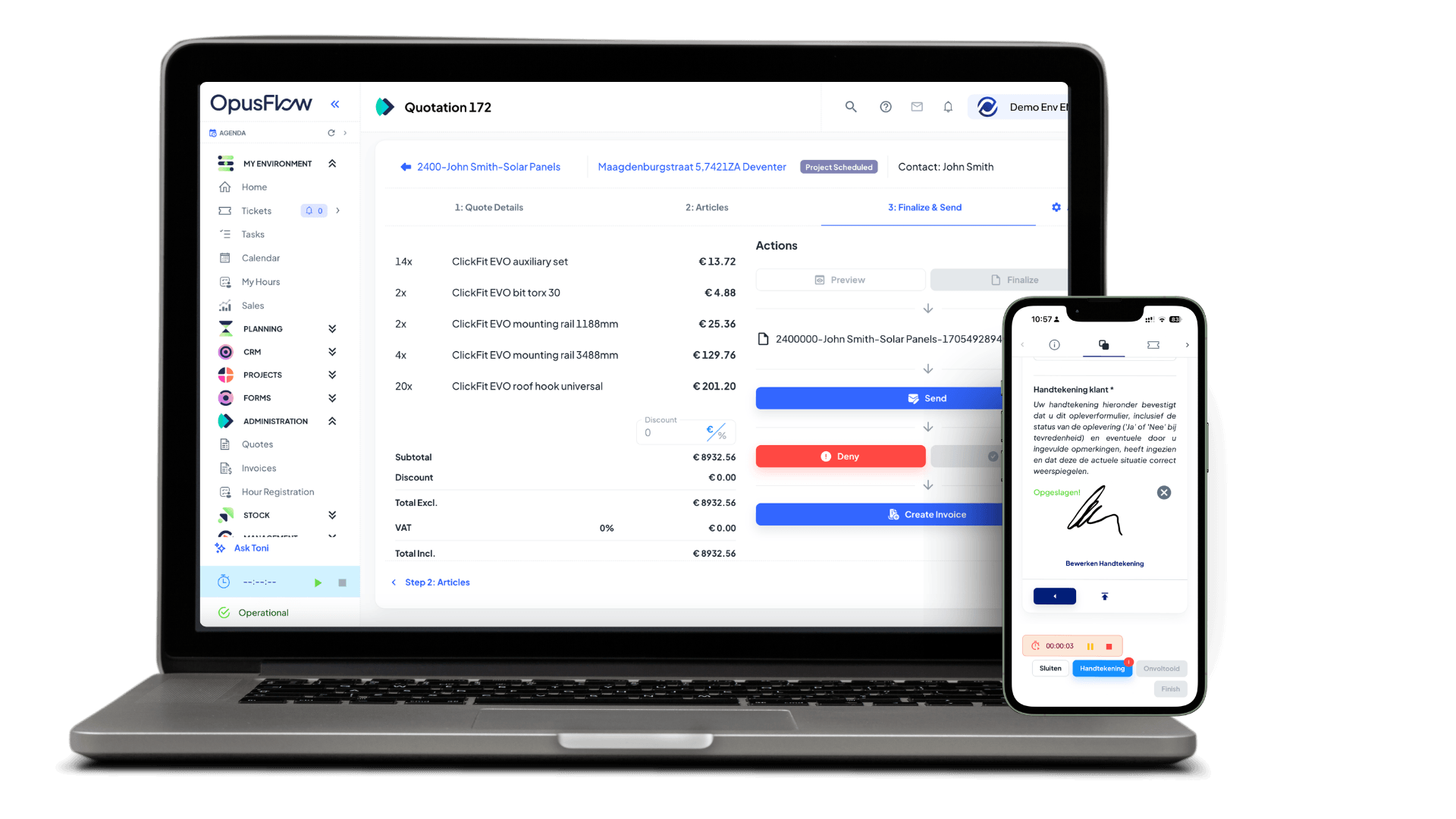
OpusFlow helps you manage the entire customer experience in one place. With an integrated CRM and Customer Portal your team always has full visibility of each project and customer interaction.
Customers receive clear updates, access key documents, and know exactly what to expect at every stage. Internally, your team avoids miscommunication and missing information. The result is a smoother journey, stronger trust, and a more professional experience that helps you win and retain more customers.
OpusFlow is designed for businesses that don’t want to stop at solar alone. The platform supports growth across multiple technologies, including solar, heat pumps, batteries, and future energy solutions.
As your business expands, OpusFlow scales with you. You can add users, manage higher project volumes, and maintain operational clarity without increasing complexity. This gives you the confidence to grow your offering while keeping control over processes, performance, and profitability.


Making the switch is a big decision. These companies made it, and here’s what changed.
Everything you want to know before booking a demo.
Yes. You can upgrade from monthly to annual at any time. Once your annual contract ends, you’re free to switch back to monthly if you prefer.
Yes. OpusFlow monitors initial response and resolution timelines against your configured targets and flags tickets that are approaching or past their deadline. Over time, the ticket data also surfaces patterns — recurring hardware issues, high-volume request types, or areas where response times consistently slip — giving your service management team the information they need to improve the process rather than just react to it.
Yes. The calculation follows the DIN EN 12831-1:2017 methodology, which is the recognised European standard for determining building heating load. It covers per-room heat loss including U-values, thermal bridges, ventilation, airtightness, and surface adjacency. The output is a DIN-compliant PDF report that includes a per-room breakdown, total heat demand, and the final hardware recommendation — suitable for use as supporting documentation with the customer or for your own internal records.
No, and it’s not designed to. OpusFlow handles everything up to the point of invoicing — project data, BOMs, hours, contracts, and administration — and then exports clean, structured financial data directly to your existing accounting package via API. Your accountant keeps working in the tool they already know. You just stop spending hours preparing the data they need.
Yes! You can add price lists, product prices and discounts directly in OpusFlow, so your team always works with the right figures when building a quote.
Yes, data migration is part of our onboarding process. Our import module lets us transfer almost any database from your current software, and your account manager will guide you through every step. Book a free demo to get started.
Yes. OpusFlow lets you create distinct user profiles with separate permission sets for internal team members, subcontractors, and any other user type you need. Subcontractors can be given access to only the specific modules and records relevant to their work, with no visibility into financial data, other clients, or internal processes. Access can be time-limited and revoked immediately when a project ends.
Browse more side-by-side comparisons and see the difference for yourself.
Get a live customized demo or discovery call focused on what your organization needs, get answers to your specific questions, and find out why OpusFlow is the right choice for your organization