The features that matter most to your business, compared side by side.


Most platforms track your projects. OpusFlow tracks your margins. Built from the ground up for solar and sustainable energy installers, it connects every job, every euro, and every team member in one system.
Below, we break down some of OpusFlow’s key capabilities that make it a powerful all-in-one alternative in the HelioScope vs OpusFlow comparison.
OpusFlow works as the central system for your entire installation business. Sales, project management, documents, planning, financials, and communication all live in one platform, giving your team a shared source of truth across every project.
Because everyone works with the same real-time data, teams stay aligned and informed at all times. Updates, task changes, and project progress are visible instantly, helping sales, operations, and installers stay synchronised and avoid costly miscommunication.
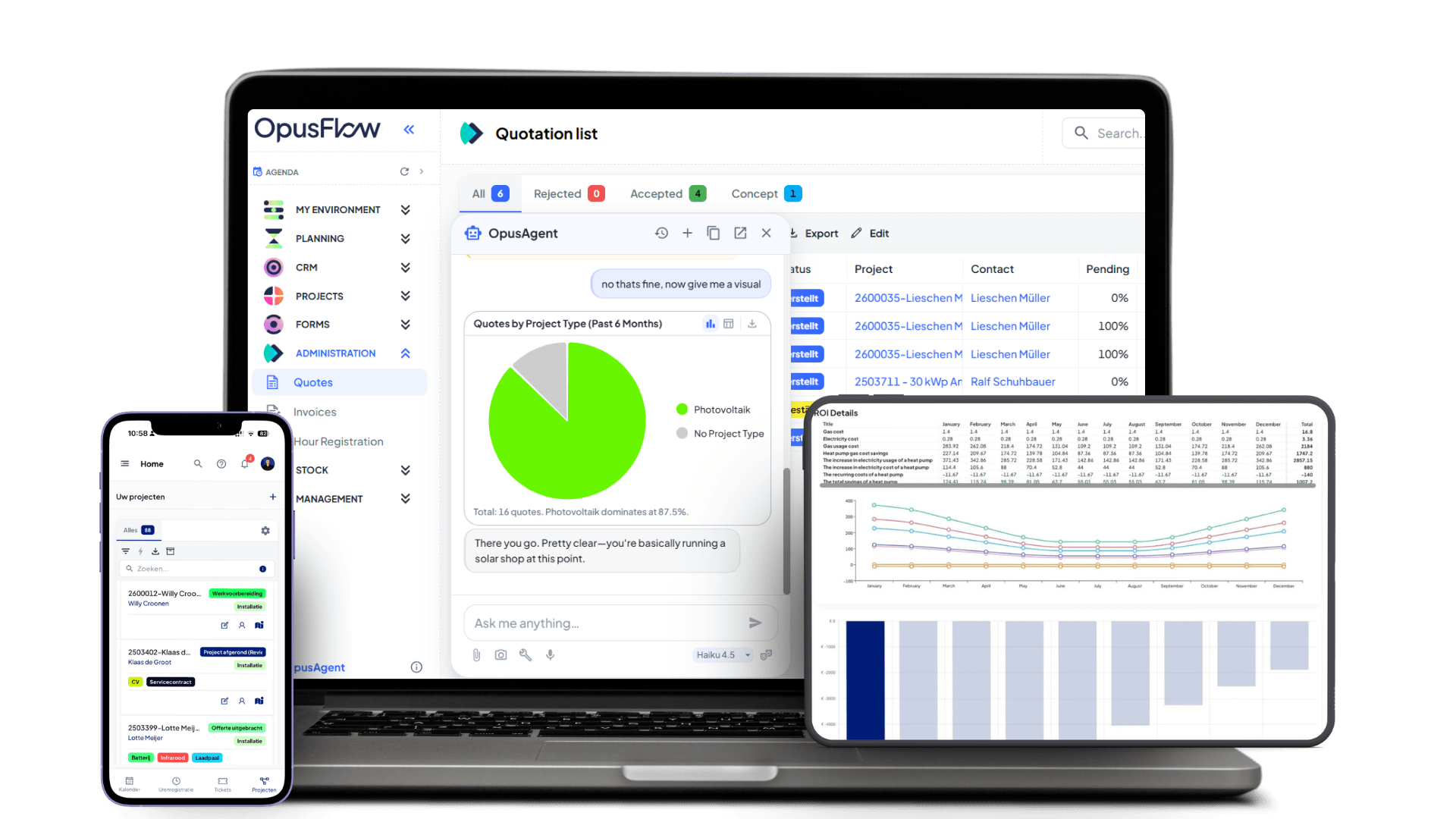
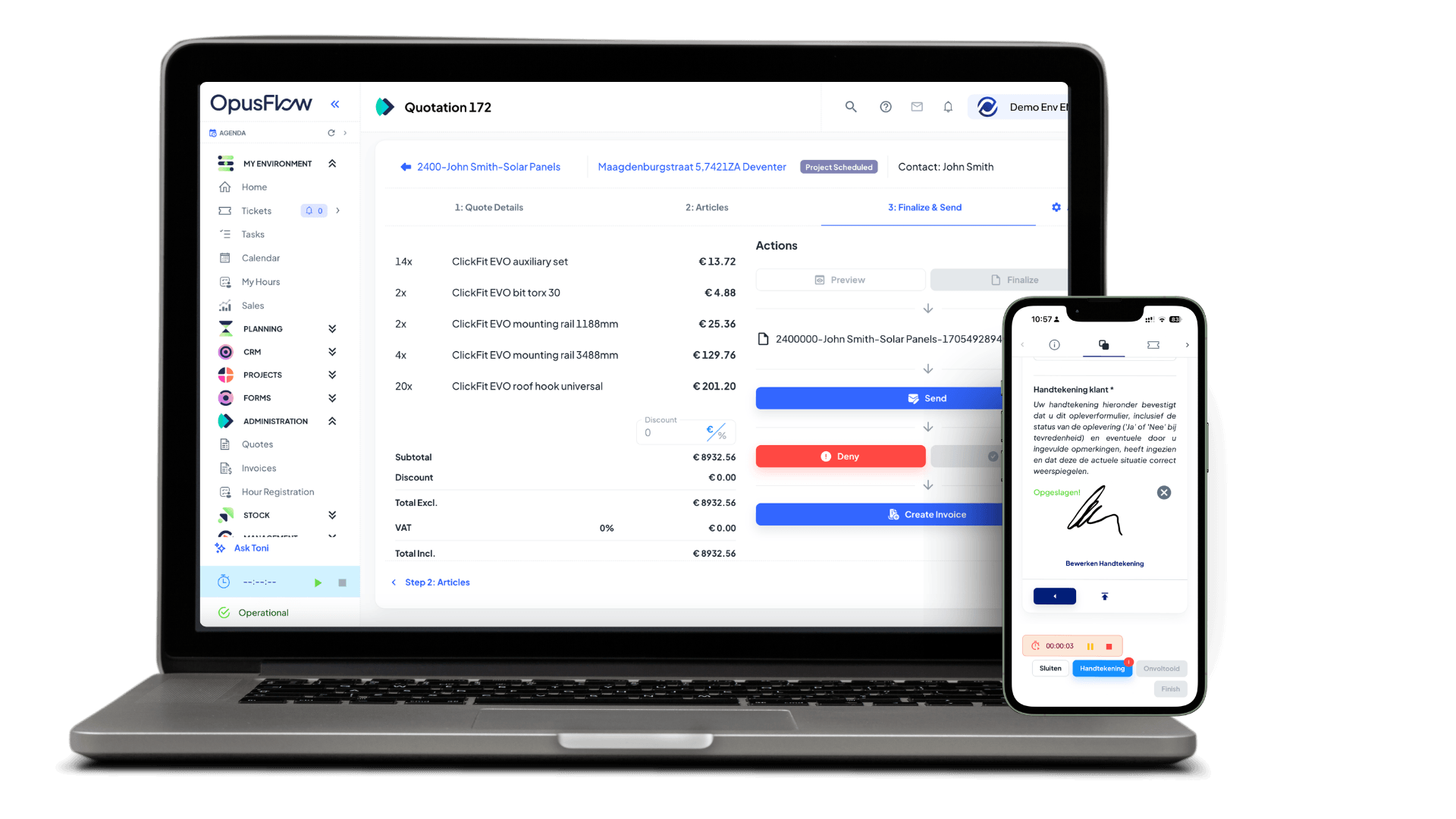
OpusFlow supports the full customer journey with built-in CRM functionality and a dedicated Customer Portal. Every interaction, document, and update is stored centrally, giving your team full context at every stage of the project.
Customers benefit from transparency and clarity. They can access documents, follow progress, and stay informed without chasing updates, while your team delivers a more professional, confident, and consistent experience.
OpusFlow is built for installation companies that grow beyond solar alone. The platform supports additional renewable technologies, including batteries and heat pumps, with dedicated calculators that help your team plan and quote complex systems accurately.
As your offering expands, OpusFlow adapts with you. You can manage different technologies, workflows, and project types in one system, giving you a scalable foundation for long-term growth.


OpusFlow automation is designed to connect every stage of your installation workflow without manual intervention. From the moment a lead enters the system, actions can be triggered automatically as projects progress through sales, planning, installation, and aftercare. Tasks are assigned, reminders are sent, documents are generated, and statuses are updated based on predefined rules that match how your business actually works.
By removing repetitive admin, OpusFlow frees your team to focus on high-impact work. Sales teams can concentrate on closing deals, project managers stay focused on delivery, and installers receive clear instructions at the right time. The result is a faster, more reliable operation that scales without adding complexity or extra overhead.
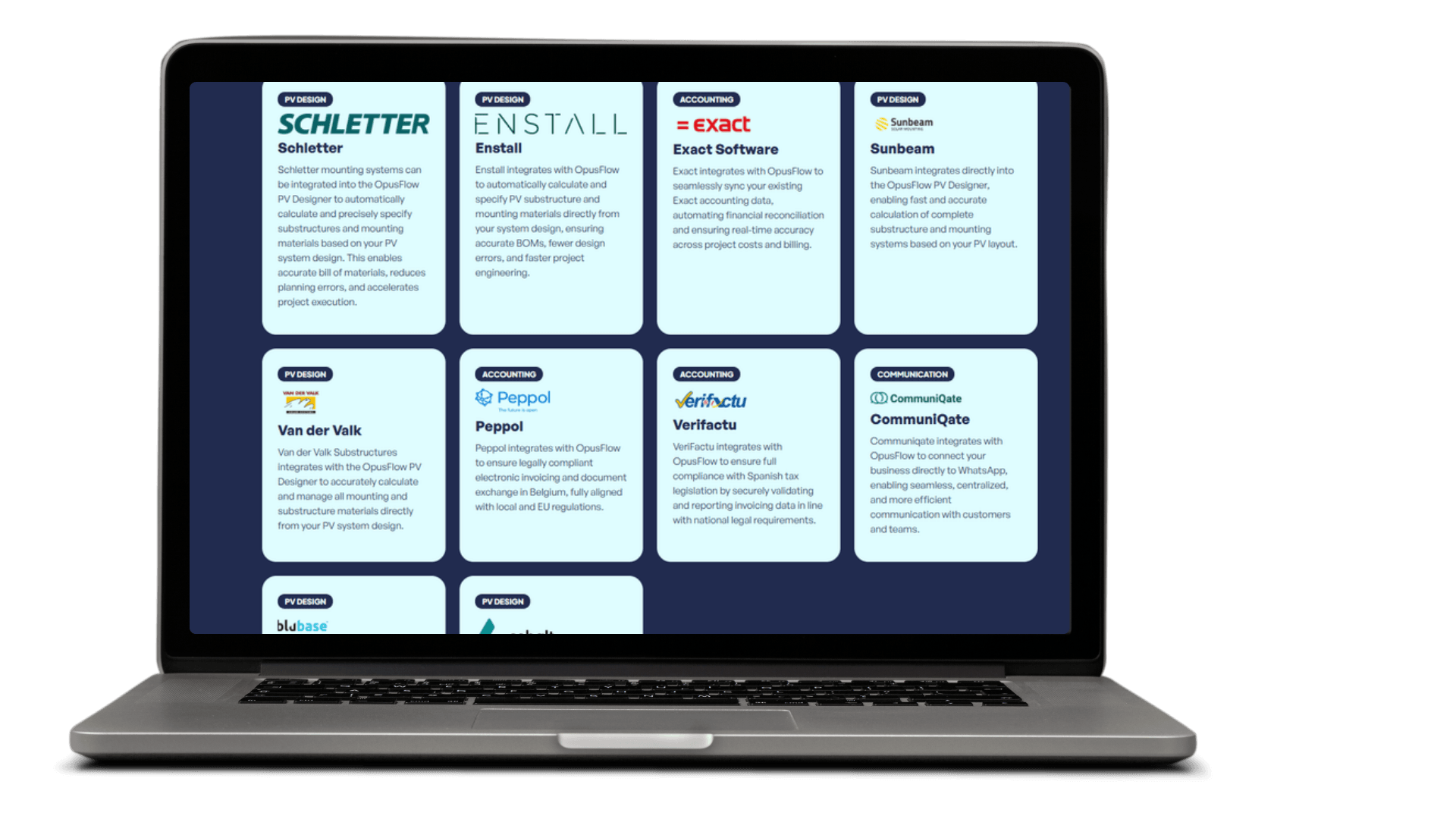
Through OpusFlow your business can connect with more than 6,000 external tools, allowing you to integrate the platform seamlessly into your existing tech stack. Accounting software, marketing tools, reporting systems, and custom applications can all exchange data automatically.
These integrations make OpusFlow flexible and future-ready. You keep the tools you rely on while OpusFlow acts as the operational hub that ties everything together and keeps data flowing smoothly across your business.

Making the switch is a big decision. These companies made it, and here’s what changed.
Everything you want to know before booking a demo.
The customer portal is a branded, self-service environment where your customers can track their installation progress, access documents, view appointment dates, and submit service requests — without needing to call or email your team. It’s available 24/7 and runs directly from OpusFlow, so everything your customer sees is always up to date.
OpusFlow tracks backorder status at the order line level and feeds the expected delivery date directly into project scheduling. That means a delay from a supplier surfaces in the planning view before it becomes an install-day problem, giving your team time to source an alternative or reschedule rather than discovering the shortage on the morning of the job.
Yes. Field technicians clock in and out against specific projects directly from the OpusFlow mobile app. Those hours appear in real time in the back-office view, feed into project cost tracking, and route through your approval workflow before they’re finalized. No paper, no WhatsApp messages, and no end-of-month reconstruction from memory.
Yes! OpusFlow is an ERP system built specifically for sustainable installers. Beyond the full ERP suite, it includes industry-specific tools like a PV Designer and Battery Calculator. All designed to work together in one platform.
You can refer professional solar installers and companies working with renewable energy technologies, such as HVAC, battery storage, and EV charging. The ideal referral is an installer with 10+ employees who manages multiple projects and could benefit from running their operations more efficiently with OpusFlow.
Yes. Ticket types are fully configurable, so you can set up categories that match how your business handles after-sales — for example Warranty, Maintenance, or Complaint. Each ticket also carries a priority level, so your team always has a clear view of what needs attention first and can filter and manage the queue accordingly.
Both. Field technicians get a mobile-first experience. Their daily schedule, job brief, materials list, and digital forms are all on their phone before they leave the depot. They can submit checklists, capture photos, collect signatures, and log hours directly on-site. No paper, no Friday-afternoon catch-up.
Browse more side-by-side comparisons and see the difference for yourself.
Get a live customized demo or discovery call focused on what your organization needs, get answers to your specific questions, and find out why OpusFlow is the right choice for your organization