



Installers lose time by hunting for the right file, resending documents that already exist, and apologising to clients because something slipped through the cracks. OpusFlow puts an end to that.
When someone moves on, so does their filing logic, their inbox threads, and the documents only they knew how to find. You are left rebuilding from scratch and hoping nothing critical is missing.
There are three versions of that contract sitting in different folders, and nobody is quite sure which one the client actually signed. So you send one, the client references another, and the conversation turns into a mess nobody has time for.
You end up emailing large attachments, chasing delivery confirmations, and re-sending things that got buried. There is no clean way to hand over documents without it becoming a back-and-forth.
Documents are stored against the project, not the person. When someone leaves, nothing gets lost.
Every document is stored and updated centrally, so your whole team is always working from the same file.
Documents can be shared instantly from within the project, with full control over who sees what.
Installers lose time by hunting for the right file, resending documents that already exist, and apologising to clients because something slipped through the cracks. OpusFlow puts an end to that.
When someone moves on, so does their filing logic, their inbox threads, and the documents only they knew how to find. You are left rebuilding from scratch and hoping nothing critical is missing.
Documents are stored against the project, not the person. When someone leaves, nothing gets lost.
There are three versions of that contract sitting in different folders, and nobody is quite sure which one the client actually signed. So you send one, the client references another, and the conversation turns into a mess nobody has time for.
Every document is stored and updated centrally, so your whole team is always working from the same file.
You end up emailing large attachments, chasing delivery confirmations, and re-sending things that got buried. There is no clean way to hand over documents without it becoming a back-and-forth.
Documents can be shared instantly from within the project, with full control over who sees what.


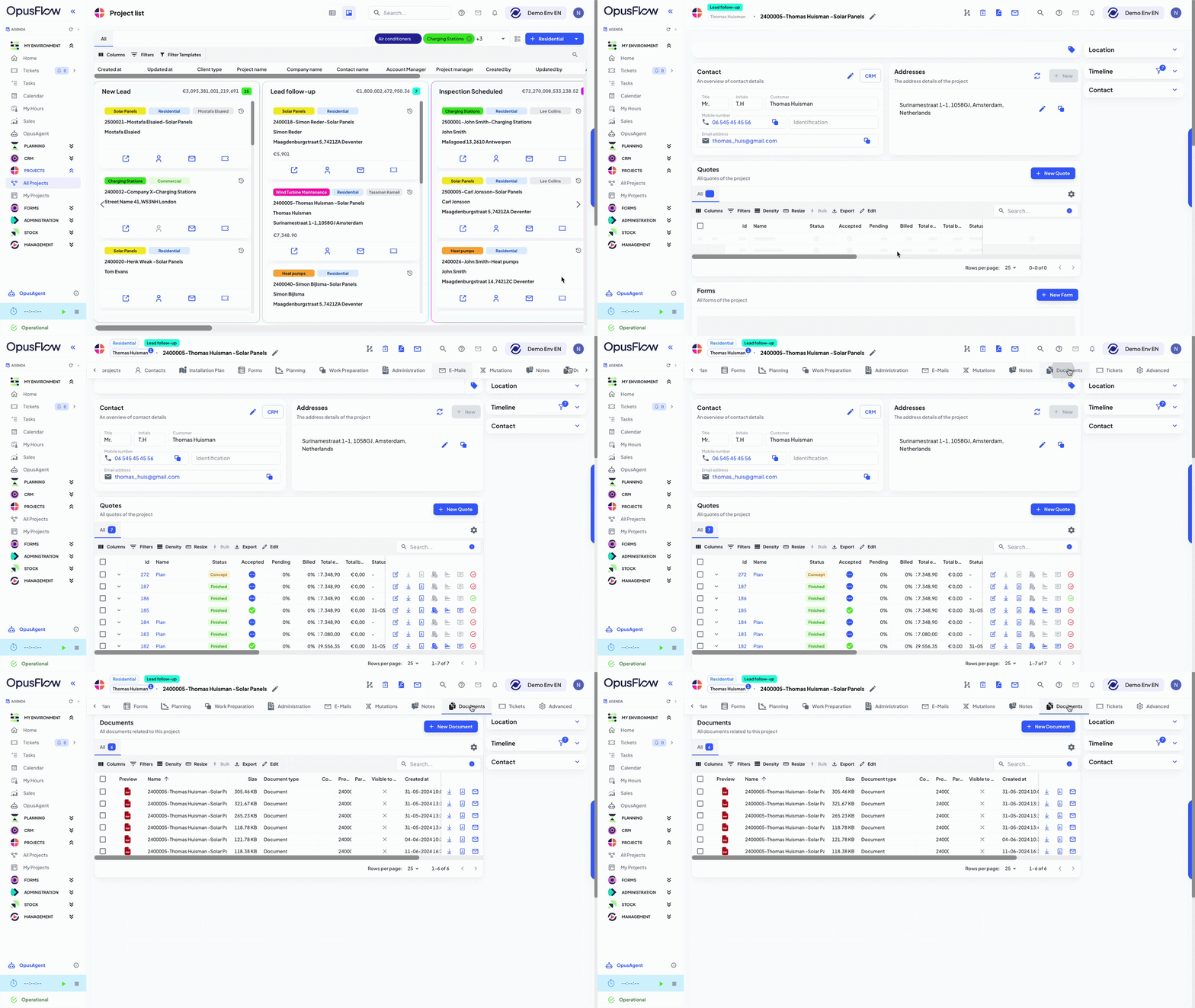
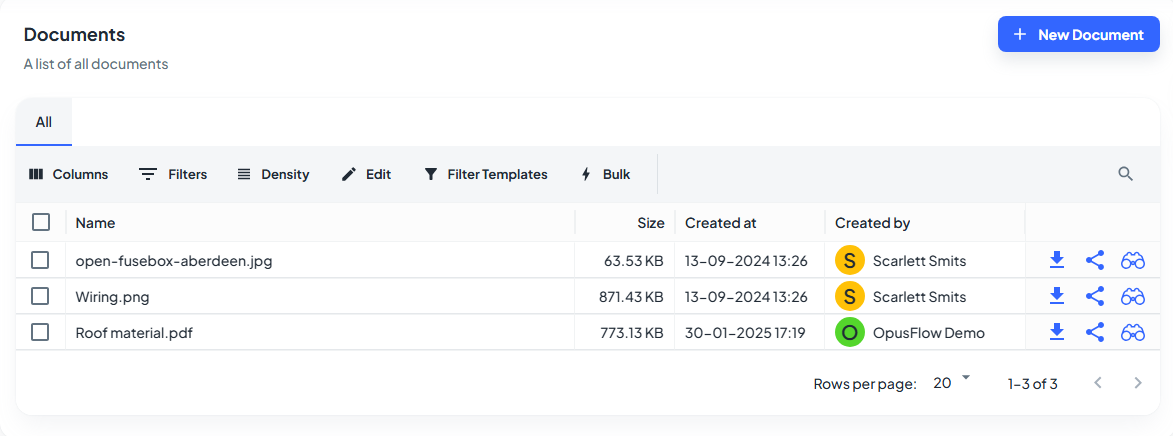
Every document you upload is automatically linked to the right project. OpusFlow creates and organises files across employees, projects, customers, and suppliers from a single action. Your team always finds the most up-to-date version without asking anyone.
OpusFlow connects natively with Google Workspace, Microsoft 365, Exact, Mollie, and more, so your team hits the ground running, not starting over.
Move away from paper and scattered digital files by bringing all your documents into OpusFlow. Quotations, contracts, forms, correspondence and invoices are digitised and stored centrally, accessible from any device. Your whole team works from the same source of truth, reducing miscommunication and keeping every department aligned.
Everything you want to know before booking a demo.
The customer portal is a branded, self-service environment where your customers can track their installation progress, access documents, view appointment dates, and submit service requests — without needing to call or email your team. It’s available 24/7 and runs directly from OpusFlow, so everything your customer sees is always up to date.
OpusFlow lets you create service and maintenance contracts, send them to customers for digital signature, and then automate the entire billing cycle that follows. Once a contract is active, invoices generate and payments are collected on the schedule you define — without anyone on your team needing to trigger it manually. It is designed to turn one-off installation projects into predictable, recurring revenue without adding to your team’s workload.
Yes. OpusFlow’s Multi-Entity Finance feature lets you manage multiple companies, labels, or subsidiaries from a single account. Each entity gets its own branding, invoice number sequences, payment terms, and accounting integration. Projects and quotes are automatically linked to the correct entity, so there’s no risk of invoices going out under the wrong logo or routing to the wrong general ledger.
A document management system brings all your communication and information flows together in one place. All data and documents are stored in a single database, and you decide yourself who has access.
Yes. OpusFlow monitors stock levels across your primary warehouses, service vehicles, and any forward staging locations in real time. Every movement — inbound receipt, outbound deployment, or internal transfer between locations — is recorded in an immutable timestamped log. Items can be tracked by barcode, supplier SKU, or your own internal identifier, so you always know exactly where each product is across your entire operation.
Three-way matching is the process of validating a purchase order against the warehouse goods receipt and the supplier invoice to confirm they all align before payment is approved. OpusFlow handles this automatically, flagging any discrepancies between what was ordered, what arrived, and what the supplier is billing. It removes a significant source of invoice errors and gives your finance team a clean, auditable trail for every purchase.
Project management software helps you plan, organize and manage your projects from start to finish. OpusFlow is built specifically for sustainable installers, so every feature fits the way you actually work.
Yes! You can easily attach photos and files directly to your forms, straight from your phone or tablet on-site.
Yes! The planning module is linked to your stock, so you can reserve inventory for upcoming projects and always know exactly what is coming in and going out.
When a project is confirmed, OpusFlow reserves the required stock against that project automatically, based on the Bill of Materials. The reservation is hard — meaning those items cannot be allocated to another project, eliminating the double-allocation problem that causes install-day shortages. Stock levels across your warehouses, vehicles, and staging locations all update in real time so you always have an accurate picture of what is actually available.
You can migrate a large part of your data to OpusFlow via a fixed Excel template. It is worth considering whether all your historical data still needs to be active in the system, as you can always choose to store older data elsewhere and start with a clean slate in OpusFlow.
Yes. Ticket types are fully configurable, so you can set up categories that match how your business handles after-sales — for example Warranty, Maintenance, or Complaint. Each ticket also carries a priority level, so your team always has a clear view of what needs attention first and can filter and manage the queue accordingly.
Yes! At every stage of a project you have a clear overview of the status, budget, timeline and all relevant documents, so you always know exactly where things stand.
Yes. The customer portal displays a visual milestone tracker showing exactly where the project stands, from initial survey through to commissioning. The indicators update in real time as your team progresses the project in OpusFlow, so customers always have an accurate picture without needing to chase your team for an update.
Yes. Field technicians clock in and out against specific projects directly from the OpusFlow mobile app. Those hours appear in real time in the back-office view, feed into project cost tracking, and route through your approval workflow before they’re finalized. No paper, no WhatsApp messages, and no end-of-month reconstruction from memory.
Our team knows the product inside out. Ask us anything — no sales pressure, no scripts.
Get a live customized demo or discovery call focused on what your organization needs, get answers to your specific questions, and find out why OpusFlow is the right choice for your organization


