The features that matter most to your business, compared side by side.


Most platforms track your projects. OpusFlow tracks your margins. Built from the ground up for solar and sustainable energy installers, it connects every job, every euro, and every team member in one system.
Below, we break down some of OpusFlow’s key capabilities that make it a powerful all-in-one alternative in the RatedPower vs OpusFlow comparison.
OpusFlow unifies the core systems your installation business relies on into a single platform. Quotations, solar design, purchasing, stock control, invoicing, project management, document handling, and internal coordination all work from the same shared data.
This connected setup eliminates silos and reduces operational friction. With everything in one place, your team gains better visibility, smoother handovers, and a more reliable workflow from start to finish.
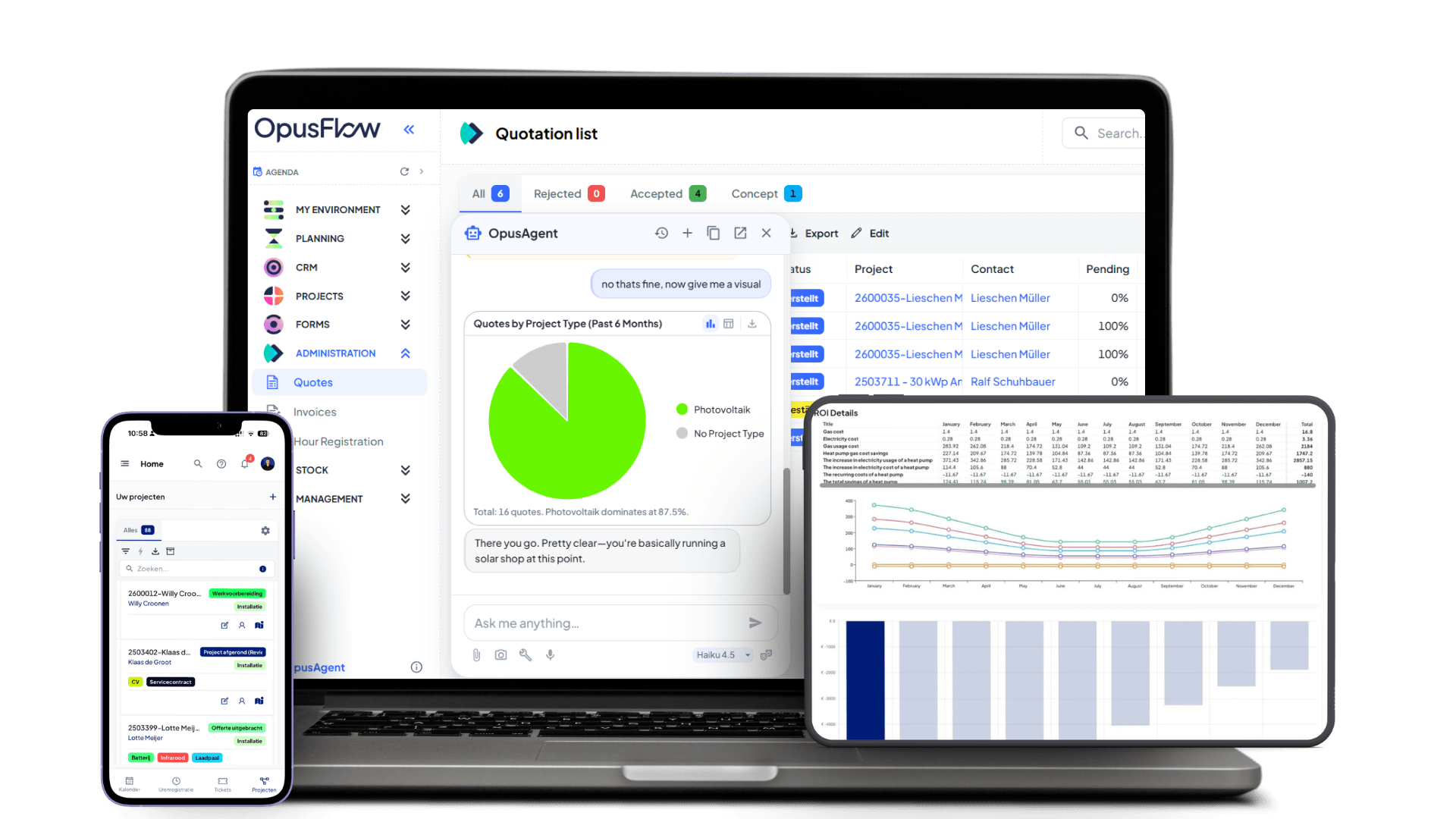
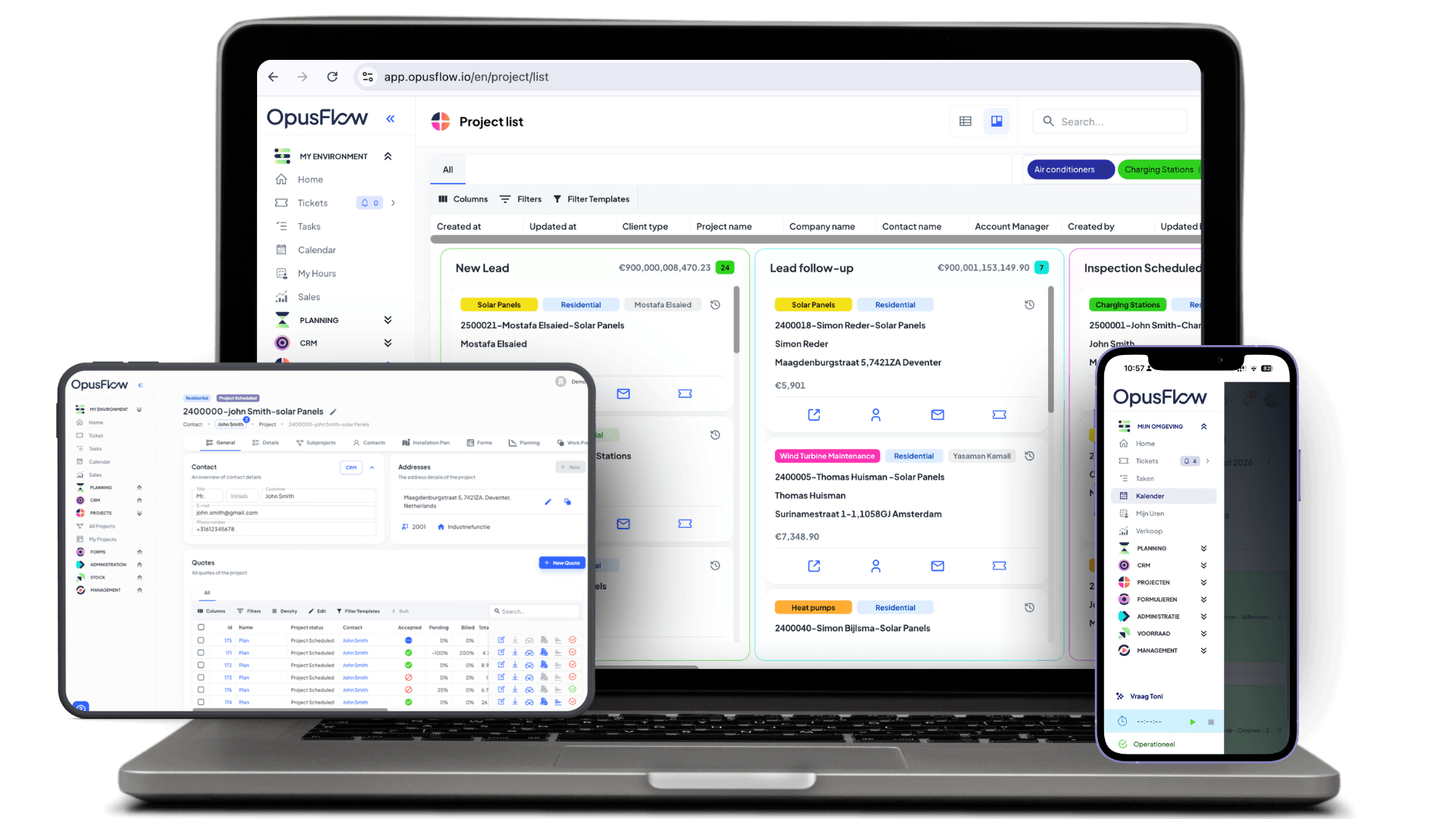
OpusFlow centralises all customer information, communication, and project history, giving your team a complete overview at every stage. From first enquiry to final delivery and follow-up, everything related to the customer is easy to access and manage.
This clarity helps your team respond faster and communicate more consistently. Customers benefit from a professional, transparent experience, while your business builds stronger relationships and long-term trust.
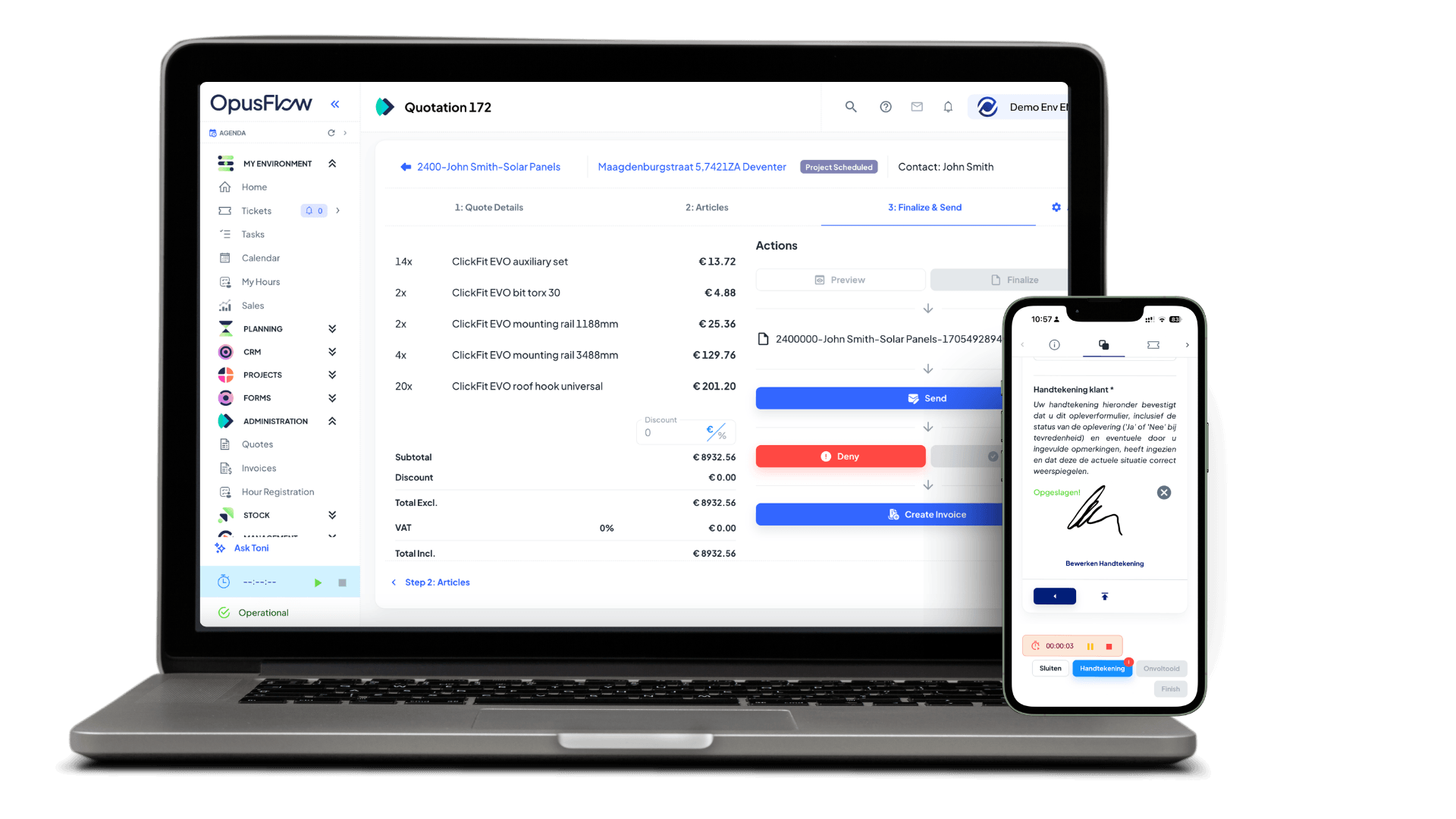
OpusFlow simplifies the quoting process by connecting customer data, system details, and pricing logic in one place. Your team can generate accurate, professional quotations quickly without repetitive manual steps.
Faster quoting means quicker responses to leads and higher chances of winning projects. OpusFlow helps you move from enquiry to proposal with speed and confidence, giving your business a competitive advantage.

OpusFlow is designed to support installation companies as they expand into additional renewable technologies. The platform handles projects involving heat pumps, battery storage, EV chargers, wind turbines, and other energy solutions within the same operational framework.
As your services grow, OpusFlow adapts without increasing complexity. You can manage different technologies, workflows, and teams while maintaining structure and control across the business.
OpusFlow automation tools reduce manual effort by handling routine actions across your workflow. As projects progress, tasks are created, updates are triggered, and reminders are sent automatically, keeping work on track without constant oversight.
This automation improves consistency and reliability. Your team spends less time managing processes and more time delivering high-quality installations.


Making the switch is a big decision. These companies made it, and here’s what changed.
Everything you want to know before booking a demo.
Yes, data migration is part of our onboarding process. Our import module lets us transfer almost any database from your current software, and your account manager will guide you through every step. Book a free demo to get started.
Yes. A single automation can span multiple modules — for example, when an installation is marked complete in project management, it can trigger an invoice in finance, create a follow-up task for the sales team, and send a completion notification to the customer portal simultaneously. Workflows aren’t limited to one department, and you can build approval chains that route between teams as part of the same sequence.
Yes! You can create and save your own time standards in OpusFlow and apply them directly to any calculation.
OpusFlow tracks backorder status at the order line level and feeds the expected delivery date directly into project scheduling. That means a delay from a supplier surfaces in the planning view before it becomes an install-day problem, giving your team time to source an alternative or reschedule rather than discovering the shortage on the morning of the job.
Yes. OpusFlow lets you create distinct user profiles with separate permission sets for internal team members, subcontractors, and any other user type you need. Subcontractors can be given access to only the specific modules and records relevant to their work, with no visibility into financial data, other clients, or internal processes. Access can be time-limited and revoked immediately when a project ends.
OpusFlow currently integrates with Google Workspace, Microsoft 365, Mollie for payment processing, the Dutch 2BA product catalog, Exact and Peppol for accounting and e-invoicing, and AEAT for the Spanish market. For tools not on this list, the open API allows you to build custom integrations and connect OpusFlow to virtually any platform in your existing stack.
Yes! All your employees can log their hours directly in OpusFlow via the mobile web app. Time registrations are linked to projects, so you always have a clear picture of project profitability including labor costs.
Browse more side-by-side comparisons and see the difference for yourself.
Get a live customized demo or discovery call focused on what your organization needs, get answers to your specific questions, and find out why OpusFlow is the right choice for your organization