The features that matter most to your business, compared side by side.


Most platforms track your projects. OpusFlow tracks your margins. Built from the ground up for solar and sustainable energy installers, it connects every job, every euro, and every team member in one system.
Below, we break down some of OpusFlow’s key capabilities that make it a powerful all-in-one alternative in the Gaussol vs OpusFlow comparison.
OpusFlow is designed as a single platform that covers the full lifecycle of an installation project. Sales activities, project planning, documentation, communication, and financial processes all live in one connected environment, eliminating the need to switch between multiple tools.
With one system as the backbone of your business, information stays consistent and accessible across teams. This reduces errors, improves collaboration, and gives you clear oversight of everything that’s happening, from first lead to final delivery.
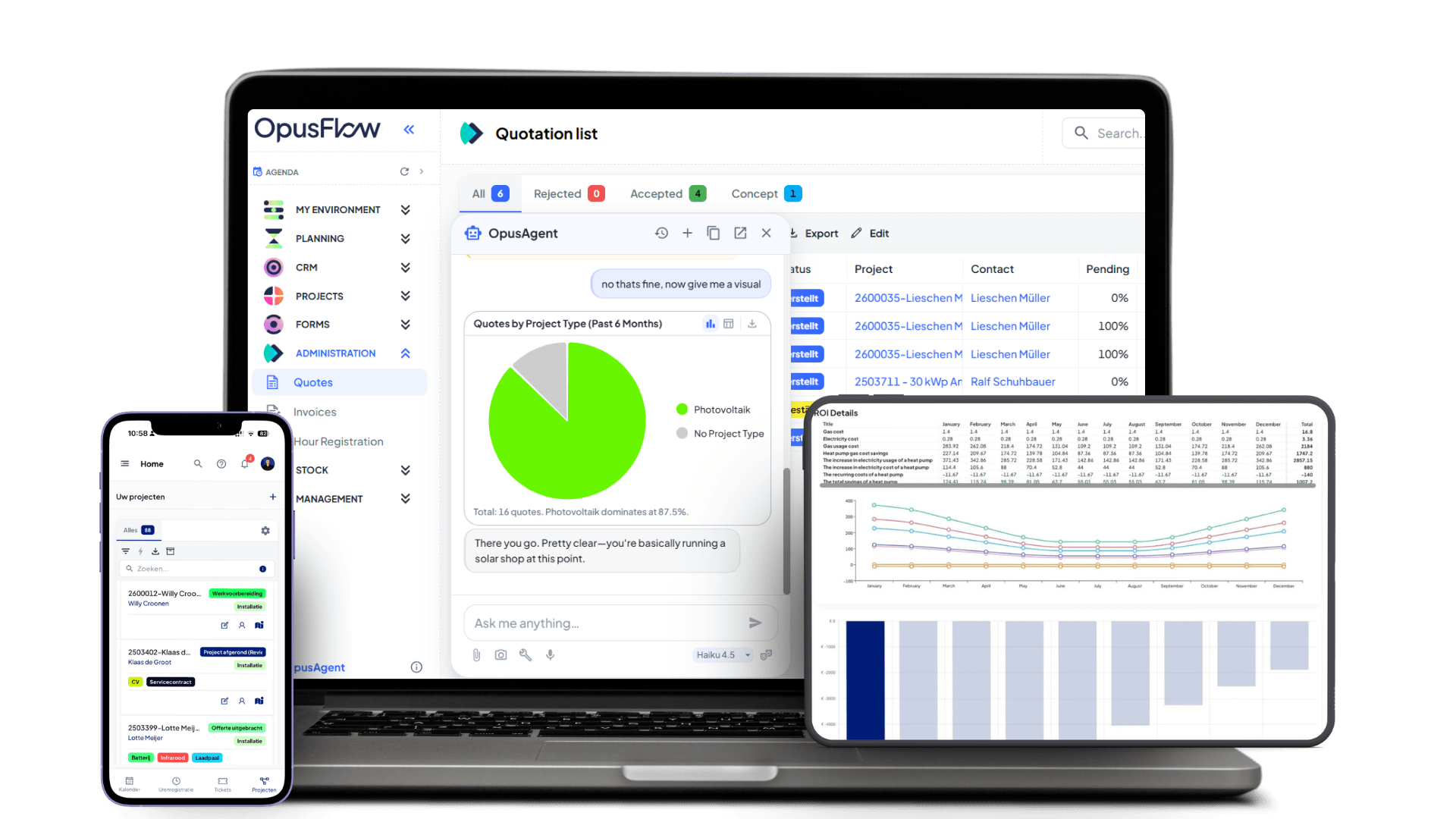
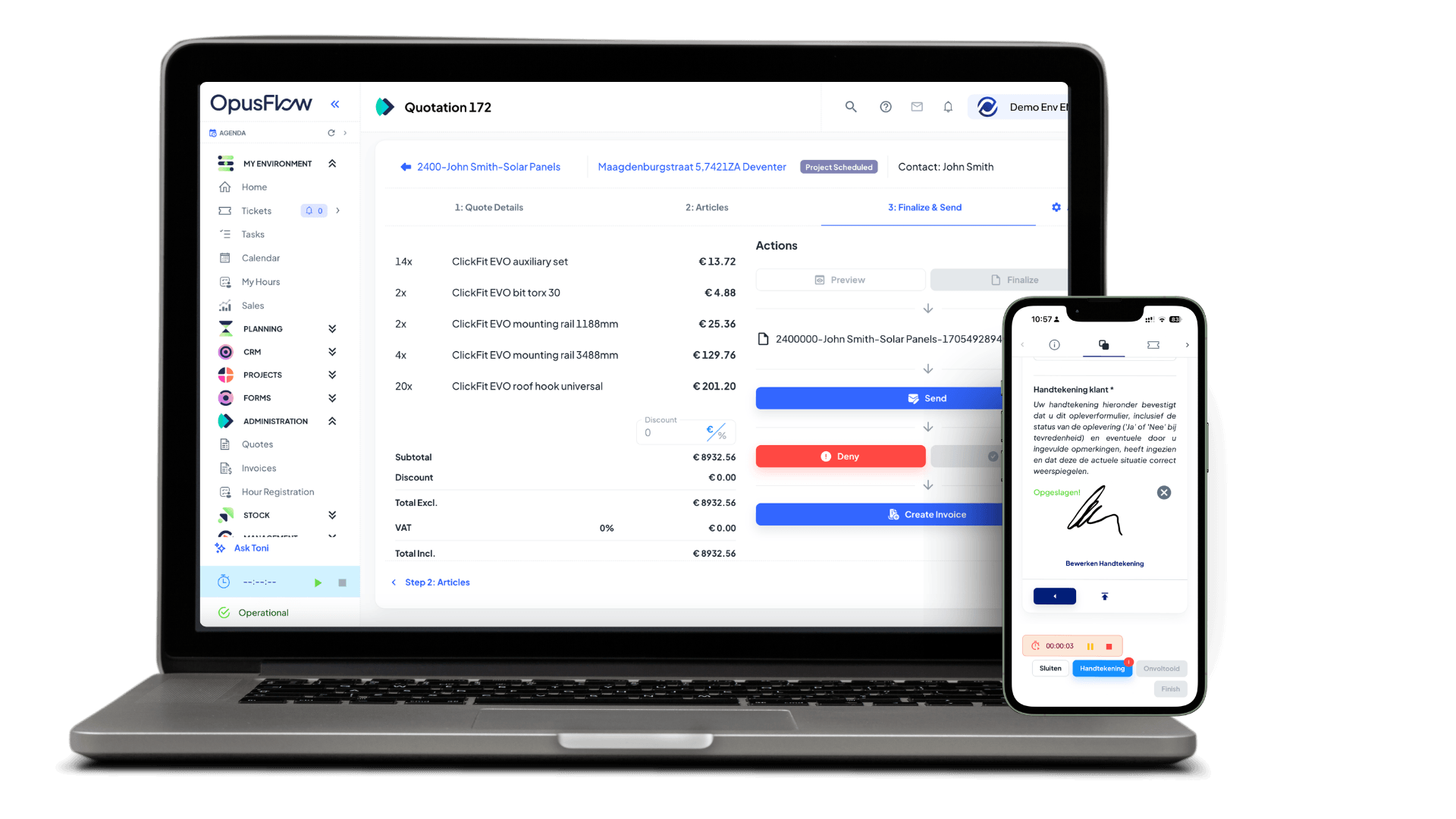
OpusFlow helps you manage customer relationships with clarity and structure throughout the entire journey. All interactions, documents, and project updates are stored centrally, giving your team a complete view of each customer at every stage.
Customers benefit from clear communication through Customer Portal, timely updates, and easy access to information, while your team avoids miscommunication and duplicated work. This structured approach builds trust, improves satisfaction, and supports long-term customer relationships.
OpusFlow is built for installation businesses that want to expand beyond solar. The platform supports a wide range of renewable technologies, including heat pumps, battery storage, EV chargers, wind turbines, and future energy solutions.
As your offering grows, OpusFlow adapts without adding complexity. You can manage different project types, technologies, and teams within the same system, giving you the flexibility to grow your business while maintaining operational control.


OpusFlow automation tools help streamline everyday operations by removing manual steps from your workflow. Tasks, reminders, updates, and follow-ups are triggered automatically as projects progress through different phases.
This automation improves reliability and consistency across projects. Your team spends less time coordinating work and more time delivering results, allowing the business to operate faster without increasing workload.
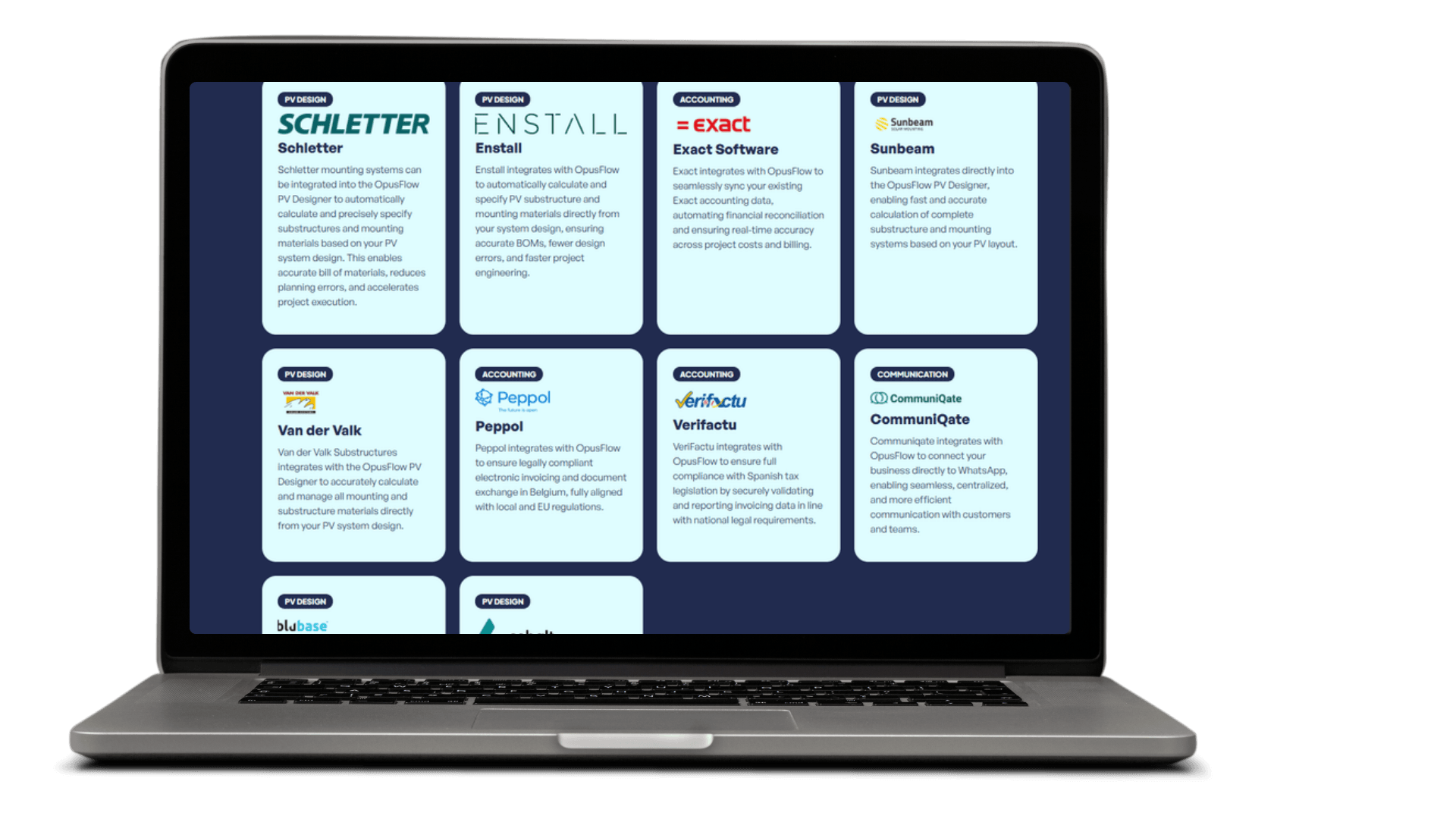
OpusFlow integrates with over 6,000 external tools, allowing you to connect the platform seamlessly with the systems you already use. From accounting and CRM tools to marketing, analytics, and custom software, data can flow automatically between platforms.
These integrations give you flexibility and future-proof your setup. OpusFlow becomes the central operational hub of your business while remaining open and adaptable to your evolving technology stack.

Making the switch is a big decision. These companies made it, and here’s what changed.
Everything you want to know before booking a demo.
Yes. OpusFlow lets you create distinct user profiles with separate permission sets for internal team members, subcontractors, and any other user type you need. Subcontractors can be given access to only the specific modules and records relevant to their work, with no visibility into financial data, other clients, or internal processes. Access can be time-limited and revoked immediately when a project ends.
You can configure leave types such as vacation, sick leave, and personal leave, each with their own rules and accrual settings. Employees submit requests through a calendar view that shows their own balances and any existing approved leave. Managers approve or reject via a dedicated workflow and approved leave is immediately reflected on the planning calendar. The module also surfaces working-hours compliance warnings in hour registrations, so break and shift rules are checked as hours are logged rather than after the fact.
Yes. The calculation follows the DIN EN 12831-1:2017 methodology, which is the recognised European standard for determining building heating load. It covers per-room heat loss including U-values, thermal bridges, ventilation, airtightness, and surface adjacency. The output is a DIN-compliant PDF report that includes a per-room breakdown, total heat demand, and the final hardware recommendation — suitable for use as supporting documentation with the customer or for your own internal records.
OpusFlow supports Single Sign-On (SSO) and Multi-Factor Authentication (MFA) for all users. Every login event and critical data action is recorded in an immutable audit log that cannot be edited or deleted. Role-based access control ensures users only interact with the data and modules relevant to their role. For businesses operating across multiple entities, each company can be managed with independent access configurations under the same overarching account.
OpusFlow tracks backorder status at the order line level and feeds the expected delivery date directly into project scheduling. That means a delay from a supplier surfaces in the planning view before it becomes an install-day problem, giving your team time to source an alternative or reschedule rather than discovering the shortage on the morning of the job.
Yes! All your employees can log their hours directly in OpusFlow via the mobile web app. Time registrations are linked to projects, so you always have a clear picture of project profitability including labor costs.
When a project reaches the invoicing stage, OpusFlow pulls the line items directly from the project’s Bill of Materials and generates the invoice automatically, with correct quantities, pricing, and totals already populated. For service contracts, you set a billing frequency at the start and the system generates and sends invoices on schedule without anyone triggering it manually. A built-in dry-run mode lets you simulate a billing cycle before it goes live.
Browse more side-by-side comparisons and see the difference for yourself.
Get a live customized demo or discovery call focused on what your organization needs, get answers to your specific questions, and find out why OpusFlow is the right choice for your organization