The features that matter most to your business, compared side by side.


Most platforms track your projects. OpusFlow tracks your margins. Built from the ground up for solar and sustainable energy installers, it connects every job, every euro, and every team member in one system.
Below, we break down some of OpusFlow’s key capabilities that make it a powerful all-in-one alternative in the Ezzing Solar vs OpusFlow comparison.
OpusFlow gives your business a clear and structured way to manage customer relationships through a dedicated CRM model and Customer Portal. All customer data, conversations, documents, and project updates are stored in one place, giving your team full visibility throughout the entire lifecycle of a project.
This centralised approach helps your team stay organised and responsive. Customers experience clearer communication and faster responses, while your business benefits from stronger relationships and better long-term retention.
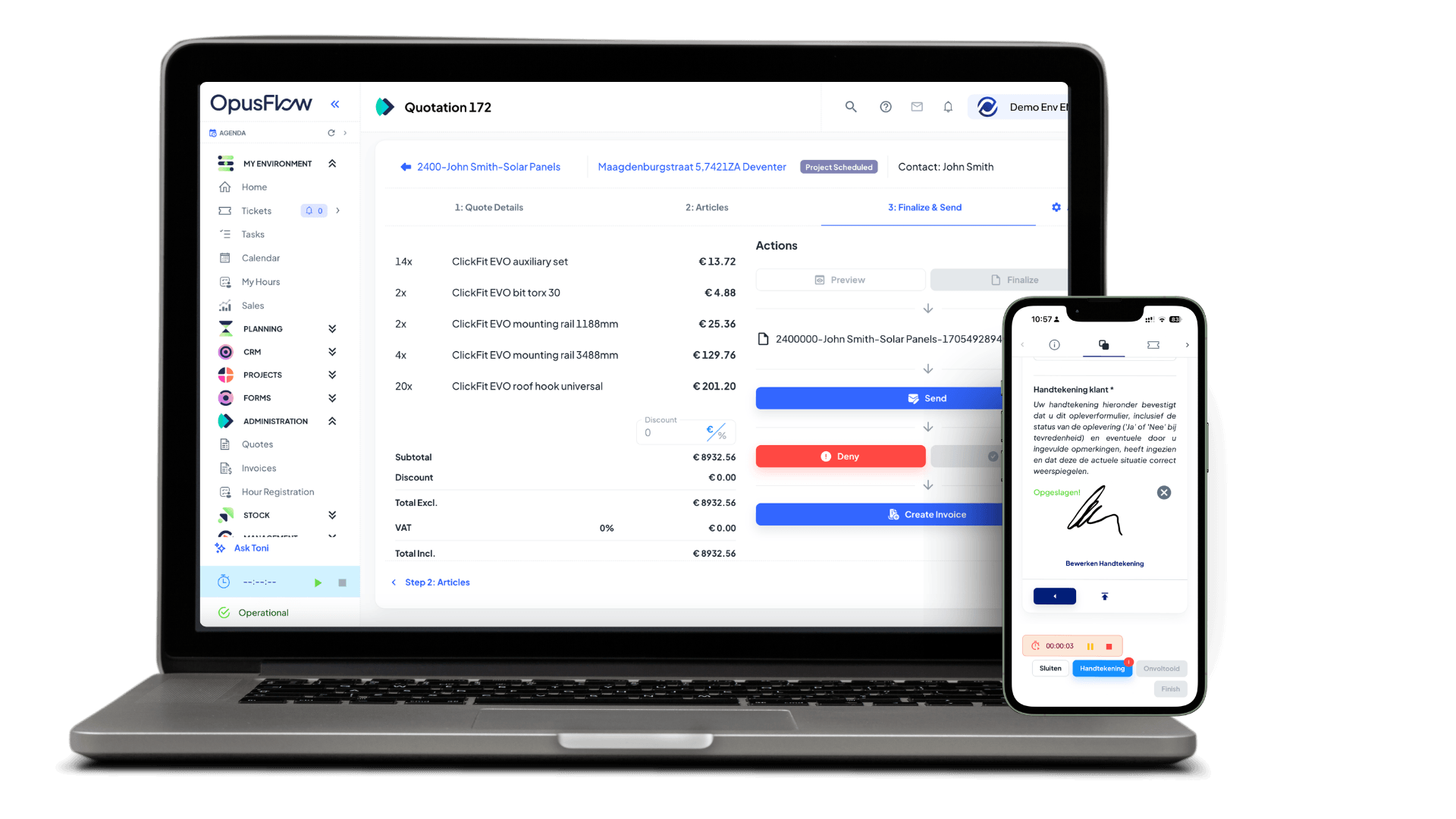
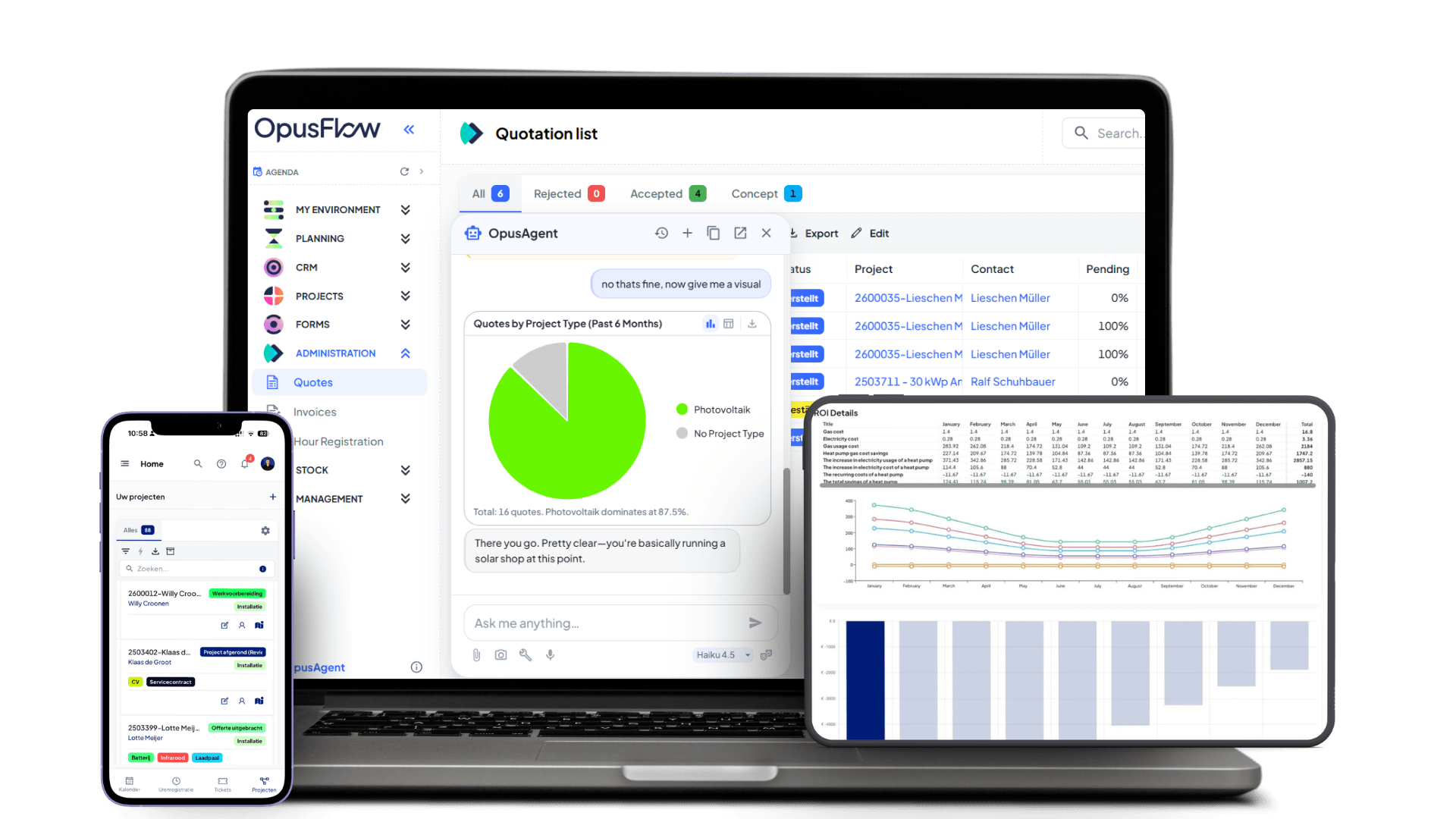
OpusFlow goes far beyond basic operations by bringing together quotations, solar design, purchasing, stock control, invoicing, project management, document handling, and internal communication in one system. Every department works from the same connected data.
By eliminating fragmented tools and disconnected processes, OpusFlow improves efficiency and reduces errors. Your team gains a complete overview of each project, allowing work to flow smoothly from sale to installation and billing.
OpusFlow is built for installation businesses that want to expand beyond solar alone. The platform supports projects involving heat pumps, battery storage, EV chargers, wind turbines, and other renewable technologies within the same operational structure.
As your service offering grows, OpusFlow adapts without adding complexity. You can manage different technologies, workflows, and teams in one platform, giving you a scalable foundation for long-term growth.


OpusFlow reduces manual workload by automating repetitive tasks across your workflow. Tasks, reminders, updates, and approvals are triggered automatically as projects move through different stages.
This automation improves consistency and reliability across your operations. Your team spends less time coordinating and more time delivering results, while OpusFlow ensures that every step is executed on time.
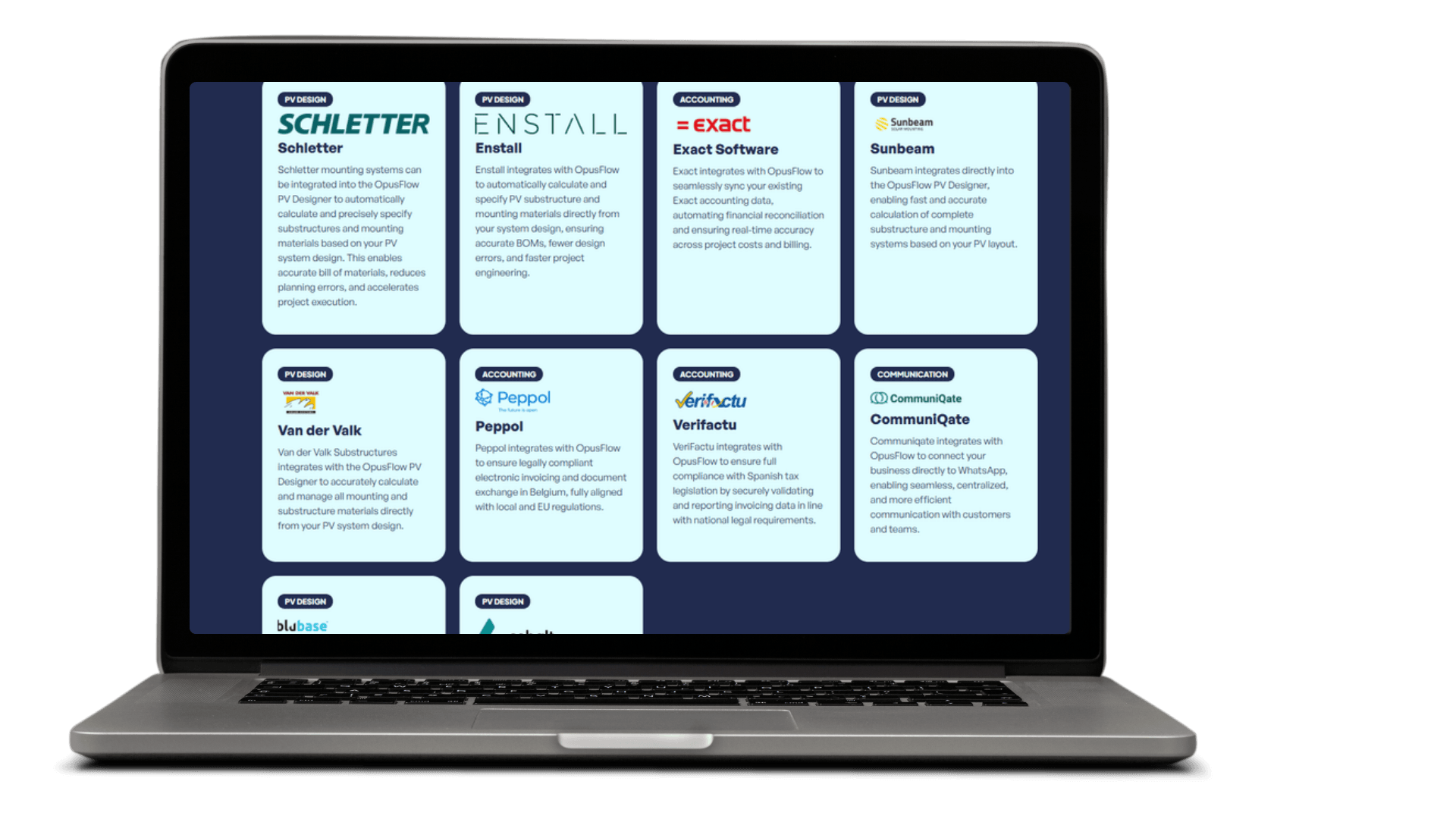
Open API of OpusFlow allows you to connect your platform with over 6000 tools, a software ecosystem you already use. Accounting systems, communication tools, marketing platforms, and custom solutions can all exchange data automatically.
These integrations keep your business flexible and future-ready. OpusFlow acts as the central operational hub while remaining open to the tools and technologies that support your unique workflows.

Making the switch is a big decision. These companies made it, and here’s what changed.
Everything you want to know before booking a demo.
OpusFlow lets you create service and maintenance contracts, send them to customers for digital signature, and then automate the entire billing cycle that follows. Once a contract is active, invoices generate and payments are collected on the schedule you define — without anyone on your team needing to trigger it manually. It is designed to turn one-off installation projects into predictable, recurring revenue without adding to your team’s workload.
The calculator is designed to be used by sales consultants on-site, not heat pump engineers. The 3D scan does the heavy lifting for room geometry, the input flow guides the consultant through the remaining variables, and the output is generated automatically from there. The plain-language recommendation is specifically written to be read straight to the customer without requiring the consultant to interpret technical data. Most teams are comfortable running a full assessment independently after a single walkthrough of the tool.
Yes! You can easily put together teams in OpusFlow and schedule them directly on projects, all from within the planning module.
OpusFlow accepts scans from iPhone Pro (via LiDAR), Matterport, Polycam, and other scanners that export in OBJ, STL, GLTF, or GLB formats. The scan is processed directly in the browser — no file upload to a server is required, which keeps the process fast and keeps your customer data on-device during the calculation.
Every ticket has a built-in conversation thread where your team and the customer can exchange messages directly. The full history is stored chronologically and cannot be edited or deleted, so there is always a clear, accurate record of what was said and when. No more hunting through email chains to piece together what happened.
Generic tools aren’t built around the way installation businesses work. OpusFlow includes industry-specific features out of the box; PV system design, energy simulation, BOM-to-purchase-order automation, subsidy tracking, and field forms with on-site signatures. You don’t need to configure workarounds for things that should already be there.
Yes. OpusFlow includes a built-in PV designer, energy simulation engine, heatpump and ROI calculator. Your sales consultants can design the system, model a 25-year financial projection, and hand the client a professional proposal all in a single appointment, without waiting for back-office sign-off.
Browse more side-by-side comparisons and see the difference for yourself.
Get a live customized demo or discovery call focused on what your organization needs, get answers to your specific questions, and find out why OpusFlow is the right choice for your organization