The features that matter most to your business, compared side by side.


Most platforms track your projects. OpusFlow tracks your margins. Built from the ground up for solar and sustainable energy installers, it connects every job, every euro, and every team member in one system.
Below, we break down some of OpusFlow’s key capabilities that make it a powerful all-in-one alternative in the Arka360 vs OpusFlow comparison.
OpusFlow brings all core business operations together in a single ERP-style platform designed for installers. Sales workflows, project management, financial processes, documentation, logistics, automations, CRM, and internal coordination all work from the same connected system.
This unified approach gives your business clarity and control. Teams avoid fragmented tools, data stays consistent, and management gains a complete overview of performance and progress across the organisation.
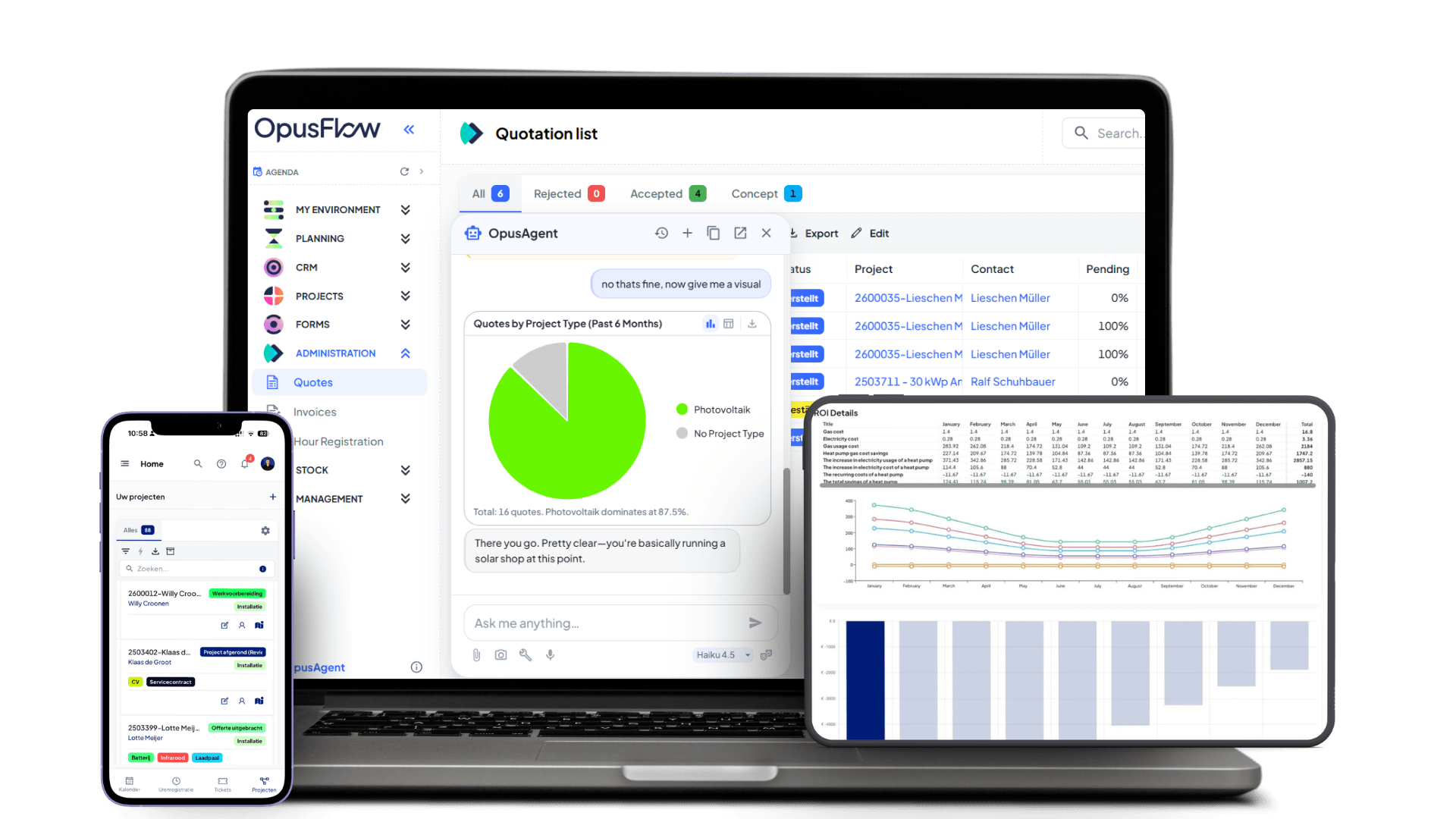
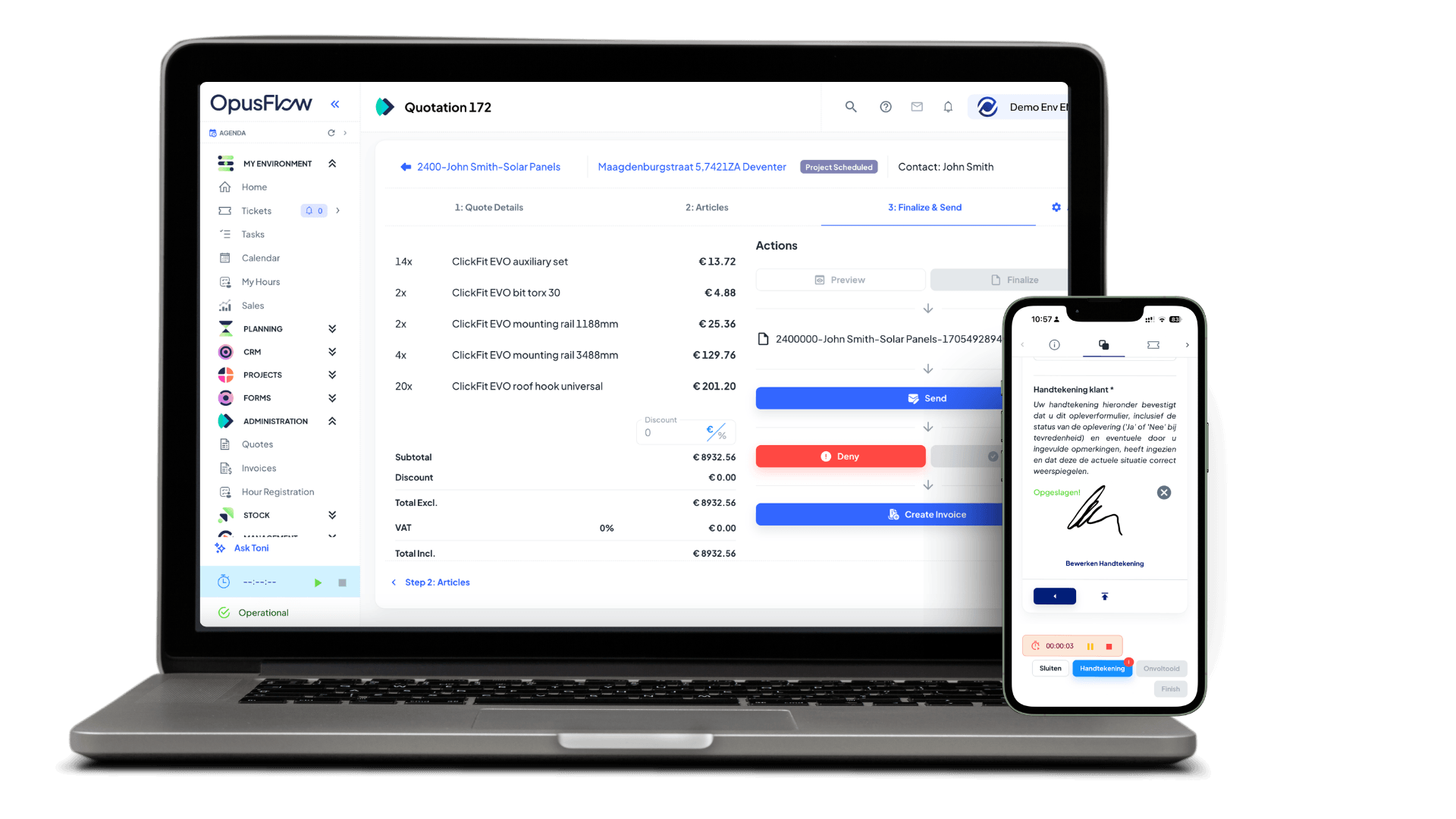
OpusFlow centralises customer data, communication, and project history, giving your team full context at every interaction. Built-in CRM functionality ensures that conversations, documents, and commitments are easy to track and manage.
With clearer communication and faster responses through the Customer Portal, customers feel supported throughout the process. This structured approach improves satisfaction, strengthens trust, and creates long-term customer relationships.
OpusFlow is built for renewable installation businesses that expand beyond solar. The platform supports batteries, heat pumps, EV chargers, wind turbines, and other energy technologies, with dedicated battery and heat pump calculators to support accurate system sizing.
These tools help your team design and price complex projects with confidence. As your offering grows, OpusFlow grows with you, providing a scalable foundation that adapts to new technologies and services.


OpusFlow automation removes repetitive manual tasks from daily operations. As projects move through different stages, tasks, reminders, and updates are triggered automatically based on your workflows.
This automation ensures consistency and keeps projects moving without constant follow-up. Your team can focus on delivery and customer care while OpusFlow handles routine operational steps.
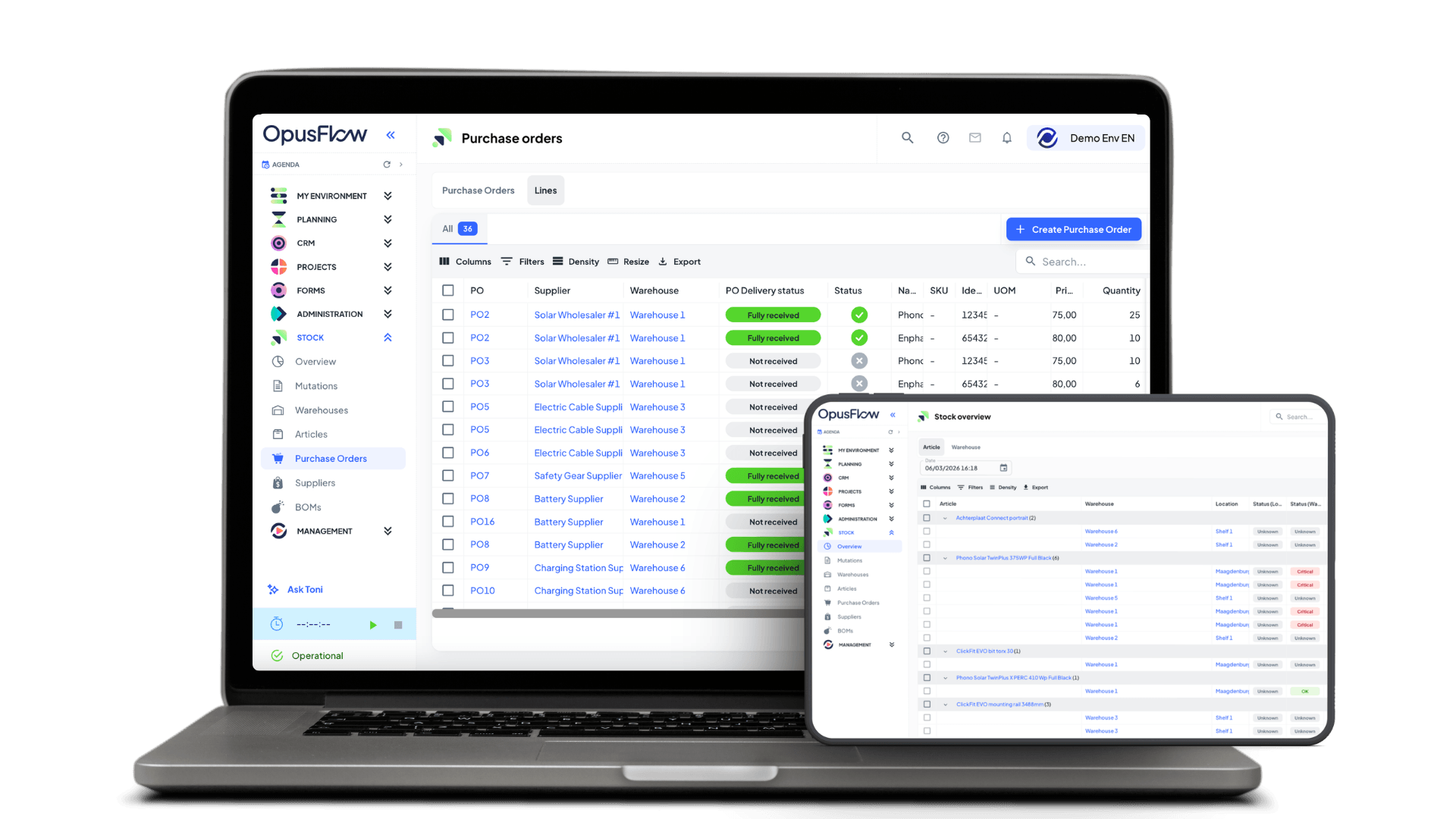
OpusFlow gives you real-time visibility into purchasing and inventory by linking materials directly to projects. Stock levels, orders, and usage are always up to date, helping your team plan installations more reliably.
With one source of truth, you avoid shortages, over-ordering, and last-minute delays. Warehouse operations become more predictable and better aligned with project schedules.
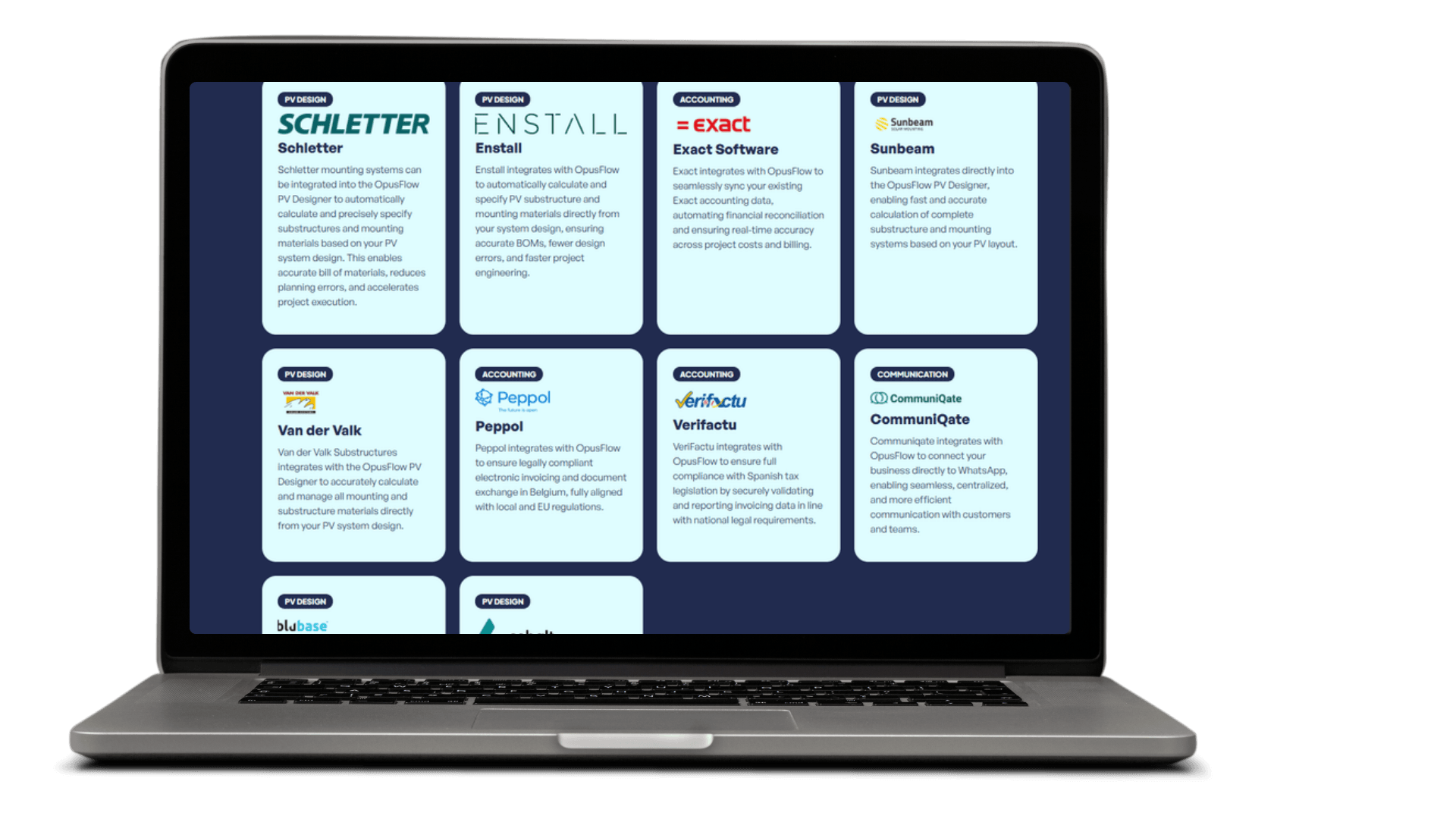
OpusFlow offers Open API integrations that allow the platform to connect seamlessly with 6000+ external tools and systems. Accounting software, analytics platforms, and custom applications can exchange data automatically.
This openness makes OpusFlow flexible and future-ready. You can adapt your tech stack over time while keeping OpusFlow as the central operational hub of your business.

Making the switch is a big decision. These companies made it, and here’s what changed.
Everything you want to know before booking a demo.
CRM software for installers is a customer management tool built specifically for installation companies. Unlike generic CRM systems, it connects your leads, quotes, projects, and after-sales service in one place, so your sales pipeline and your operations stay in sync from the first contact to the final handover.
Solar yield calculations are based on real localised irradiance data, factoring in the exact orientation, tilt, and shading conditions entered during the design. The ROI model incorporates current energy tariffs, applicable subsidies, and hardware degradation curves to build a 25-year projection. For the Dutch market, additional levers are available including feed-in cost modeling and salderingsregeling phase-out scenarios. The methodology is consistent across every consultant, so the numbers your team presents reflect the same underlying model every time.
Yes! You can easily attach photos and files directly to your forms, straight from your phone or tablet on-site.
Yes! You can build your own forms from scratch and save them as templates, so every installation type has exactly the right checklist.
Tickets can be created through several routes: logged manually by your team after a phone call, parsed directly from an incoming email, or submitted by the customer themselves through the Customer Portal. However a request comes in, it ends up in the same structured queue — so nothing gets handled informally through a personal inbox and nothing falls through the cracks.
The automation engine runs predefined rule-based workflows in the background — you set the trigger and the actions once, and they fire automatically whenever the conditions are met. OpusAgent is the AI layer that lets you give instructions in plain language and get results on demand. They work well together: automations handle the predictable, recurring work, and OpusAgent handles the ad-hoc requests that would otherwise need manual effort.
You can configure leave types such as vacation, sick leave, and personal leave, each with their own rules and accrual settings. Employees submit requests through a calendar view that shows their own balances and any existing approved leave. Managers approve or reject via a dedicated workflow and approved leave is immediately reflected on the planning calendar. The module also surfaces working-hours compliance warnings in hour registrations, so break and shift rules are checked as hours are logged rather than after the fact.
Browse more side-by-side comparisons and see the difference for yourself.
Get a live customized demo or discovery call focused on what your organization needs, get answers to your specific questions, and find out why OpusFlow is the right choice for your organization