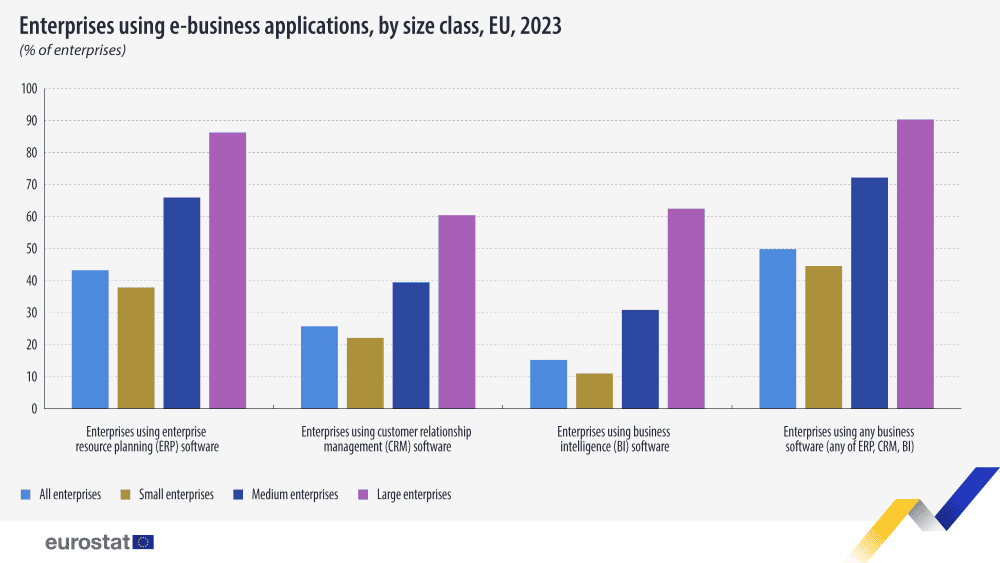
In fact, according to Eurostat, while approximately 86% of large European enterprises use ERP software, only about 38% of small companies do. This gap suggests that many smaller installers haven’t yet tapped into the benefits of ERP.
Let’s find out, what ERP system is?
ERP is essentially an all-in-one software platform that centralizes a company’s core processes – it can track everything from inventory and project schedules to sales and finances and even HR.
Such a system acts as the central nervous system of your business, connecting different departments and ensuring everyone works from the same data. It also leads to less manual work, fewer errors, and a clearer overview of your operations.
Learn more: The Installer’s guide to outgrowing chaos: Why ERP is your next power tool
In this blog, we’ll explore how ERP for solar business can transform companies, we’ll look at how OpusFlow ERP solution drives growth for installation businesses, explain why integrating ERP & CRM is a game changer for solar companies, and show how a solar-specific ERP reduces project delays and costs.
How ERP for solar business transforms your operations
ERP for solar business as well as for other renewable technologies transforms companies by streamlining and uniting all your business processes in one place, which leads to huge gains in efficiency, clarity, and growth.
Without an integrated system, these activities often happen in isolation – data gets re-entered multiple times, communications slip through the cracks, and it’s hard to see the big picture. ERP solves this by acting as a single source of truth that connects everyone and the whole workflow.
Here are 5 ways an ERP can transform your business
- Centralized data and real-time insights
- Improve your efficiency and automation
- Coordinate and manage your projects efficiently
- Scale and standardize your processes
- You get regulatory compliance and reporting
1. Gain centralized data and real-time insights
System spreads data across departments, giving solar and renewable companies a unified view of operations. When a sale closes, inventory and scheduling updates happen automatically, keeping teams aligned.
Real-time dashboards let managers track performance, costs, and progress without waiting for reports. This instant visibility helps companies react quickly in a fast-moving sector where timing and efficiency drive success.
2. Improve your efficiency and automation
Since all the systems are centralized into one, it’s possible to automate tasks and actions. By automating repetitive tasks like order creation, invoicing, and inventory updates, software dramatically reduces manual workload. Routine workflows happen in the background, allowing staff to focus on value-added activities such as customer engagement or quality control.
Automation ensures consistency, accuracy, and speed – key for growing solar businesses juggling many moving parts. Ultimately, it turns time-consuming administration into streamlined execution.
3. Coordinate and manage your projects efficiently
ERP systems centralize project planning, scheduling, and budgeting, minimizing delays and miscommunication. Teams can instantly see timelines, dependencies, and risk updates, ensuring smooth coordination between procurement, logistics, and installation. If a shipment is delayed, schedules adjust automatically, keeping crews productive. With all project data in one system, you gain control, prevent overruns, and deliver on time and budget.
4. Scale and standardize your processes
As renewable businesses expand, such platforms provide the structure to scale efficiently. They enforce standardized workflows – from design to inspection – so every branch operates consistently.
This foundation allows new teams or regions to adopt proven processes without disruption. With ERP handling higher volumes and added services seamlessly, growth happens without losing control, quality, or profitability.
5. You get regulatory compliance and reporting
All-in-one software simplifies compliance by storing all operational data and generating required reports automatically. It ensures traceability for components, tracks certifications, and supports sustainability reporting – all in one place. This accuracy helps meet regulatory requirements quickly and confidently. The result is greater transparency and trust with both regulators and customers.
For a solar business aiming to scale, this transformation is game-changing: you can take on more projects and bigger clients without things breaking down, because your operations are organized and optimized.
How OpusFlow’s ERP for solar business drives growth and scalability
Across Europe, ERP systems come in many forms – from specialized solutions designed for niche industries to large-scale platforms serving multinational enterprises. Each system is built to address different business needs, whether that’s managing complex supply chains, automating administrative tasks, or supporting fast-growing small and medium-sized companies.
In this section, we take a closer look at OpusFlow as an example of an ERP solution developed to meet the evolving demands of modern businesses.
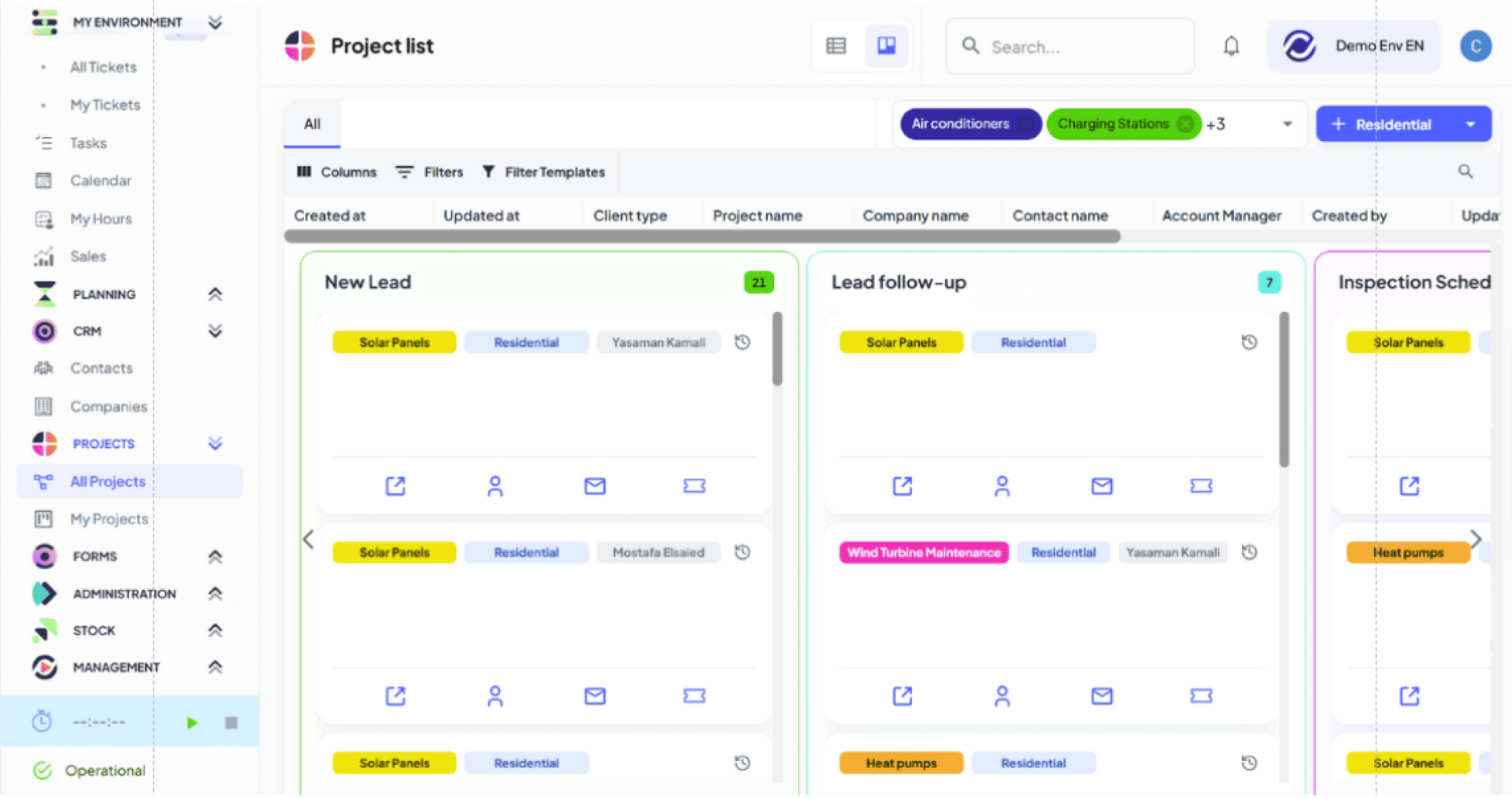
When it comes to ERP tailored for solar and installation companies, OpusFlow, Dutch company, stands out as a dedicated all-in-one solution. OpusFlow is an all-in-one package developed specifically for the installation industry, meaning it includes all the modules a solar or sustainable energy installer needs to run their business from A to Z.
This isn’t a generic system – it has industry-specific features that other software often lack, such as the ability to digitally register solar panels and track installations in detail.
In OpusFlow, all your business processes are unified: it combines PV design, CRM for managing leads and customers, project and workforce management, planning and scheduling, calculation & quotation tools, invoicing and stock management, procurement, a customer portal, dashboards, forms, and workflow automations – everything working together in one place.
The idea is to save valuable time and eliminate errors by having one integrated system instead of juggling separate apps. OpusFlow’s modern, modular design also means you can adapt it as you grow, adding functionality without losing simplicity.
For a solar installer looking to scale, OpusFlow is like a “ServiceTitan of Europe”. It provides a ready-made backbone, so you don’t have to patch together different tools. It’s an example of how a focused ERP can drive growth by catering exactly to an installation company’s workflow.
One Platform to Run Your Entire Installation Business
Manage leads, projects, stock, and invoicing — everything in one smart system built for sustainable installers.

Why an integrated ERP & CRM system is a game changer for solar companies

An integrated ERP and CRM system is a game changer for solar companies because it bridges the gap between your customer-facing activities and your back-end operations – effectively linking the heartbeat of your sales and customer service to the brain of your operations and finance.
Many solar installers start off using a Customer Relationship Management (CRM) tool to track leads and customers, and separately use spreadsheets or basic software for scheduling jobs and managing inventory.
If these two spheres don’t talk to each other, it’s like your right hand doesn’t know what the left is doing. An integrated ERP & CRM means sales, installations, and support teams all share the same information in real time, which leads to happier customers and a healthier business.
Consider this scenario
Your sales team closes a deal for a new solar panel installation and enters it into the CRM. If the CRM isn’t integrated with your operations, your project team might not immediately know that there’s a job to schedule or that certain panels need ordering.
Perhaps days pass before someone manually re-enters the data into an operations system, risking delays or mistakes.
With an integrated ERP & CRM, the moment a deal is marked as won. Everyone from the warehouse manager to the installation crew gets the information without delay. This seamless flow greatly shortens the lead-to-installation cycle and keeps customers in the loop with fewer hiccups.
When these systems are unified, customers don’t fall through the cracks. If the customer calls with a question, any team member can immediately update them on the project status. This level of responsiveness builds trust.
In an isolated setup, if a customer’s address changes or a change order is made on a project, you might have to update that in multiple systems (CRM, project management, accounting, etc.). With an integrated solution, you update it once and it reflects everywhere. This enhanced data accuracy and consistency translates to fewer mistakes.
From a sales perspective, having ERP data accessible in the CRM can help you upsell and plan better. Imagine your CRM shows not only that you installed 20 solar panels for a client two years ago, but your ERP data shows that their system is due for a maintenance check or battery upgrade. Your sales team can proactively reach out for a service (creating a new revenue opportunity) armed with those insights.
Moreover, an integrated system can automate customer communications through the whole project lifecycle. For example, as soon as the ERP system marks a project phase as complete, the CRM module could trigger an email update to the customer or prompt a sales follow-up for feedback or referrals.
Solar projects often have multiple steps – a tight ERP-CRM integration keeps the customer informed at each step without someone manually composing emails.
So, 5 key benefits of an integrated ERP & CRM are:
- Improved customer experience
- Reduced errors
- Reduced and automated administrative workload
- Better upsell and planning
- Automated customer communications
How ERP for solar business reduces project delays and costs
Solar ERP software helps reduce project delays and costs by providing tight control over scheduling, resources, and budgets – all in one unified platform – so that potential problems are spotted and addressed before they escalate into costly delays.
In the solar installation world, delays can happen for many reasons. Each delay can eat into profit margins and upset customers. ERP software geared toward project management handles these issues in such a way:
1. You can integrate planning and scheduling
Delays in solar projects often stem from missing parts, permit issues, or scheduling conflicts. ERP software tackles this by integrating project planning tools like Gantt charts with inventory and procurement systems.
When an installation is scheduled, the ERP automatically checks stock availability and flags shortages early. Real-time schedule updates allow teams to adjust instantly – keeping everyone on the same page and avoiding last-minute surprises.
2. Control costs in a real time
ERP systems continuously track labor, materials, and expenses against budgets. If a project starts exceeding planned costs, the system alerts managers immediately, allowing quick corrective actions. Built-in approval workflows for change orders prevent unnecessary spending, helping maintain profit margins and reduce unplanned costs by as much as 50%.
3. Improve communication and visibility within your company
Instead of relying on fragmented communication (calls or texts), ERP systems centralize project information. Field technicians can update progress directly through mobile apps, instantly notifying office staff of any issues like structural problems or delays. This live data flow allows managers to act fast before small problems escalate.
4. Optimize resource and inventory use
ERP software optimizes crew assignments and job scheduling, minimizing downtime and overtime. If one job is delayed, teams can be swiftly reassigned to other projects. Accurate inventory data also prevents over-ordering, keeping stock lean and freeing up cash flow without risking material shortages.
5. Unite your project control
Think of ERP as your project control tower – it monitors time, cost, resources, and materials, issuing alerts when things drift off track. By consolidating all project data and workflows, ERP systems ensure disorganization and miscommunication.
The result: faster installations, lower costs, and improved customer satisfaction – helping your solar business stay competitive and profitable.
A quick overview
In today’s fast-paced renewable energy market, ERP for solar business isn’t just for large corporations – it’s a must-have for growing solar businesses of any size. By uniting every part of your operation – from sales and inventory to installation and finances – a system eliminates chaos, cuts costs, and keeps projects on time.
Whatever platform you choose, the goal is the same: streamlined workflows, real-time visibility, and happier customers.
An integrated ERP & CRM ensures every project runs smoothly while every client feels informed and valued – the key to growth through efficiency and referrals.
Forward-thinking installers across Europe are already adopting ERP to gain a competitive edge. Now’s the time to do the same. Evaluate your current bottlenecks and explore how ERP can simplify, automate, and scale your operations.
Ready to take the next step?
Book a free demo with OpusFlow today, and see how an all-in-one solar ERP can supercharge your business. The renewable market is shining – make sure your company shines with it.
One Platform to Run Your Entire Installation Business
Manage leads, projects, stock, and invoicing — everything in one smart system built for sustainable installers.